Introduction
Navigation apps route drivers through residential neighborhoods that were never designed for cut-through traffic — and the consequences fall on the communities, not the algorithm. UC Berkeley transportation researchers documented this directly, citing streets like Miguel Street in San Francisco and Baxter Street in Los Angeles as examples where algorithm-driven routing sends vehicles through residential corridors without accounting for pedestrian activity, school zones, or street capacity.
The stakes are real. FHWA research estimates pedestrian fatality risk at 5% at 20 mph, rising to 45% at 30 mph and 85% at 40 mph — meaning the difference between a neighborhood street and an arterial speed isn't just discomfort. It's survival probability.
That risk is manageable — but only with the right devices matched to the right conditions. This guide walks through what traffic calming is, what the research shows about its effectiveness, every major device category with specifications, and how to select and implement the right solution for your road context.
Key Takeaways
- Traffic calming uses physical design to reduce vehicle speeds or volumes on local and residential streets
- Devices fall into three functional categories: vertical deflection, horizontal deflection, and cut-through reduction
- Choosing the wrong device for a road's classification, speed target, or emergency route status can undermine safety outcomes
- Speed humps are associated with a 22% reduction in pedestrian-motor-vehicle collisions in a 2015 Toronto study
- Effective programs depend on aligning engineering decisions with community input and emergency services sign-off
What Is Traffic Calming?
FHWA and ITE define traffic calming as a system of physical, self-enforcing measures designed to reduce vehicle speeds or volumes on a street or network — improving safety, mobility, and livability for pedestrians, cyclists, and transit riders.
Transportation professionals often frame speed management around three approaches:
- Engineering — physical devices and street design changes (traffic calming)
- Education — community awareness and driver behavior programs
- Enforcement — police presence and automated speed monitoring
Traffic calming belongs to engineering. Physical devices work because they don't depend on driver compliance or resource-intensive enforcement — the road itself requires slower speeds. Devices work best when paired with clear signage, public communication, and consistent enforcement on adjacent corridors.
From the Dutch Woonerf to North American Practice
Traffic calming originated in post-war Europe. FHWA traces the concept to the Dutch woonerf, a shared residential street design that integrated pedestrian space with vehicle movement. By 1978, more than 120 North American jurisdictions had documented traffic calming experience. The discipline has grown steadily since, increasingly tied to Complete Streets policies and Vision Zero programs at the state and municipal level.
Key Benefits of Installing Traffic Calming Devices
Safety Impact on Pedestrians
The speed-injury relationship is steep and well-documented. Beyond FHWA's fatality risk estimates, a 2013 study by Tefft found that death risk reaches 10% at 24.1 mph, 25% at 32.5 mph, and 50% at 40.6 mph — with risk varying by pedestrian age. The practical implication: measures that bring operating speeds down even 5–10 mph on a residential street meaningfully reduce injury severity.
Crash Reduction
Physical devices produce measurable results. A 2015 quasi-experimental Toronto study found that speed hump installation was associated with a 22% reduction in pedestrian-motor-vehicle collision incidence overall, and 26% fewer collisions on local roads specifically. A broader review of area-wide traffic calming schemes found an injury rate ratio of 0.85 — roughly 15% fewer injuries compared to untreated areas.
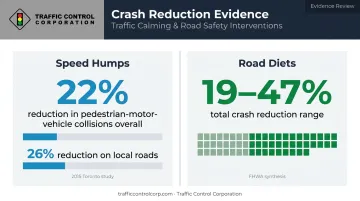
Road diets (lane reduction projects) show particularly strong crash evidence: FHWA's synthesis documents total crash reductions of 19–47% on converted corridors.
Secondary Community Benefits
A 2019 Portland, Oregon study of 1,187 traffic calming devices found 20% lower 85th-percentile speeds and 16% lower traffic volumes on treated streets — meaningful mobility improvements for pedestrians and cyclists. The same study found no reliable average effect on home prices, so leading with livability and mobility outcomes is more defensible than property value claims.
These benefits come with at least one documented trade-off: a 2025 peer-reviewed noise study found traffic calming locations were measurably noisier than controls in some configurations, with speed humps generating the highest noise readings among devices tested. For installations near residences, noise impact warrants evaluation alongside speed and volume outcomes.
Alignment With Broader Transportation Goals
Traffic calming is increasingly integrated into Complete Streets and Vision Zero programs — making it directly relevant for DOTs, city planners, and local agencies. For Midwest municipalities, many of these projects also involve complementary ITS infrastructure that works alongside physical calming measures:
- Radar speed signs — provide real-time speed feedback to drivers approaching calmed zones
- School zone beacons — reinforce reduced speed limits during active school hours
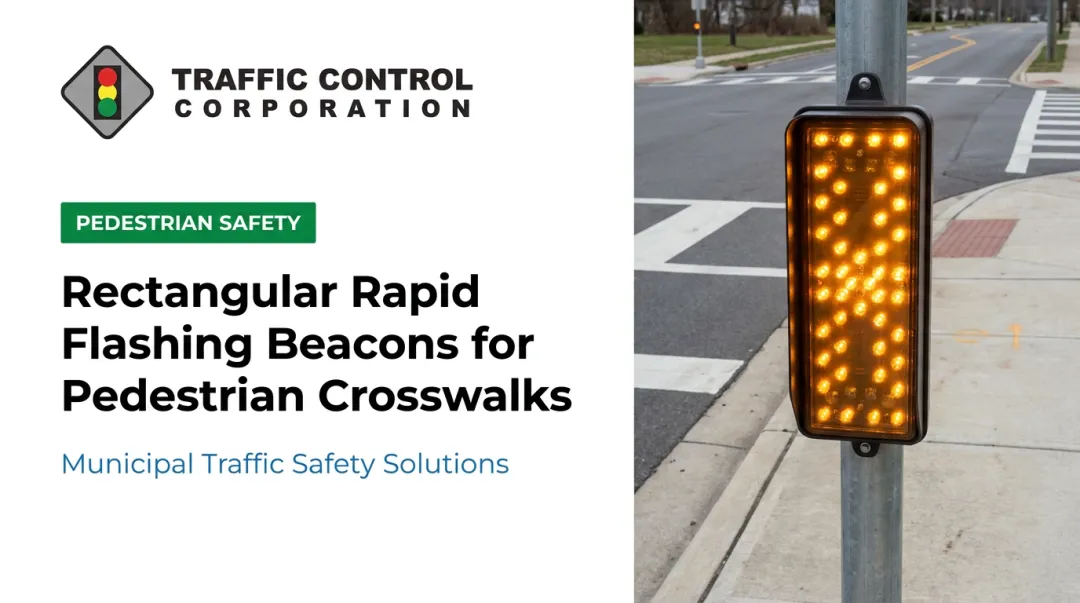
- RRFB systems — enhance pedestrian crossing visibility at uncontrolled locations
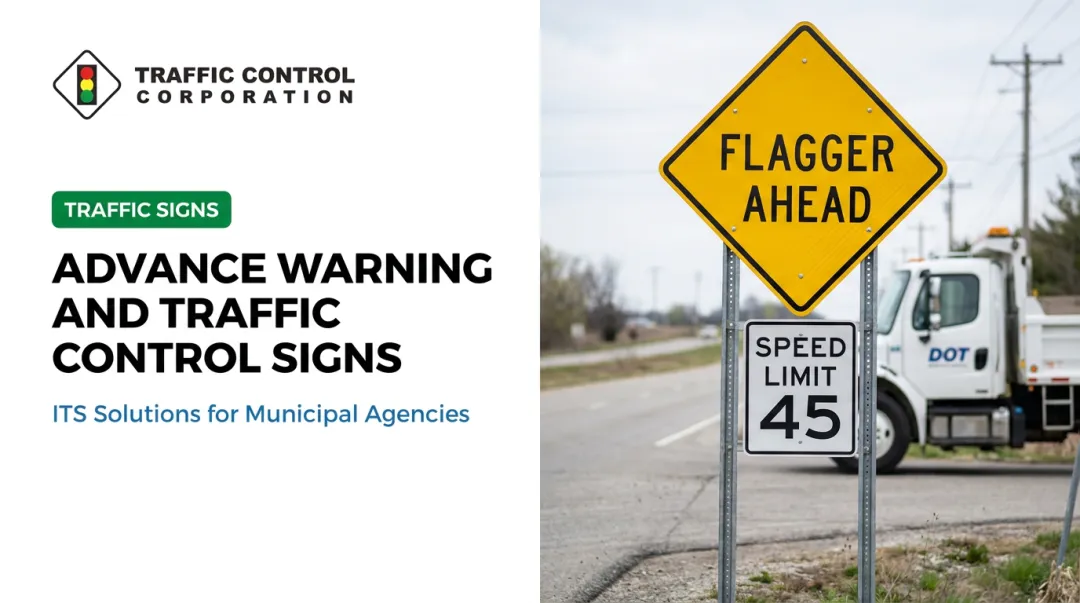
- Advance warning beacons — alert drivers to upcoming calming features on higher-speed approaches
Types of Traffic Calming Devices
Vertical Deflection Devices
Vertical deflection raises the roadway surface, forcing drivers to slow down for physical comfort. FHWA distinguishes four primary types:
| Device | Dimensions | Target Crossing Speed | Best Application |
|---|---|---|---|
| Speed bump | 1–2 ft long, up to 6 in high | 5–10 mph | Parking lots, private roads |
| Speed hump | Typically 12 ft long, 3–4 in high | 15–20 mph | Low-volume residential streets |
| Speed table | 22 ft overall (10-ft flat top + two 6-ft ramps), 3–3.5 in high | 25–35 mph | Local/collector streets, pedestrian crossings |
| Speed cushion | Hump-like with wheel-track cutouts | 85th-percentile reduction of 5–7 mph | Streets with emergency vehicle routes |
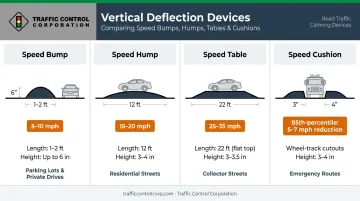
Note on terminology: Speed humps and speed tables are frequently confused. A standard speed hump is 12 feet long with a parabolic profile. A speed table is 22 feet long with a flat plateau — the configuration often used at raised crosswalks. The distinction matters for both driver behavior and design compliance.
Speed cushions deserve special mention for agencies near emergency corridors. The wheel-track cutouts allow fire trucks and ambulances with wider wheelbases to straddle the device and pass without slowing — addressing the most common concern with vertical deflection near emergency routes.
Horizontal Deflection Devices
Horizontal measures force lateral steering changes, which naturally reduce speeds without raising the roadway surface.
- Chicanes create a zigzag path through alternating curb extensions, producing 85th-percentile speed reductions of 3–9 mph on low-volume roads. They integrate well with landscaping or on-street parking bays.
- Traffic circles place a raised central island at unsignalized intersections, requiring vehicles to circulate and yield. Agencies have documented speed reductions of 5–13 mph, and the islands create pedestrian refuge and green space opportunities.
- Chokers and bulb-outs extend the sidewalk to narrow the roadway at mid-block or intersection entry points. They shorten pedestrian crossing distances and create a natural one-lane pass-through that slows approaching vehicles.
- Road diets convert four undivided lanes to three (with a center turn lane), reducing effective lane width. FHWA identifies roads carrying up to roughly 20,000 vehicles/day as candidates; evaluate for bicycle lane compatibility and snow removal operations before finalizing.
Cut-Through Reduction and Routing Restriction Measures
These devices are typically deployed when speed reduction alone hasn't resolved cut-through volumes. They work through access restriction rather than speed control:
- Diagonal diverters are barriers placed diagonally across four-way intersections, blocking through-movements while allowing pedestrian and bicycle passage. They effectively eliminate cut-through routes but require network-level analysis — displaced traffic must be routed somewhere.
- Half closures block vehicle travel in one direction at a street segment, creating a de facto one-way entry that discourages cut-through use from arterials.
- Median barriers and turn islands are raised islands at arterial entry points that restrict turns into residential streets. Permeable for cyclists and pedestrians, they require coordination with transit and freight operations before installation.
FHWA treats emergency access and network circulation as selection criteria for these measures — not after-installation details. Involve fire and EMS agencies before finalizing any routing restriction design.
Non-Physical and Perceptual Measures
These devices work through sensory cues rather than physical obstruction:
- Radar speed feedback signs display a driver's current speed in real time. FHWA's local road speed management manual documents reductions of 2–10 mph, with effectiveness diminishing if overused. A Minnesota before-after study found average speed reductions of 7 mph sustained over one year. TCC carries both fixed and portable trailer-mounted radar speed signs through JSF Technologies, including radar-activated school zone beacons with scheduled or 24-hour continuous activation modes.
- Rumble strips use grooves that create vibration and noise to alert drivers to speed transitions or hazards. They raise noise concerns in residential contexts and are better suited to arterial or school zone approaches.
- Textured pavement — brick, cobblestone, or stamped asphalt — signals pedestrian-priority zones and triggers instinctive speed reduction without physical obstruction.
- Pavement markings such as "School Zone," "Slow," and optical narrowing patterns have generally weaker effects than physical devices, but their low cost makes them practical when combined with other measures.
How to Choose the Right Traffic Calming Device
Match Device to Road Context
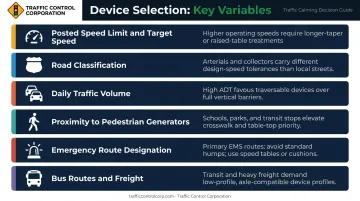
No single device works everywhere. Key selection variables include:
- Posted speed limit and target speed — Humps are appropriate at 30 mph or below; tables and circles can handle collector-level speeds
- Road classification — Residential local streets, neighborhood collectors, and arterials each have different warrants
- Daily traffic volume — Higher-volume roads may require horizontal deflection or road diets rather than vertical measures
- Proximity to pedestrian generators — Schools, parks, and transit stops increase the priority for marked crossings and associated beacons
- Emergency route designation — Primary fire or EMS routes should avoid standard humps; speed cushions or horizontal measures are more appropriate
- Bus routes and freight — Vertical deflection creates operational issues for transit vehicles and heavy trucks
Consider a Layered Approach
Successful programs typically combine device types. Single devices often see speed recovery between installations — so spacing, sequencing, and pairing matter as much as device selection. Common layered strategies include:
- Combining speed humps with lane narrowing to address both speed and driver psychology
- Deploying chicanes in series to maintain calming effects across a longer corridor
- Pairing vertical and horizontal measures to handle mixed road classifications
FHWA notes that hump effects decay between devices, and ITE spacing guidance targets 85th-percentile speeds around 25–30 mph. Design the system, not just the individual device.
Work With a Traffic Control Specialist
Agencies planning traffic calming installations should work with experienced traffic control specialists for product selection, application guidance, and compliance with MUTCD and AASHTO standards. A knowledgeable distributor can help match device types to site conditions and identify complementary ITS solutions — such as radar speed signs or school zone beacons — that extend calming effects beyond physical infrastructure.
Traffic Control Corporation (TCC) provides product selection assistance and technical support to state and local agencies across an 11-state Midwest territory, with factory-trained staff experienced in traffic management applications.
Implementation Challenges and Considerations
Emergency Vehicle Access
FHWA documents measurable delays per speed hump : Portland field tests found delays of 1.0–9.4 seconds per hump for fire apparatus; Montgomery County measured 2.8–7.3 seconds. Those numbers compound over a route with multiple humps.
Mitigation options:
- Use speed cushions on primary emergency routes (Austin reported less than 1 second of delay when vehicles straddled the device)
- Verify cushion geometry against local apparatus wheel tracks before installation
- Involve fire and EMS agencies in the planning process, not after design is complete
ADA Compliance and Pedestrian Integration
Every traffic calming measure must maintain accessible pedestrian routes. PROWAG requires pedestrian access routes to be stable, firm, slip-resistant, and at least 48 inches clear (60 inches through medians and refuge islands). Specific requirements apply to:
- Curb ramps at bulb-outs and chokers
- Detectable warning surfaces at raised crosswalks
- Level changes and surface materials at speed tables used as pedestrian crossings
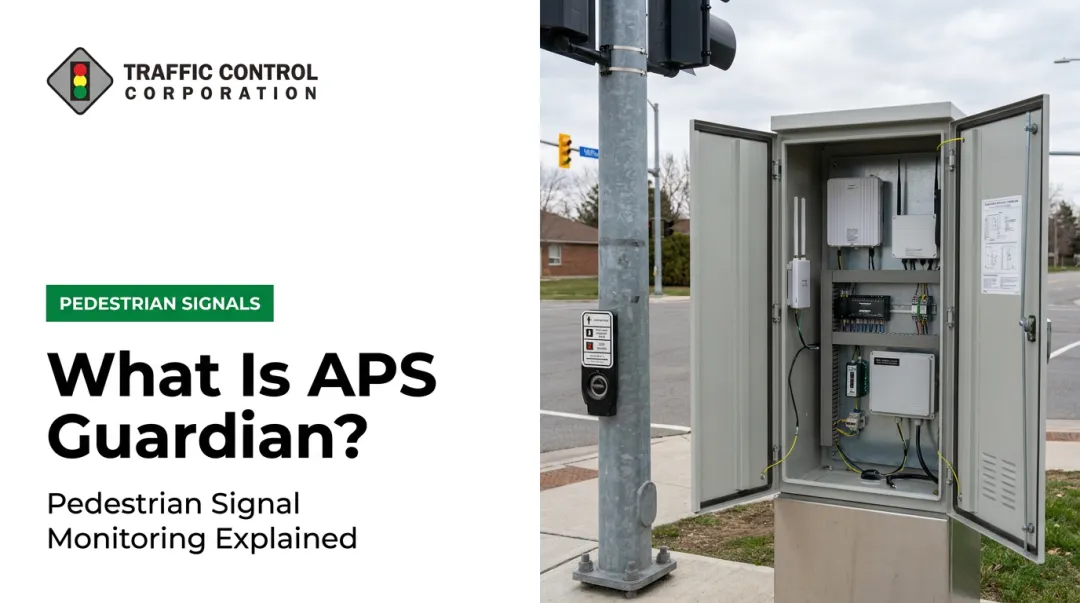
At traffic-calmed intersections where ADA compliance is required, standard components include APS units, pushbuttons, and audible beacons. TCC distributes these products through PedSafety and JSF Technologies.
Community Process and Legal Considerations
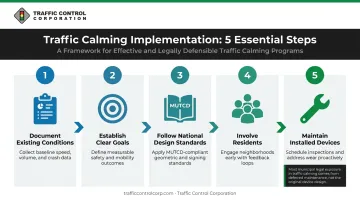
Public agencies reduce liability by following a documented, transparent process:
- Document existing conditions (speed data, crash history, pedestrian volumes)
- Establish clear goals (target speeds, collision reduction objectives)
- Follow national design standards (MUTCD-compliant signing and markings)
- Involve residents (public meetings, notification of affected properties)
- Maintain installed devices (most legal exposure comes from failure to replace or maintain warning signs after notice, not from the device design itself)
Frequently Asked Questions
What are examples of traffic calming devices?
Common physical devices fall into three categories:
- Vertical deflection: speed bumps, speed humps, speed tables, speed cushions
- Horizontal deflection: chicanes, traffic circles, chokers, road diets
- Routing restriction: diagonal diverters, half closures
Non-physical measures include rumble strips, textured pavement, and radar speed feedback signs.
How do you stop speeders in your neighborhood?
Start with a formal request to your local transportation agency to document the problem. From there, effective solutions combine road-type-appropriate physical measures (speed humps or chicanes on residential streets), MUTCD-compliant signage, and radar speed feedback signs.
What is the difference between a speed bump and a speed hump?
Speed bumps are 1–2 feet long and up to 6 inches high, designed for parking lots and private roads targeting 5–10 mph. Speed humps are 12 feet long and 3–4 inches high — a gentler profile suited to residential streets where 15–20 mph operating speeds are the goal.
Are traffic calming devices effective at reducing accidents?
Research supports their effectiveness. A 2015 Toronto study found a 22% reduction in pedestrian-motor-vehicle collisions following speed hump installation, with a 26% reduction on local roads. Road diet projects show total crash reductions of 19–47% in FHWA's synthesis of documented projects.
What are the disadvantages of traffic calming measures?
The main trade-offs are increased noise near speed humps, potential emergency vehicle delays with vertical deflection devices, snow removal complications from raised features, and upfront infrastructure costs. Speed cushions address the emergency response concern specifically; careful design mitigates most of the rest.
Who is responsible for installing traffic calming devices?
On public roads, responsibility falls to the local municipality, county transportation department, or state DOT depending on road jurisdiction. Private roads — HOA communities, campus streets, or commercial properties — are the responsibility of the property owner or association, typically with input from a civil engineer and subject to local ordinances.