Introduction
According to NHTSA, 7,080 pedestrians were killed and more than 71,000 were injured in traffic crashes in 2024. Those numbers represent real people — at crosswalks, in parking lots, crossing mid-block. For traffic engineers and transportation agencies, they're also a call to act.
Pedestrian detection technology has matured considerably in the past decade, and it operates across two distinct domains with very different purposes. Vehicle-based ADAS systems alert drivers and trigger automatic braking. Infrastructure-based systems detect waiting or crossing pedestrians at signalized intersections and communicate directly with signal controllers, eliminating the need for a push button.
This guide covers both, with a practical emphasis on infrastructure detection for transportation professionals. You'll come away understanding how the core technologies work, where they perform well (and where they don't), what deployment looks like in the real world, and what best practices separate effective installations from ones that generate false detections, missed calls, or compliance gaps.
Key Takeaways
- Pedestrian detection serves two distinct purposes: automotive collision avoidance and infrastructure-level signal actuation
- Cameras, radar, microwave, infrared, and LiDAR each offer distinct performance trade-offs worth understanding before selecting a system
- 76% of pedestrian fatalities occur at night, making sensor selection for low-light environments critical
- Infrastructure-based detection extends signal timing, supports vulnerable road users, and reduces unsafe crossings
- No single sensor type handles all conditions; multi-sensor approaches provide the best real-world reliability
What Is Pedestrian Detection?
Pedestrian detection uses sensors and intelligent processing to identify where pedestrians are, how they're moving, and what they're likely to do next. Two distinct deployment contexts use overlapping sensor technology toward very different ends: automotive ADAS systems focused on collision avoidance, and infrastructure-based systems that manage signal timing at crosswalks and intersections.
Automotive Pedestrian Detection (ADAS)
Vehicle-based pedestrian detection is a component of Advanced Driver Assistance Systems. When a pedestrian enters the vehicle's predicted path, the system alerts the driver and, in newer ADAS-equipped vehicles, applies automatic emergency braking. NHTSA's final rule on FMVSS No. 127 now requires Pedestrian Automatic Emergency Braking (PAEB) on most new passenger vehicles by September 1, 2029 — with the system required to operate in both daylight and darkness at test speeds up to 45 mph.
Infrastructure-Based Pedestrian Detection
Fixed sensors installed at crosswalks and signalized intersections take a different approach. Rather than stopping a vehicle, these systems detect pedestrians waiting at the curb or already crossing, then communicate with the signal controller to place a pedestrian call or extend the clearance interval.
The goal is to eliminate dependence on push buttons and give every pedestrian the crossing time they actually need. Key benefits of infrastructure-based detection include:
- Automatically places a pedestrian call without a button press
- Extends clearance intervals based on detected crossing speed
- Improves reliability for elderly, mobility-impaired, and visually impaired users
- Reduces missed calls at intersections with low pedestrian volumes
How Pedestrian Detection Technology Works
Automotive and infrastructure systems share the same core sensor technologies. Performance differences come down to which sensors are deployed, how their outputs are combined, and how much processing intelligence sits behind the detection logic.
Camera-Based Detection
High-resolution cameras capture visual data and use image analysis to identify human forms, gait patterns, and movement direction. They perform well in daylight with clear sight lines — but degrade in low-light conditions, heavy rain, glare, and fog. Lens contamination alone can compromise zone accuracy in an infrastructure deployment.
Radar and Microwave Sensors
Radar uses radio waves to measure object distance and velocity. Microwave sensors detect motion within a defined zone. Both are significantly more robust than cameras in darkness and precipitation, which makes them a preferred choice for infrastructure crosswalk detection where nighttime performance is non-negotiable. The tradeoff: lower spatial resolution can complicate pedestrian classification in complex scenes.
Infrared Sensors
Passive infrared (PIR) and thermal infrared sensors detect heat signatures from the human body — no visible light required. This makes them effective for complete darkness applications, both in automotive night vision systems and in infrastructure-grade detectors at signalized crossings. Thermal imaging can struggle when ambient temperatures approach body temperature, and lower-resolution thermal sensors may not reliably classify pedestrians versus other heat sources.
LiDAR Technology
LiDAR emits laser pulses and measures return time to build a detailed 3D point-cloud map of the environment. It provides precise spatial detection regardless of lighting conditions and is now standard in advanced autonomous vehicle platforms and advanced intersection monitoring systems. Rain, fog, and snow can attenuate returns, and high unit costs have historically limited widespread infrastructure deployment.
Sensor Comparison at a Glance
| Sensor Type | Strengths | Limitations |
|---|---|---|
| Camera | Visual detail, gait/direction analysis | Fails in low light, rain, glare |
| Radar / Microwave | Works in darkness and precipitation | Lower spatial resolution |
| Infrared / Thermal | No visible light required | Struggles near body-temperature ambients |
| LiDAR | Precise 3D mapping, lighting-independent | Weather attenuation, higher unit cost |
AI and Sensor Fusion
Sensor fusion — combining multiple sensor inputs and processing them through machine learning algorithms — is where detection accuracy meaningfully improves. A 2024 peer-reviewed nighttime detection study found that mid-level RGB-thermal fusion achieved 69.4% mAP50 on the KAIST dataset, compared to 54.3% for RGB alone and 62.3% for thermal alone. On the LLVIP dataset, fusion reached 97.5% versus 75.4% for RGB only — a substantial gap that illustrates why single-sensor approaches leave accuracy on the table.
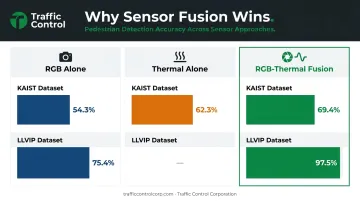
Those accuracy gains extend to classification as well. Distinguishing a pedestrian from a cyclist, a dog, or a stationary shopping cart requires contextual reasoning that no single sensor handles reliably on its own.
Automated Pedestrian Detection at Traffic Intersections
For transportation agencies, DOTs, and municipalities, infrastructure-based pedestrian detection addresses a gap that push buttons simply can't close. Field studies cited by FHWA found that push buttons were used in only 33.8% to 41.8% of cycles with pedestrians present before feedback improvements were introduced. That means the majority of pedestrian crossings were going undetected by the signal system — automated detection addresses this directly.
How It Integrates with Signal Systems
Pedestrian detector hardware presents a cabinet input that the signal controller maps to a pedestrian call or presence state. A sensor positioned in the curb zone can place a WALK call when a pedestrian arrives — and cancel it if they leave before the phase begins. A second sensor in the crosswalk zone can hold or extend pedestrian clearance for slower users still in the street.
This is the operating principle behind the PUFFIN (Pedestrian User-Friendly Intelligent) crossing model, which originated in Great Britain and uses infrared or pressure-sensitive sensors at the waiting area to actively monitor crossing behavior.
FHWA has documented U.S. adaptations of this approach — including an automated video detection installation at 9th and Howard Streets in San Francisco that provided up to 3 additional seconds of pedestrian clearance — as well as infrared and microwave clearance-extension systems in Portland and Los Angeles.
Microwave vs. Infrared Detection for Crosswalks
These are the two dominant sensor types for infrastructure-grade pedestrian detection:
| Feature | Microwave | Infrared |
|---|---|---|
| Detection principle | Motion and proximity via radio waves | Heat signature within a defined zone |
| Range | Wider area, can detect through some obstructions | Shorter range, precise zone-based presence |
| Low-light performance | Strong | Strong |
| Weather sensitivity | Low | Moderate (temperature contrast affects accuracy) |
| Best use | Approaching pedestrian detection | In-crosswalk presence detection |
Both types can be programmed with a delay to prevent false activations from passersby who don't intend to cross. A 2020 field evaluation used a 30-second drop delay to avoid premature signal cancellation — though agencies should validate that timing against their specific controller configuration and site conditions before adopting it.
Typical Installation Costs and Considerations
Cost varies based on equipment type, site conditions, and existing infrastructure. Some context from available data:
- Individual detector units: Depending on technology and specifications, furnish-and-install costs can range from under $200 to over $1,300 per unit
- Adding automated detection to an existing signalized intersection: Estimates range from approximately $10,000 to $70,000 per crosswalk, accounting for sensors, mounting hardware, wiring, cabinet input equipment, controller programming, zone configuration, acceptance testing, and traffic control during installation
- Annual operating costs: Monitoring, cleaning, and component replacement should be budgeted separately — costs vary by system complexity and agency maintenance capacity
These are reference ranges, not guarantees. A straightforward upgrade to an existing cabinet with compatible infrastructure will cost far less than a site requiring new poles, conduit, and controller reprogramming.
Where TCC Can Help
Traffic Control Corporation (TCC) has distributed and supported traffic signal equipment across the Midwest since 1946. For agencies deploying infrastructure-based pedestrian detection, TCC supplies detection products from manufacturers including PedSafety and Image Sensing Systems, and carries radar and video detection systems from Econolite — including the EPIQ RADAR™ and EVO RADAR, which support pedestrian-in-crosswalk detection with up to a 110-degree field of view.
TCC's factory-trained technical staff supports agencies through every stage of deployment:
- Product selection aligned with DOT specifications
- Application guidance for specific intersection geometries
- Detection system turn-on service and calibration
- Ongoing audit and health check services
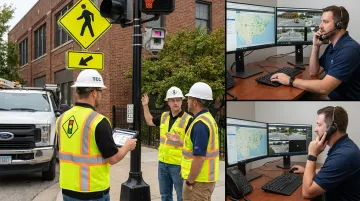
For agencies in Illinois, Indiana, Iowa, Minnesota, and across the 11-state Midwest service territory, TCC's regional offices provide localized support throughout the project lifecycle.
Key Benefits of Pedestrian Detection for Road Safety
Collision Avoidance
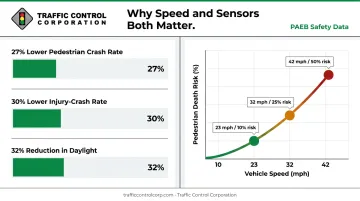
The evidence for automotive PAEB is concrete. An IIHS real-world study published in 2022 found pedestrian crash rates 27% lower and pedestrian injury-crash rates 30% lower for vehicles equipped with pedestrian AEB — with estimated reductions of 32% in daylight and 33% on lit roads at night. Speed is the other critical variable: AAA Foundation modeling puts average pedestrian death risk at roughly 10% at 23 mph, 25% at 32 mph, and 50% at 42 mph. Systems that trigger braking even a fraction of a second earlier can shift outcomes from fatal to survivable.
Protecting Vulnerable Users
Children, elderly pedestrians, individuals using mobility aids, and visually impaired users are among those least likely to reliably operate a push button — and most likely to need extended crossing time. Infrastructure-based automated detection directly addresses both problems: it places the pedestrian call without requiring any action from the user, and it can extend the clearance interval for anyone still in the crosswalk.
These capabilities carry direct equity and ADA compliance implications for agencies managing aging pedestrian infrastructure.
Operational Efficiency
The system-level benefits extend well beyond safety. Accurate detection gives engineers real data on how pedestrians actually use an intersection — information that fixed timing plans simply can't provide. Effective pedestrian detection delivers:
- Fewer improper crossings and signal activations
- Reduced unnecessary cycle extensions that slow vehicle throughput
- Accurate pedestrian demand data to support capital planning and timing optimization
- Better-calibrated signal timing that reflects real-world use patterns
Limitations and Real-World Challenges
The Low-Light Problem
FHWA data shows that 76% of pedestrian fatalities occur at night, yet the IIHS real-world study found no significant crash-risk reduction from pedestrian AEB on unlit roads at night. In IIHS's first nighttime evaluation of 23 vehicles, only 4 earned a "superior" rating. Camera-based systems are the weakest link in low-light scenarios — which is why radar, microwave, and thermal infrared sensors are strongly preferred for any deployment where nighttime or low-illumination performance matters.
Testing Reveals Real System Gaps
IIHS testing has documented clear performance limitations across current automotive systems:
- Turning vehicles showed no significant crash-risk reduction in real-world analysis — a scenario that accounts for a substantial share of pedestrian-vehicle conflicts at intersections
- Child detection at perpendicular crossings (tested at 12 and 25 mph) shows mixed results across the tested fleet
- Nighttime evaluations top out at 37 mph, leaving field performance above that range uncertain
These results aren't reasons to dismiss the technology — PAEB demonstrably reduces crashes in daylight and on lit roads. They are reasons to set appropriate expectations, communicate limitations to users, and not treat any current system as a substitute for safe road design.
Environmental and Scene Complexity
Both automotive and infrastructure systems contend with conditions that no sensor handles perfectly:
- One pedestrian blocking another from the sensor's view (occlusion) is one of the most common detection gaps
- Crowded scenes with groups moving in different directions create classification challenges for AI models
- Children running laterally, cyclists, mobility aid users, and wheelchair users often behave outside training data assumptions
- Vegetation, shadows, parked vehicles, and stationary objects near detection zones increase false-positive risk
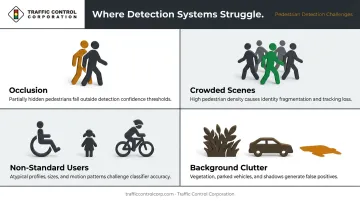
Sensor fusion and AI models trained on diverse, representative datasets are the primary tools for addressing these gaps. Even well-designed systems require careful zone calibration and ongoing monitoring to maintain accuracy in real-world conditions.
Best Practices for Deploying Pedestrian Detection Systems
Conduct a Site-Specific Needs Assessment First
A high-volume urban crosswalk near a senior center has different requirements than a low-volume rural crossing near a school. Before specifying any technology, document:
- Pedestrian volume and demographic profile
- Lighting conditions (ambient and supplemental)
- Existing cabinet and controller infrastructure
- Crosswalk geometry and sight lines
- Weather exposure and seasonal variation
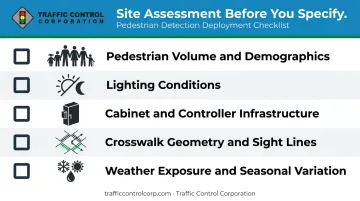
The sensor type, detection zone geometry, and signal integration approach should all follow from site conditions — not the other way around.
Prioritize Multi-Sensor Approaches
No single sensor type performs optimally across all conditions. Combining microwave or radar with infrared or video provides redundancy and maintains reliability when any one sensor type is compromised by weather, lighting, or scene complexity. Peer-reviewed evidence supports complementary sensing as the highest-reliability approach.
Get Sensor Placement Right from the Start
Height, angle, detection zone size, and proximity to the curb directly affect system performance. A 2020 field evaluation found that high-resolution thermal equipment could be mounted up to 30 feet, low-resolution thermal up to 20 feet, and optical trackers required approximately 30 feet for their tracking radius. These are equipment-specific constraints, not universal standards. Follow manufacturer specifications and verify zone coverage during acceptance testing.
Field data from the same study found that roughly 5% of pedestrians began or ended their crossing outside marked crosswalk lines, which suggests extending detection zones at least 3 feet beyond marked lines improves capture rates.
Test, Calibrate, and Plan for Ongoing Maintenance
Post-installation testing should cover:
- Valid detections, missed detections, and false activations
- Call placement, cancellation, and clearance extension behavior
- Day, night, rain, and varying pedestrian types
- Bicycle and group scenarios that can stress zone logic
Systems should be recalibrated periodically as environmental conditions change. Agencies should budget for annual operating costs and establish a maintenance relationship with their equipment distributor. TCC offers detection system audits, health checks, camera zone maintenance, and radar calibration services for agencies across the Midwest — helping catch configuration drift before it affects safety outcomes.
Stay Aligned with MUTCD and State DOT Standards
The current federal standard is the 11th Edition of the MUTCD, issued December 2023. Key compliance requirements include:
- Part 4 governs highway traffic signals, with passive detection recognized as an alternative to pushbutton actuation
- All installations at signalized intersections must comply with applicable MUTCD provisions and state DOT specifications
- Qualified traffic engineers should be engaged from site assessment through acceptance testing
- Certified equipment providers should be involved at each stage of the procurement and installation process
Frequently Asked Questions
What is a pedestrian detection system?
A pedestrian detection system uses sensors to identify the presence and movement of pedestrians. Depending on deployment context, it either alerts a vehicle driver and triggers automatic braking, or communicates with a traffic signal controller to place a pedestrian WALK call or extend the crossing interval — without requiring any action from the pedestrian.
What types of intersections are best suited for automated pedestrian detection?
High-volume signalized intersections, mid-block crossings, and locations with high pedestrian fatality risk are the most common deployments. Automated detection is especially valuable where push button compliance is low or where pedestrians include elderly, disabled, or school-age users. NHTSA's FMVSS No. 127 rulemaking — requiring pedestrian automatic emergency braking on new light vehicles by 2029 — is also driving parallel investment in infrastructure-side detection to complement vehicle systems.
Does pedestrian detection work at night or in bad weather?
Performance varies significantly by sensor type. Camera-based systems degrade in low light, heavy rain, and fog. Radar, microwave, and thermal infrared systems maintain much stronger performance in darkness and adverse weather. For any deployment where nighttime performance matters — which is most of them, given that 76% of pedestrian fatalities occur at night — sensor selection and fusion are critical.
What is the difference between radar and infrared pedestrian detection for crosswalks?
Radar and microwave sensors detect motion and proximity over a wider area, are less affected by environmental conditions, and can detect pedestrians at a distance. Infrared sensors detect heat signatures within a defined zone and are better suited to precise presence detection. Both are used in infrastructure-grade crosswalk systems, and both can be programmed with a delay to reduce false activations from passersby.
How much does it cost to install automated pedestrian detection at an intersection?
Adding automated detectors to an existing signalized intersection typically ranges from approximately $10,000 to $70,000 per crosswalk, depending on equipment type, existing infrastructure, and site conditions. Annual operating and maintenance costs add to that figure. Agencies should get project-specific estimates from a qualified traffic equipment distributor — costs vary too much across sites to rely on published ranges for budgeting purposes.
What are the main challenges in pedestrian detection accuracy?
The primary challenges include low-light conditions, pedestrian occlusion, non-standard movement patterns (children, wheelchair users, cyclists), crowded scenes, and background clutter near detection zones. Multi-sensor fusion and AI models trained on diverse datasets offer the most reliable mitigation — though no system eliminates all false positives or missed detections under every condition.