Indiana's Department of Transportation, part of Traffic Control Corporation's 11-state Midwest footprint, includes wireless in-pavement magnetometers as an approved detection category in its recurring special provisions. TCC has distributed ITS products across Illinois, Indiana, Iowa, Kansas, Michigan, Minnesota, Missouri, Nebraska, North Dakota, South Dakota, and Wisconsin for over 75 years.
Yet despite that adoption, plenty of agencies and contractors still misunderstand how magnetic anomaly detection actually works. That gap leads to bad sensor placement, false calls, and the wrong technology getting specified. This guide breaks down the mechanics, not just the use cases.
Key Takeaways
- Magnetic sensors passively detect vehicles by sensing disturbances they create in Earth's magnetic field
- Fluxgate magnetometers detect stopped and moving vehicles; induction coils detect only moving traffic
- Detection runs through four stages: baseline calibration, anomaly sensing, signal filtering, and data output
- Applications include stop-bar detection, freeway counting, ramp metering, and bridge decks where loops can't go
What Is a Vehicle Detection System Using Magnetic Sensors?
A magnetic vehicle detection system is a passive sensing technology that identifies a vehicle by measuring the "magnetic anomaly," or perturbation, its ferrous mass creates in the Earth's ambient magnetic field. No energy is emitted toward the vehicle. The sensor just watches for a distortion in a field that's already there.
This approach exists because inductive loops have real drawbacks. Loops require pavement saw-cuts, cause surface damage, and involve lane closures for installation and repair. Magnetic sensors emerged as a way to detect vehicles without that same footprint, as documented in an FHWA research report on non-intrusive detection technologies.
This technology differs from several familiar alternatives. It has nothing to do with a compass or navigational magnetometer. It's also a different physical principle entirely from piezoelectric weight sensors, radar, or video — those measure force, reflected microwave energy, or optical patterns, not magnetic field disturbance.
Why it still matters today: despite radar and video alternatives, magnetic sensors remain relevant because of minimally invasive installation and wireless capability. They're also well suited to sites like bridge decks, where embedding a loop simply isn't structurally possible.
Types of Magnetic Sensors
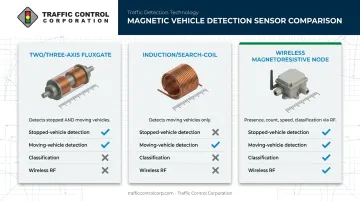
Two core sensor types dominate the field, plus a modern wireless variation:
| Type | How it detects | Vehicle state |
|---|---|---|
| Two/three-axis fluxgate | Measures threshold voltage changes in secondary windings around a driven core | Detects stopped and moving vehicles |
| Induction/search-coil | Detects rate-of-change in magnetic flux through a passive coil | Detects moving vehicles only |
| Wireless magnetoresistive node | Samples X, Y, and Z field components and transmits via RF | Supports presence, count, speed, classification |
The wireless variation is the one seeing the most new deployment. Instead of hardwired connections back to a cabinet, these nodes sample field components (some at rates as high as 128 Hz) and transmit detections over RF. This wireless approach strips out most of the conduit and lead-in wiring that made loop installs so disruptive.
How Does a Magnetic Sensor Vehicle Detection System Work?
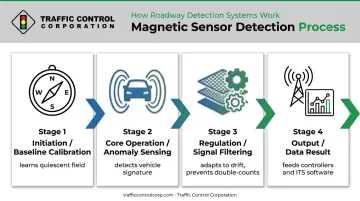
Detection isn't instantaneous or magic. It happens in a defined sequence: baseline calibration, anomaly sensing, signal regulation, and data output. Understanding each stage explains why sensors sometimes misbehave and how to avoid it.
Initiation
Before a magnetic sensor detects anything, it has to learn what "nothing" looks like. During calibration, the sensor records the quiescent, undisturbed Earth's magnetic field reading with no vehicle present. That reading becomes the reference baseline everything else gets measured against.
Once calibrated, detection is continuous and automatic. There's no manual trigger. The instant a ferrous vehicle mass enters the sensor's detection zone, the system activates on its own.
The common bottleneck: the sensor has to be rigidly fixed and properly aligned at install. If it shifts afterward, even slightly, that misalignment introduces signal drift and false readings that can be hard to diagnose remotely.
Core Operation
Here's the physical principle in plain terms. A vehicle's ferrous body (engine block, chassis, frame) carries its own magnetic dipole. As the vehicle passes near the sensor, that dipole vector-adds with Earth's quiescent field, producing a measurable "magnetic signature."
Electronically, the sensor's windings (fluxgate) or coil (induction) convert that flux change into a voltage output. When the output crosses a calibrated threshold, the system registers presence or passage.
Signature strength and shape depend on:
- Vehicle size: larger ferrous mass produces a stronger signature
- Speed: affects how the signature develops over time
- Crossing angle: the direction a vehicle travels relative to the sensor's axis
Speed matters more for some sensor types than others. Induction/search-coil detectors rely on a changing disturbance, so FHWA documentation notes they can miss vehicles moving below roughly 5 mph, a real concern in stop-and-go queues. Fluxgate and magnetoresistive sensors, which measure static field disturbance, don't share that limitation.
Real-world testing backs this up. Caltrans evaluated Sensys wireless magnetometers against inductive loops at both a ramp meter and a signalized intersection, tracking 3,522 vehicle passages.
| Lane Type | Magnetometer Sensitivity | Loop Sensitivity |
|---|---|---|
| 12-ft intersection lane | 99.55% | 99.69% |
| Ramp lane (up to 24 ft) | 94.17% | 98.05% |
Lane width and geometry, not just raw technology, drive accuracy.
Regulation / Control
Beyond lane geometry, long-term environmental drift threatens that same accuracy. Roads aren't static environments. Temperature swings, seasonal drift, and nearby ferrous infrastructure all shift the ambient field over time. To stay accurate, systems run a continuously updated moving-average baseline that adapts to these slow environmental changes without losing detection sensitivity.
There's also a corrective layer for a specific failure mode: an idling or stopped vehicle's engine vibration can create multiple small peaks in the signature, which a poorly tuned system might count as multiple vehicles instead of one.
This regulation stage matters because, without it, agencies risk:
- Double-counting vehicles at low speeds or stops
- Missing counts entirely if thresholds drift too far
- Misclassifying wrong-way or wrong-lane vehicles
That's part of why engineers are generally advised against placing certain sensor types where vehicles routinely stop and idle for extended periods. The calibration math gets noticeably harder to tune in those spots.
Output / Result
At the end of the pipeline, the system produces a presence or passage signal. More advanced sensors add vehicle count, speed, occupancy, and length classification on top of that base signal.
That output doesn't just sit in the sensor. It feeds:
- Traffic signal controllers for actuated timing decisions
- Data loggers at permanent count stations
- Centralized ITS/traffic management software, via wired contact closure or wireless IP
The quality of that output has real downstream consequences. Bad detection data means bad signal timing, unreliable planning data, and weaker queue or incident detection performance. These are the kind of problems that show up as complaints long before anyone traces them back to a sensor.
Where Are Magnetic Sensor Vehicle Detection Systems Used?
Magnetic sensors show up at specific points in a traffic network:
- Stop-bar and advance detection at signalized intersections
- Freeway and arterial count stations for volume data
- Ramp metering applications
- Long-loop emulation where agencies want loop-like data without loop-like installation
They tend to perform best at sites where conventional loops struggle:
- Deteriorating pavement, where a saw-cut risks further cracking
- Bridge decks, where structural constraints rule out embedded loops entirely
- Cold-climate regions, where below-grade or flush-mount installation protects the sensor from snowplow contact
Beyond signalized intersections, the same magnetic anomaly principle supports drive-thru monitoring and weigh-station pre-screening applications, confirming its value as a general-purpose vehicle detection technology across multiple traffic scenarios.
Key Advantages of Magnetic Sensor Vehicle Detection
Cost and installation efficiency set magnetic sensors apart from inductive loops. A cored hole for a flush-mount sensor is a fraction of the pavement disruption a full loop saw-cut requires, and wireless models eliminate conduit runs entirely. Less lane closure time means less risk exposure for field crews and less disruption for drivers.
Durability and low maintenance matter just as much over the sensor's lifespan. The passive design resists traffic-induced pavement stress better than hardwired loops. Wireless units run on battery power for years between service visits, eliminating the wired splice points where hardwired connections tend to fail.
Choosing the right sensor type isn't a catalog decision. It depends on:
- Lane geometry and pavement condition
- Cabinet compatibility with existing controllers
- Data needs — presence detection only, or full count, speed, and classification data
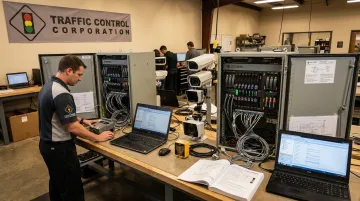
That's where an experienced local distributor earns its place in the process. TCC has spent over 75 years helping state DOTs, municipalities, and contractors across its 11-state Midwest territory work through those trade-offs, pairing detection products with compatible controllers from partners like Econolite and Reno A&E.
Getting that pairing right up front avoids the false-call and integration headaches that show up months after installation.
Conclusion
Magnetic sensors work by detecting the anomaly a vehicle's ferrous mass creates in Earth's magnetic field, then converting that disturbance into usable traffic data through calibration, thresholding, and filtering. It's a straightforward physical principle applied through fairly precise engineering.
Getting the deployment right, though, takes more than understanding the theory. Sensor type, placement, and controller compatibility all affect whether a system delivers clean data or generates false calls for years. Agencies weighing magnetic sensors against loops, radar, or video should bring in an experienced local distributor, such as TCC, early in the design process, not after the equipment is already ordered.
Frequently Asked Questions
What is a wireless magnetometer vehicle detection system?
It's a self-contained, battery-powered magnetic sensor that detects vehicles through magnetic anomaly sensing and transmits detection data via RF instead of a hardwired connection. This eliminates conduit runs back to the cabinet.
How does a wireless magnetometer sensor work?
It calibrates to a baseline Earth's-field reading, senses the anomaly created by a passing vehicle's ferrous mass, filters that signal against drift and noise, then transmits the resulting detection wirelessly to a receiver or access point.
What is the difference between a fluxgate and induction magnetometer?
Fluxgate sensors detect both stopped and moving vehicles because they measure static field disturbance. Induction/search-coil sensors only detect moving vehicles, since they rely on a changing flux to generate a signal.
Are magnetic sensors as accurate as inductive loops for vehicle detection?
Magnetic sensors can match or exceed loop accuracy in narrower lanes, though loops still edge out in wider lanes with more precise perimeter detection. Many agencies pair magnetic sensors with a second sensor for speed and occupancy data.
Can magnetic sensors detect stopped vehicles?
Fluxgate magnetometers can hold a presence call for a stopped vehicle. Induction/search-coil types generally cannot, since they only respond to a changing magnetic disturbance.
How deep are magnetic sensors installed in the road?
Installation depth varies by product design. Flush-mount wireless sensors typically install in a 4-inch cored hole, 2 to 4 inches deep, though some fluxgate units need deeper bores. Always verify manufacturer specs before bidding a project.