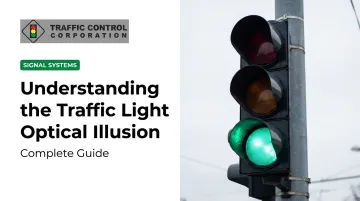
That's the illusion BBC presenter Dean Jackson (@beatonthebeeb) posted to TikTok, racking up over 16 million views according to Indy100. The comments filled with disbelief. Many viewers assumed the video was edited or faked.
It wasn't. And the explanation is genuinely fascinating.
This guide covers everything: how the illusion works, the neuroscience behind why your brain "fills in" red when none exists, the concept of color constancy, and what it all means for how traffic signals are actually designed.
Key Takeaways
- The "red" traffic light under a cyan filter is completely gray — zero red pixels
- Cyan blocks red wavelengths, leaving gray, but your brain interprets that gray as red
- Color constancy makes your visual system "correct" toward a familiar color even when it isn't there
- The same mechanism explains the famous "what color is this dress?" debate
- Traffic signal designers rely on position and brightness alongside color so every driver reads signals correctly
What Is the Traffic Light Optical Illusion?
The setup is simple: a standard three-light traffic signal shown with a cyan (blue-green) filter applied over the entire image. The top light still appears red to most viewers — despite the filter having eliminated every red wavelength from the scene.
Why Cyan Specifically?
Cyan is nearly the complementary color of red in additive color relationships. A cyan filter absorbs red wavelengths and transmits blue and green components. So when you apply it to a traffic signal image, the red lamp doesn't turn a different color — it becomes gray. Not reddish, not warm — just gray.
You can confirm this two ways:
- The hand tunnel method — Roll one hand into a loose tube and look through it with one eye, isolating just the "red" area of the image. Remove the surrounding context, and the light looks gray.
- Digital verification — On a Mac, open the built-in Digital Color Meter app and hover over the "red" pixel area. It registers as gray. Any online color picker produces the same result.
The same logic applies to the amber/yellow light — under a cyan filter, it too reads as gray. The illusion isn't limited to the red lamp.
Is the Video Fake?
Many first-time viewers assume so — and that reaction makes sense. The visual experience is that convincing. But the illusion is fully reproducible and rooted in color science. The hand tunnel trick alone is enough to break it for most people once they try it.
The Science Behind Why Your Brain Still Sees Red
Cone Cells and Color Comparison
Human color vision relies on three types of cone photoreceptors: short (S), medium (M), and long (L) wavelength. A critical detail that surprises most people: a single cone cannot identify wavelength on its own. Its response depends on both wavelength and intensity. Perceived color emerges from comparisons across all three cone classes, not from one cone "detecting" one color.
When the cyan filter removes long-wavelength (red) light, the L-cones receive reduced input from that region — but the brain doesn't simply report "no color." It compares signals across all cone classes and processes them through opponent pathways before color perception even reaches conscious awareness.
Chromatic Adaptation and Context
The visual system continuously adjusts to the prevailing illumination — a process called chromatic adaptation. This begins in the retina and continues through cortical processing. When the entire scene is dominated by cyan, your visual baseline shifts. A neutral gray patch within that cyan-biased scene can appear to take on a compensatory reddish quality, because the brain is actively comparing that patch against its cyan-heavy surroundings.
Research on color constancy in real-world settings confirms that richer scene context — like a recognizable traffic light housing — improves this compensatory response.
Predictive Processing
The brain doesn't wait passively for complete sensory data. It generates predictions based on prior experience and reconciles them against incoming signals. When context strongly suggests "top light of a traffic signal," the brain's model biases toward red. That prediction overrides the incomplete sensory input, producing a subjective experience of red even when the physical stimulus is gray.
Individual variation exists in how strongly this works. A 2017 study of 13,417 observers of the viral dress image found that individual assumptions about illumination accounted for substantial perceptual differences. Prior experience and adaptation history both influence susceptibility to color illusions like this one.
Color Constancy: How Your Brain Auto-Corrects Color
Color constancy is the visual system's ability to perceive an object's color as relatively stable despite changes in illumination. A red apple looks red in morning light, noon sun, and shade — even though the wavelengths reaching your eye are measurably different in each setting. It's a survival adaptation: recognizing objects regardless of lighting conditions matters more than tracking exact wavelengths.
How It Creates the Traffic Light Illusion
When viewers see the cyan-filtered signal image, their visual system treats the cyan cast as a lighting condition rather than a change to the object itself. It then attempts to recover the "true" color of the light — which prior experience has encoded as red. The brain corrects toward red even though no red is physically present.
The Strawberry Parallel
Psychology professor Akiyoshi Kitaoka shared a now-famous image in 2017: red strawberries photographed through a cyan filter, containing no red pixels whatsoever. The fruit still appears reddish to most people. Isolating individual pixels reveals gray. The mechanism is identical — prior knowledge of strawberry color drives a compensatory perceptual correction.
The Dress Connection
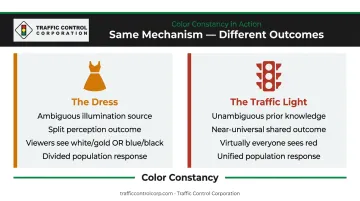
The 2015 "what color is this dress?" debate is a close cousin. That photograph was unusually ambiguous about illumination, causing different observers to assume different light sources and "correct" toward opposite conclusions : some saw white and gold, others blue and black.
The traffic light illusion works differently. Because virtually everyone shares the same prior knowledge about red traffic signals, the perceptual correction is nearly universal — almost everyone sees red. Two illusions, one mechanism, opposite outcomes:
- The dress: ambiguous illumination → split perception (white/gold vs. blue/black)
- The traffic light: unambiguous prior knowledge → near-universal shared error
How to Verify the Illusion and Other Real-World Examples
Verifying the Illusion Yourself
Two methods, both accessible:
- Hand tunnel — Curl your hand into a loose tube, close one eye, and look through the tube at just the "red" region of Jackson's image. Block out the signal housing and surrounding lights. The red disappears and gray emerges.
- Digital color picker — Use macOS Digital Color Meter (built-in, found under Applications > Utilities) or any free browser-based color picker. Hover over the "red" pixel region and read the RGB values. Gray will register as roughly equal R, G, and B values — no red spike.
Both methods work by removing contextual cues. Without the housing, position, and surrounding lights, the brain's prediction collapses and the actual gray pixel value becomes apparent.
Related Color Constancy Illusions
These examples share the same underlying mechanism:
- Kitaoka's gray strawberries — No red pixels, fruit still looks reddish. Color constancy driven by strong prior knowledge of strawberry color.
- Adelson's checker shadow illusion — Two squares that are physically identical shades of gray appear dramatically different due to surrounding context and an implied shadow. Lightness constancy operates the same way chromatic constancy does in color illusions.
- Tinted sunglasses and signal lights — A 2009 study published in Ophthalmic and Physiological Optics found that sunglass tint and signal color both affected response times and error rates in color-normal and color-deficient observers alike — confirming that filtering a light source creates genuine perception challenges, not just inconvenience.
For traffic engineers and signal designers, this matters practically: the same prediction machinery that generates these illusions also explains why signal visibility standards — hood depth, visor geometry, lens color specifications — exist in the first place. The visual system fills in information; good signal design controls what it fills in with.
What This Means for Traffic Signal Design and Road Safety
The traffic light color scheme wasn't arbitrary. Red, amber, and green were chosen through a combination of historical inheritance and practical optics.
Why Red, Yellow, and Green?
According to the Smithsonian's history of the stoplight, James Hoge's 1914 municipal signal borrowed red and green indications already used by railroads, where red had long signaled danger. Red also sits at the longer end of the visible spectrum — near 700 nm — making it detectable at greater distances than shorter wavelengths. The high-contrast red/amber/green combination was selected for maximum discrimination under varied lighting conditions.
Position as a Safety Redundancy
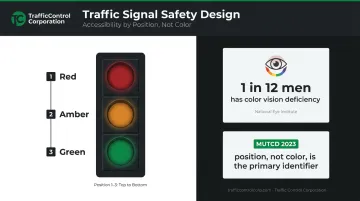
This is the underappreciated part. The 2023 MUTCD (Manual on Uniform Traffic Control Devices) standardizes signal arrangement — red above yellow above green for vertical displays — specifically so that color-vision-deficient users can identify an illuminated signal by position rather than hue alone. Signal meaning is not supposed to depend on color perception alone.
About 1 in 12 men has some form of color vision deficiency, according to the National Eye Institute. Standardized position is the primary accommodation built into the system.
The Brain's "Fill-In" as a Safety Feature
The fact that our visual system fills in expected colors based on context is generally a safety advantage. Drivers reliably perceive signal states even under glare, low contrast, or mild visual impairment, because the brain uses housing shape, position, and surrounding context as cross-checks. The illusion isn't a bug — it's evidence the system is working.
LED signal heads add another layer of precision. Unlike incandescent bulbs, LEDs emit narrow-band wavelengths that stay within specified chromaticity ranges throughout the product's lifespan. LED technology does introduce one notable trade-off, though: significantly lower heat output means these signals can't melt accumulated snow, a real visibility issue in Midwestern winters.
Addressing that trade-off is where equipment selection matters. TCC (Traffic Control Corporation) has worked with Midwestern municipalities for over 75 years on exactly these kinds of compliance and product challenges, including snow-resistant visor options and DOT-compliant signal housings for agencies navigating winter conditions.
Frequently Asked Questions
How does a colorblind person see a traffic light?
People with red-green color blindness may struggle to distinguish red and green by color alone. This is why the 2023 MUTCD standardizes position — red on top, green on bottom — as the primary signal identifier, so location, not hue, communicates the signal state.
Why does a cyan filter make a traffic light appear red when it's actually gray?
Cyan blocks red wavelengths, leaving behind gray. But the brain uses the surrounding context of a familiar traffic signal to predict red and generates that color perception even without physical red light present. Expectation fills in what the light spectrum leaves out.
What is color constancy and why does it cause optical illusions?
Color constancy is the brain's ability to perceive object colors as stable despite changing illumination — useful for recognizing objects across different lighting environments. It misfires when contextual cues strongly suggest a color that physically isn't there.
Can you actually verify there's no red in the traffic light illusion?
Yes. Isolate the "red" area using the hand tunnel method to remove contextual cues, or sample the pixels with any digital color picker tool. The RGB values will confirm gray — equal red, green, and blue values with no red spike.
Why are traffic lights red, yellow, and green?
Red was already used for danger signals in railroads before it moved to roads, and its longer wavelength makes it visible at greater distances. Green and amber were selected for high contrast and discrimination under varied conditions.
Is the traffic light illusion similar to the viral "what color is the dress?" debate?
Both stem from color constancy. The dress divided viewers because illumination assumptions varied; the traffic light unites nearly everyone toward red because prior knowledge of signal colors is essentially universal. Both debates begin from different assumptions but expose the same perceptual shortcut.