Introduction
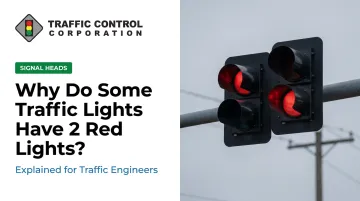
You pull up to an intersection and glance at the signal head. Instead of one red lens, you see two, stacked one above the other or mounted side by side. Both glow red. Is the signal broken? Are you supposed to do something different?
Relax. No malfunction here. It's intentional traffic engineering that shows up in two distinct forms: signal heads built with duplicate red lenses, and twin flashing red lights like the ones at railroad crossings.
Both designs exist for one reason: a missed stop indication at the wrong location can be catastrophic. Understanding how these systems work matters for every driver.
Getting them installed and maintained correctly matters even more for the agencies responsible for public safety. That's where specialized traffic control equipment providers, including TCC, support state DOTs and municipalities across the Midwest.
This article breaks down both scenarios, what they mean for drivers, and why redundancy remains a cornerstone of modern signal design.
Key Takeaways
- Dual red lenses add visibility or backup, not a new rule
- Twin flashing reds at railroad crossings mean stop and wait until they stop
- Right-angle crashes dominate dark-signal data, proving stop reliability matters
- Both configurations carry the same legal weight as a single red light
- Agencies rely on MUTCD guidance and studies to place these signals correctly
Understanding Traffic Signals with Two Red Lenses
A signal head with two identical red lenses, whether stacked vertically or mounted side by side, sends one message twice for emphasis, not two separate commands.
The Federal Highway Administration's MUTCD permits two identical circular red or red arrow indications to be displayed next to each other for emphasis under Section 4E.03. A duplicate red doesn't create a new driver command. The rule stays exactly the same: stop, completely, every time.
Where You'll Typically See This Design
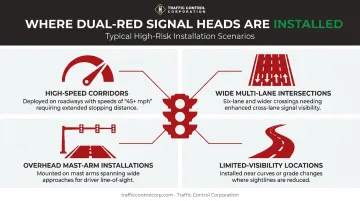
Dual-red configurations show up most often at:
- High-speed corridors where approach speeds exceed 45 mph and drivers need extra warning distance
- Wide, multi-lane intersections where a single signal head might fall outside a driver's natural line of sight
- Overhead mast-arm installations on approaches with long sightlines
- Locations with limited visibility, such as curves, grades, or heavy truck traffic
Alabama DOT's traffic signal design guide describes this directly. Its manual calls for vertical four-section heads with dual red indications specifically where "extra visibility is desirable," including the first signal on a high-speed route or a location with restricted sightlines. The reasoning is visibility, not just backup protection.
Same Rule, Doubled for Emphasis
A double red lens carries the exact same legal weight as a single one. Drivers must stop completely. The duplication adds no permissions and changes no right-of-way rules.
As LED modules replace incandescent bulbs, some agencies are reevaluating where redundant heads remain necessary. LEDs typically dim gradually instead of failing all at once, unlike the sudden bulb burnout older signal designs were built to guard against.
Even so, visibility-driven dual-red heads on high-speed approaches remain standard practice in many state manuals.
Twin Flashing Red Lights: A Different Kind of "Double Red"
Steady dual-red lenses are one thing, but alternating flashing red lights are something else entirely, and mixing up the two can lead to dangerous assumptions.
The most familiar example sits at railroad crossings. MUTCD Section 8D.02 requires a grade-crossing flashing-light signal to display two red lights in a horizontal line facing approaching traffic, flashing alternately between 35 and 65 times per minute. Many drivers know this setup by its nickname: the "wig-wag" signal.
The Required Driver Action
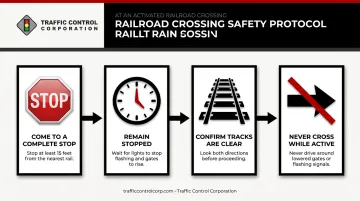
When these lights activate, there's exactly one correct response:
- Come to a complete stop before the crossing
- Remain stopped until the lights stop flashing entirely
- Confirm the tracks are clear before proceeding
- Never attempt to cross while lights are active or gates are down, even if no train is visible
Federal guidance makes this mandatory rather than a suggestion, and the consequences for ignoring it are well documented. NHTSA data shows 336 drivers went around lowered gates and were struck by trains in 2018 alone, with 99 fatalities, a ten-year high at the time.
Other Places Twin Reds Appear
Railroad crossings aren't the only setting for this pattern; similar flashing-red logic also appears at:
- School bus stop-arm signals, where flashing red lights and an extended arm mean children are boarding or exiting
- Fire station emergency vehicle signals, which can alternate between flashing yellow, steady yellow, and flashing red to clear a path for responding apparatus
- Movable bridge warning signals, which use the same alternating red pattern to stop traffic before an open span
Don't Confuse This With a Single Flashing Red
A single flashing red light at a regular intersection functions like a four-way stop: stop, check for traffic, then proceed when it's safe. Twin flashing reds at a railroad crossing carry no such shortcut, and there's no "proceed when clear" moment until the entire signal sequence ends.
Why Redundant Red Signals Matter for Road Safety
Traffic engineers build in redundancy because not all signal failures carry equal risk. A green light that fails dark causes confusion. A red light that fails dark can cause a collision.
Data backs this up. A New York State DOT-sponsored study identified 310 dark-signal crashes across more than 1,000 state crash records over a five-year period. Right-angle crashes, the kind that happen when one driver never sees a stop indication, made up 77.7% of that sample. Rear-end crashes accounted for another 11.2%.
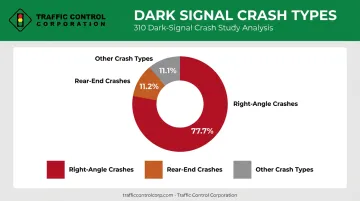
That imbalance tells you something important: when a signal goes dark or fails at a critical approach, the resulting crashes tend to be the severe, intersection-crossing kind rather than minor fender-benders.
How Agencies Decide Where Redundancy Belongs
Traffic engineers don't add dual-red heads everywhere. They follow a structured process:
- Engineering studies evaluate traffic conditions, pedestrian volumes, and physical intersection characteristics before any signal decision
- Warrant analysis considers factors like approach speed, sightline distance, and crash history
- Site-specific risk factors such as grades, curves, high truck volumes, and intersection width all weigh into the final call
Meeting one risk factor doesn't automatically trigger installation. Engineering judgment still drives the final decision, which is exactly why redundant heads cluster at high-speed, high-consequence locations rather than every corner in town.
What Drivers Should Do When They Encounter These Signals
The good news: none of this requires learning new rules. It requires trusting the ones you already know.
For a steady double red lens:
- Treat it exactly like a normal red light
- Stop completely at the line
- Proceed only when clear and legally permitted, such as a right turn on red where allowed
For twin flashing reds at a railroad crossing:
- Stop and stay stopped until the signal fully ends
- Don't rely on how traffic "looks," wait for the lights to stop, not just for a gap in visible trains
- Never drive around a lowered gate, regardless of how urgent your trip feels
The single biggest mistake drivers make with either configuration is assuming it signals a malfunction. It doesn't. Both designs are deliberate safety engineering meant to be obeyed at face value, not interpreted or second-guessed.
What Happens If You Accidentally Run a Red Light
Running a red light carries consequences whether that light was single, doubled, or flashing. The signal type doesn't change the legal outcome.
Common results include:
- Citations and fines, which vary by state and jurisdiction
- Points on your driving record, which can accumulate toward license suspension
- Higher insurance premiums, since moving violations typically factor into how insurers calculate risk
Because doubled and redundant red signals are engineered for maximum visibility, they can weaken a driver's argument that they simply didn't see the signal. Courts and insurers tend to view "I didn't notice it" less favorably when the signal was specifically designed with extra visibility in mind.
If you're involved in a violation or accident at one of these intersections:
- Remain at the scene and exchange information as required
- Document the situation with photos, notes, and witness details if possible
- Consult local traffic laws or legal counsel for guidance specific to your state
These practical steps protect you regardless of outcome. For guidance specific to your case, consult a licensed attorney in your state.
How TCC Supports Reliable, Redundant Traffic Signal Systems
None of this redundancy happens by accident. Somebody has to select the right signal heads, source the LED modules, and keep the whole system running through snow, brownouts, and equipment age.
Traffic Control Corporation has distributed traffic signal equipment across the Midwest since 1946, starting as the exclusive Illinois, Indiana, and Wisconsin distributor for Automatic Signal Company. Today, TCC represents more than 40 manufacturers, including Econolite, Alpha Technologies, and EDI/Reno A&E, supplying the signal heads, LED modules, backplates, and visors that keep redundant and backup-indication configurations working as designed.
One real example: Lake County, Illinois faced a winter visibility problem — snow accumulating on red LED lenses that no longer generate enough heat to melt it. TCC's product line supported the installation of snow-proof visors across all 176 county-owned traffic signals, funded through an IDOT Highway Safety Improvement Program grant.
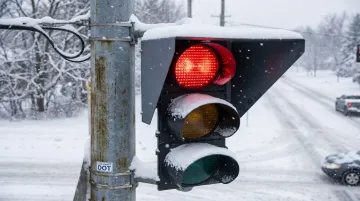
Keeping a red indication visible takes ongoing attention, not just a one-time install.
TCC's factory-trained technical field service team helps state DOTs, municipalities, and contractors:
- Select signal heads and housings suited to specific intersection geometry
- Troubleshoot equipment onsite
- Access training on signal systems, controllers, and detection technology
If your agency is evaluating redundant or backup-indication signal configurations, TCC's team can help with product selection and onsite support. Coverage spans an 11-state Midwest service area, including Illinois, Indiana, Iowa, Kansas, Michigan, Minnesota, Missouri, Nebraska, North Dakota, South Dakota, and Wisconsin.
Frequently Asked Questions
What's the point of a double red light?
A double red lens is a built-in backup so the signal never fails to show "stop" if one bulb or module goes out. It carries the exact same legal meaning as a single red light.
What do twin flashing red lights mean?
Alternating flashing red lights, common at railroad crossings, require a complete stop. Remain stopped until the lights stop flashing and the tracks are confirmed clear before proceeding.
What happens if a signal fails to show red?
A failed indication trips the controller's conflict monitor, which drops the intersection into flash mode as a safety fallback. Agencies then dispatch technicians to diagnose and replace the faulty module or backplate.
Is a flashing red light the same as a stop sign?
A single flashing red light at an intersection functions like a stop sign. Come to a full stop, yield to other traffic, then proceed when it's safe.
Why do some traffic lights have backup or duplicate signal heads at all?
Agencies install redundant heads at high-speed, high-traffic, or visibility-limited locations where losing a stop indication would create serious safety risk. Engineers apply this configuration selectively, based on site-specific risk factors rather than a universal rule.
Who decides where redundant or flashing traffic signals are installed?
State and local traffic engineers use national guidelines like the MUTCD along with site-specific engineering studies to determine where these configurations are warranted.