Introduction
Most city intersections still look the same from the street — signal heads, sensor loops cut into the pavement, a cabinet on the corner humming quietly. What's changed is what's happening inside that cabinet and across the network connecting it to dozens or hundreds of other intersections.
Traffic management has shifted from static timing plans set weeks in advance to systems that read live conditions and respond in seconds. The global intelligent traffic management system market was valued at $13.8 billion in 2025 and is forecast to reach $48.67 billion by 2033 — a 17.8% annual growth rate that reflects how aggressively municipalities are investing in this infrastructure.
Yet most coverage of smart city traffic management stops at the concept level. Terms like "adaptive signals" and "AI-powered traffic control" get used without explaining what actually happens between a vehicle pulling up to a red light and the system deciding to change it.
This article breaks down how smart city traffic management works: the detection layer, the data flow, the decision logic, and the control output. Transportation professionals can use it to evaluate, specify, and deploy these systems with a concrete understanding of how each component fits together.
Key Takeaways
- Smart traffic management is a continuous closed loop: detect conditions → transmit data → process and decide → execute a control response
- Unlike fixed-time signals, adaptive systems adjust green/red durations based on live traffic volumes and queue lengths
- Core technologies include IoT sensors, NTCIP-compliant controllers, communication backhaul, and ATMS software platforms
- Field results show meaningful gains: Pittsburgh's Surtrac deployment cut travel times by over 25% and estimated emissions by 21%
- Smart systems also deliver gains in emergency preemption, pedestrian safety, and long-term capital planning
What Is Smart City Traffic Management?
Smart city traffic management — formally called an Intelligent Transportation System (ITS) — is an integrated approach to controlling vehicle and pedestrian movement across a road network using real-time data, connected devices, and automated control systems.
The distinction from traditional signal control matters. Fixed-time systems run predetermined cycle plans on a schedule. They cannot respond to an unexpected backup, a major event emptying a parking garage, or a crash blocking an arterial. Those plans are calibrated for average conditions, so performance degrades whenever real-world conditions diverge from the baseline.
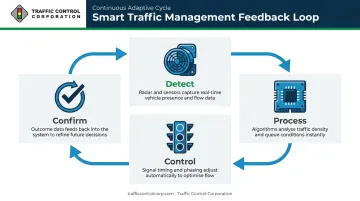
Smart systems close that gap by making signal control dynamic. The core feedback loop runs through four stages:
- Detect — sensors capture real-time vehicle and pedestrian presence on the road
- Process — a central or edge computing layer calculates the optimal signal response
- Control — signal timing adjusts based on that output
- Confirm — sensors verify the result and feed updated data back into the cycle
What Smart Traffic Management Is Not
Installing a few cameras or connected signals at isolated intersections is not smart city traffic management. The defining characteristic is integration — components sharing data across a coordinated network with centralized monitoring and automated decision-making. The difference comes down to scope and coordination:
- A standalone signal upgrade at one intersection is a maintenance action
- A corridor with linked adaptive signals is a limited deployment
- A citywide ATMS platform with centralized monitoring is the full system
Systems scale from single-intersection adaptive control to corridor-level coordination to full network management platforms. Scope and capability vary, but the sections below follow that same progression — from individual components to network-wide coordination.
How Smart City Traffic Management Works
The system operates as a continuous data loop — always sensing, transmitting, processing, and responding. Each stage feeds the next in near real time.
Stage 1: Detection and Data Collection
Detection initiates everything. Sensors embedded at or near intersections capture what's happening on the road:
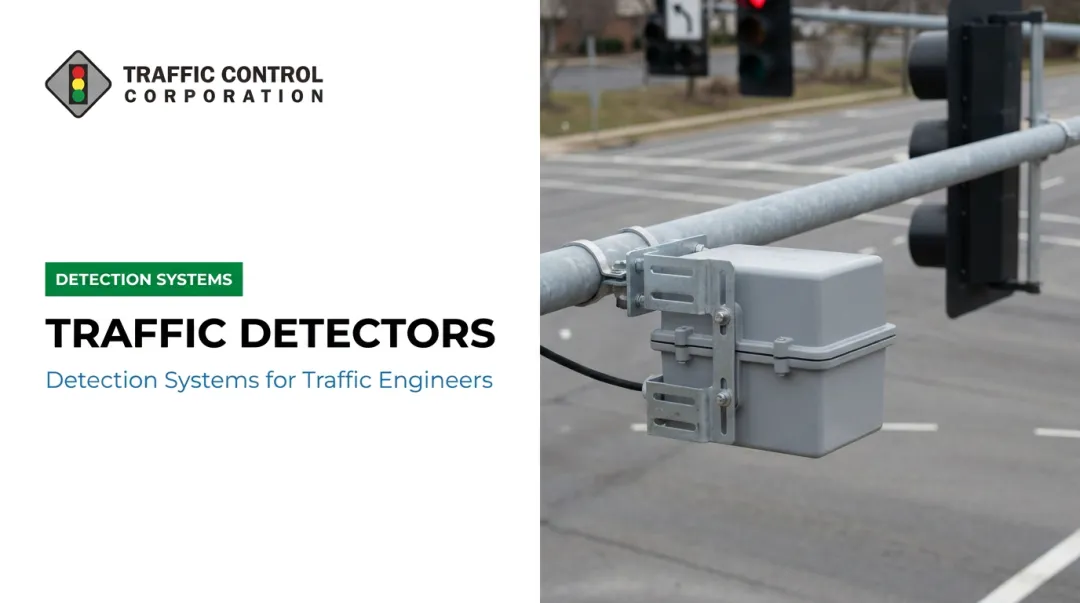
- Inductive loop detectors — cuts in the pavement that register vehicle presence and count; accurate in controlled conditions but vulnerable to pavement deterioration
- Video detection systems — cameras with image processing that track presence, count, queue length, speed, and vehicle classification; affected by poor visibility conditions
- Radar sensors — microwave or FMCW radar that captures speed, count, occupancy, and classification across wide fields of view; less sensitive to lighting but subject to occlusion and alignment issues
- Multi-modal sensor fusion — combining radar and video in a single unit to offset each technology's individual limitations
Advanced deployments use multiple sensor types simultaneously. No single sensor type is universally most accurate — performance varies by site, weather, installation quality, and the specific metrics being measured.
Stage 2: Data Transmission and Communication
Sensor data moves from field cabinets to a central Traffic Management Center (TMC) (or in decentralized systems, to neighboring intersection controllers) via fiber, cellular (4G LTE or 5G), or hybrid configurations. FHWA documents that most contemporary signal systems rely on fiber for its bandwidth and reliability, though wireless configurations are common where fiber installation isn't practical.
Communication reliability is non-negotiable for municipal traffic networks. Encrypted channels (IPsec tunnel configurations per NIST SP 800-77 guidance) and redundant backhaul connections are standard in modern deployments.
In advanced systems, initial processing happens locally at the cabinet before data is transmitted upstream. This reduces latency and bandwidth demand , which matters most for time-sensitive applications like emergency preemption.
Stage 3: Processing, Analysis, and Decision-Making
Once data reaches the processing layer, algorithms evaluate current conditions against historical patterns and calculate the optimal control response. The primary output is adaptive signal timing: extending a green phase where queues are building, shortening a red where cross-traffic is light, or triggering priority for a bus or emergency vehicle.
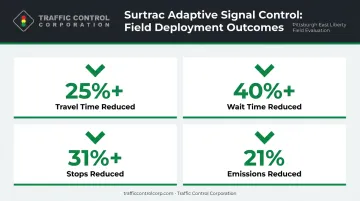
Carnegie Mellon's Surtrac system, deployed across nine intersections in Pittsburgh's East Liberty neighborhood, shows what this looks like in practice. A 2012 field evaluation comparing GPS drive-run data before and after deployment found:
- Travel time reduced by over 25%
- Wait time reduced by over 40%
- Stops reduced by over 31%
- Estimated emissions down 21%
Surtrac makes timing decisions locally at each cabinet and communicates projected outflows to neighboring signals, a decentralized architecture that keeps response times tight.
Stage 4: Control Output and Closed-Loop Feedback
The system's output is an intersection behavior change: adjusted signal timing or emergency preemption activating a green corridor. It may also push rerouting recommendations to connected vehicles or driver information signs, or flag a condition for a TMC operator.
What makes this a smart system rather than one-way automation is what happens next. After executing a control action, the sensors continue monitoring to measure whether conditions actually improved. That feedback becomes the input for the system's next adjustment. Unlike fixed-time systems that run the same cycle regardless of conditions, this closed-loop structure lets the network respond to what's actually happening on the road.
Key Technologies Powering Smart Traffic Systems
System performance is directly tied to the quality and integration of its components. The ITS stack spans four primary layers.
IoT Traffic Sensors and Detection Hardware
The sensor layer sets the ceiling for everything downstream. Data quality at the detection stage determines whether adaptive algorithms have reliable inputs to work with.
TCC distributes detection hardware across all major technology categories:
| Technology | Key Parameters | Representative Products |
|---|---|---|
| Video detection | Count, classification, queue, turning movements | Econolite Autoscope® OptiVu |
| Radar (FMCW + camera) | Count, speed, classification, occupancy, pedestrian/bicycle | Econolite EPIQ RADAR™, EVO RADAR |
| Inductive loop | Presence, count, occupancy | EDI Oracle Series, LM222 Series |
| Radar/microwave (ITS data) | Speed, volume, occupancy, classification | Sensys Networks RTMS Echo |
The Econolite EPIQ RADAR™ illustrates how far single-unit sensor capability has advanced: one device combines FMCW radar with an integrated 1080p camera, covers two approaches at up to 900 feet with a 110° field of view, tracks up to 128 objects simultaneously, and transmits data via power line communications without requiring new cable infrastructure.
Adaptive Signal Controllers and Traffic Signal Equipment
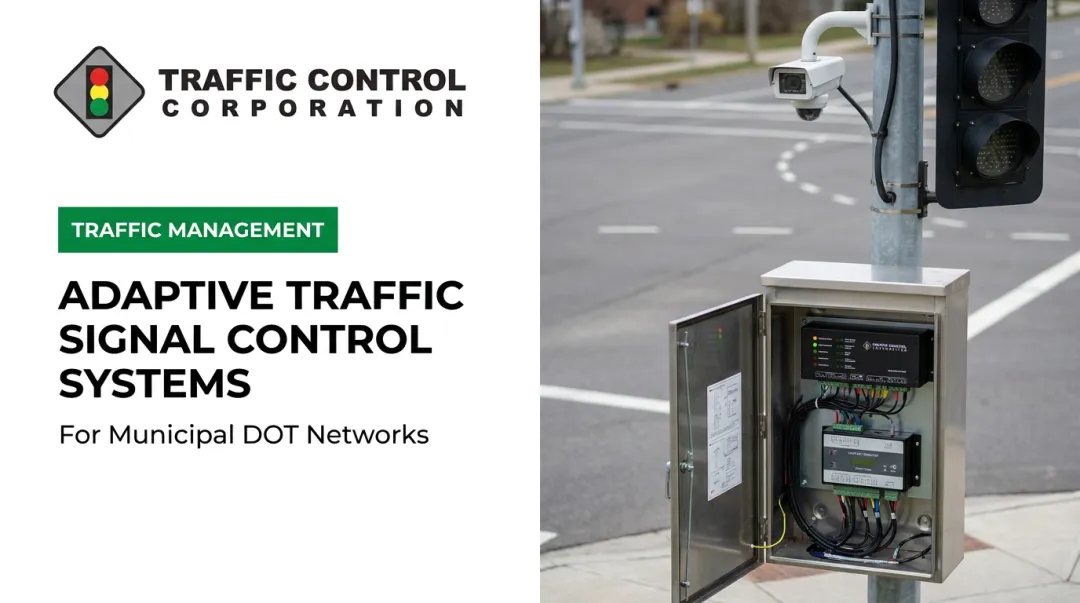
At each smart intersection, the traffic signal controller receives processed data and executes timing changes. Modern controllers must support open communication protocols — NTCIP 1202 defines the standard interface for management stations to monitor and control actuated controllers, enabling multi-vendor interoperability.
TCC distributes Econolite's full controller lineup for Midwest municipalities and DOTs:
- Cobalt Series: next-generation platform with a hardened touchscreen GUI, Linux-based OS, and compatibility with Econolite's EOS Traffic Control Software (10,000+ field installations as of 2023)
- 2070LX+ / 2070LX: ATC-compliant controllers running Linux real-time OS, meeting NEMA TS1/TS2 and Caltrans TEES standards, designed for the widest range of state and municipal deployment environments
- ATCC Cabinets: advanced traffic control cabinets with high-density I/O (up to 32 signal outputs, 120 detection inputs) and advanced diagnostics via high-speed serial communications
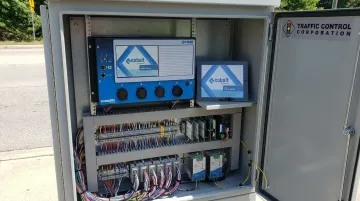
The Cobalt platform is well-suited for adaptive deployments — it's the controller TCC features in its own training programs and supports V2I applications including red light violation warning and connected vehicle communication via compatible roadside units. Applied Information's Glance EVP System, also distributed by TCC, extends this with GPS/cellular-based emergency preemption, dual-channel redundancy (cellular primary, 900 MHz radio backup), and documented response time reductions of up to 20%.
Communication Networks and Backhaul
The communication layer connects field equipment to the TMC. Configurations vary:
- Fiber: highest bandwidth, most reliable; preferred where infrastructure exists
- Cellular (4G LTE / 5G): practical for areas without fiber; 5G's low latency is especially relevant for emergency preemption and connected vehicle applications
- Hybrid: most common in practice, combining fiber on main arterials with wireless fills
TCC distributes Intuicom wireless radios — including traffic signal interconnect radios (EB-X series) and wireless broadband systems — designed for ITS environments where fiber runs aren't feasible. Ruggedcom industrial-grade networking hardware addresses the environmental demands of outdoor cabinet deployments.
Backup power is part of communication continuity. Alpha Technologies UPS systems, available through TCC, are deployed at over 50,000 traffic intersections and ITS installations. During a power interruption, without a functioning UPS, field cabinets lose the ability to transmit data or receive updates — creating blind spots in the network even if the TMC stays online.
Traffic Management Software and Analytics
The software layer aggregates sensor data, runs adaptive algorithms, displays real-time network status, generates alerts, and archives operational data for planning.
TCC distributes and deploys the Econolite Centracs® ATMS platform across its Midwest territory. In DuPage County, Illinois, a Centracs-based expansion grew from 72 signals to approximately 200, integrating 60 CCTV cameras for real-time remote traffic observation — a project developed in partnership with the City of Naperville that earned ITS Midwest Project of the Year recognition.
Centracs' Signal Performance Measures (SPM) module provides:
- Continuous high-resolution signal monitoring without manual data collection
- Proactive optimization aligned with FHWA's Every Day Counts program
- Automated performance data replacing costly field surveys
Key Benefits for Cities and Transportation Agencies
The case for smart traffic investment rests on several distinct outcome categories.
Reduced Congestion and Travel Time
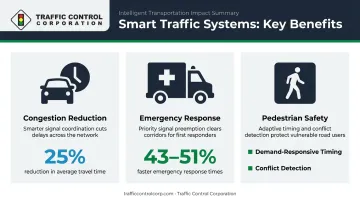
The Pittsburgh Surtrac field evaluation gives the clearest documented evidence of what adaptive signal control delivers: travel time fell over 25% and stops decreased over 31% compared to coordinated-actuated baseline plans. Estimated emissions dropped 21% — a direct result of less idling and fewer acceleration cycles.
Emergency Response and Safety
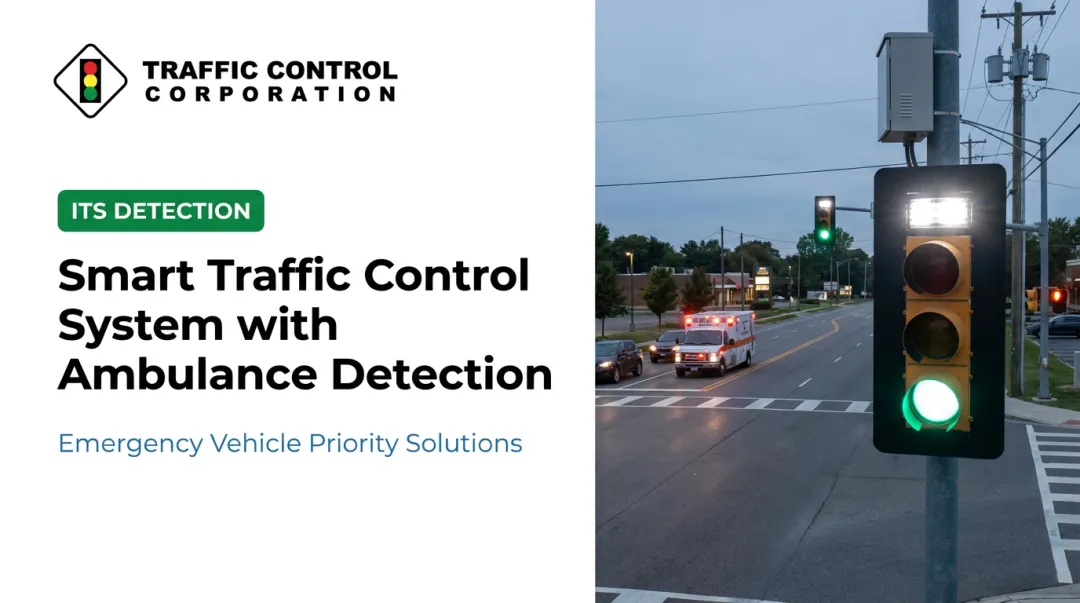
A 2018 USDOT simulation found that vehicle-to-infrastructure emergency signal preemption reduced response time by 43% to 51% depending on traffic density. The figures come from simulation, not field measurement — but the operational logic holds: when a preemption system clears a green corridor ahead of a responding unit, every intersection that would have caused a stop or delay is eliminated from the route.
For agencies deploying or upgrading preemption capability, TCC distributes both GTT Opticom (infrared and GPS, deployed at 90,000+ intersections globally) and Applied Information Glance EVP (cellular/GPS with dead reckoning) systems.
Adaptive systems also improve pedestrian and cyclist safety in two concrete ways:
- Demand-responsive timing — signal phases adjust to actual pedestrian presence rather than running on a fixed schedule
- Real-time conflict detection — the system flags vehicle-pedestrian conflicts before they develop, rather than relying on static timing assumptions
Data for Capital Planning and Federal Reporting
Smart traffic systems generate archived operational data that transportation agencies use well beyond day-to-day signal management. TRB's 2024 monitoring review documents that archived count and operations data support project prioritization, performance monitoring, and federal reporting used in allocating road-improvement funds.
For Midwest DOTs and municipalities managing constrained budgets, that matters beyond traffic flow. The system reduces dedicated data collection costs while producing higher-quality evidence for capital programming — a compounding return that shows up in both operating budgets and grant applications.
Conclusion
Smart city traffic management works because it closes the loop. Detection feeds transmission, which feeds processing, which drives control decisions that loop back into detection — running continuously across hundreds of intersections. That continuous cycle is what separates a connected traffic network from a collection of signals on fixed timers.
The system is only as effective as its weakest component. A reliable sensor feeding data into a poorly configured controller produces poor results. Degrade the backhaul on a well-configured controller, and it loses the ability to coordinate with neighboring intersections. How well each layer integrates with the next determines whether the network performs as designed.
For municipalities and transportation agencies across the Midwest, TCC has spent over 75 years helping them identify, source, and support the right ITS equipment for their specific networks — from adaptive signal controllers and detection hardware to ATMS software, communication infrastructure, and backup power systems.
TCC represents 40+ manufacturers across 11 states, with factory-trained technical staff who support deployments from pre-sale specification through commissioning and ongoing maintenance.
If your agency is scoping a new smart traffic system or evaluating where to modernize existing infrastructure, contact TCC to connect with a regional representative.
Frequently Asked Questions
What traffic solutions are used in smart cities?
Smart cities deploy adaptive signal controllers, IoT-based detection hardware, real-time traffic management software (ATMS), signal preemption systems, and communication backhaul networks. These components work as an integrated system, with data flowing continuously between field equipment and a central management platform.
What is the difference between traditional and smart traffic management?
Traditional systems follow pre-set timing plans that run on a fixed schedule regardless of actual traffic volumes. Smart systems use real-time detection data to adjust signal timing dynamically, responding to actual conditions rather than predicted averages, which reduces congestion and improves safety outcomes.
How do adaptive traffic signals work?
Adaptive signal controllers receive live data from roadway sensors, evaluate current volumes and queue lengths against available capacity, and adjust phase durations based on current demand. Unlike fixed-time plans, they recalculate continuously rather than following a predetermined schedule.
What role does AI play in smart city traffic management?
AI serves two primary functions: real-time adaptive control (processing sensor data to optimize signal timing as conditions change) and predictive analytics (using historical patterns combined with live inputs to anticipate congestion before it develops).
How do smart traffic systems support emergency vehicles?
When an emergency vehicle is detected — via GPS, cellular, or optical/acoustic sensors — the preemption system transfers control to a special mode that clears a green corridor along the vehicle's route. This reduces response time by eliminating intersection stops and minimizing conflict with cross-traffic.
What are the main challenges of implementing smart traffic management?
The most common barriers include legacy infrastructure compatibility, upfront equipment and networking costs, cybersecurity requirements for networked critical infrastructure, and interoperability gaps between vendors' systems. Older controllers and copper communications are particularly limiting — they constrain both modern detection integration and software deployment.