
Introduction
Inside a construction work zone, workers share tight spaces with dump trucks, pavers, dozers, and rollers — all moving through shifting layouts, limited sight lines, and noise levels that make backup alarms easy to miss.
A 2024 NIOSH review found that 55% of investigated roadway work zone fatalities were caused by construction vehicles and equipment operating inside the work zone — not public traffic passing through it.
An Internal Traffic Control Plan (ITCP) addresses that directly. It's the structured, site-specific document that coordinates how workers, vehicles, and equipment move within the activity area — defining clear patterns before conflicts develop into injuries.
This guide walks through what an ITCP must include, how to build one from the ground up, and how to keep it current as site conditions change.
Key Takeaways
- An ITCP governs worker and equipment movement inside the work zone, distinct from external traffic control plans
- 55% of work zone fatalities involve construction vehicles operating inside the activity area
- Every ITCP needs three components: a diagram, a legend, and notes
- The plan must be updated whenever site conditions, phases, or access routes change
- OSHA's struck-by provisions and general duty clause make the ITCP a direct compliance requirement
What Is an Internal Traffic Control Plan (ITCP)?
An ITCP is a site-specific document that coordinates the movement of workers, construction vehicles, and equipment within the activity area of a work zone. Per FHWA guidance document FHWA-HOP-17-046, it serves as a tool for project managers to inform all parties operating within the activity area where others are located — and how to move safely around them.
How It Differs from a Temporary Traffic Control Plan
Contractors often conflate the ITCP with the Temporary Traffic Control Plan (TTCP), but they address distinct problems:
| Plan | Focus | Audience |
|---|---|---|
| TTCP | Public traffic flow around the work zone | Motorists, cyclists, pedestrians on public roads |
| ITCP | Worker and equipment movement inside the work zone | Operators, pedestrian workers, flaggers, spotters |
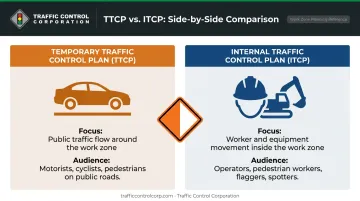
Both plans can — and often should — coexist on the same project. The TTCP handles what happens outside the cones; the ITCP handles what happens inside them.
ITCPs aren't new. NIOSH Publication 2001-128 called for internal traffic control plans as far back as April 2001. Adoption has lagged behind the guidance — but that's shifting as the construction industry recognizes their direct role in preventing fatalities and establishing employer due diligence.
Why ITCPs Are Critical for Work Zone Safety
Workers on foot are the most vulnerable people on any active construction site. Equipment operators are focused on their tasks, backup alarms become background noise, and blind spots on large vehicles like dump trucks, rollers, and pavers can swallow entire pedestrian zones.
The Backing Hazard Is Well-Documented
Backing vehicles are one of the most consistent killers in construction work zones. NIOSH data shows that during 2003–2010, 143 workers were fatally struck by backing vehicles or mobile equipment at road construction sites — including 84 struck by backing dump trucks specifically. That figure reflects foundational historical data; the pattern hasn't disappeared.
Behavioral Hazards Are Just as Dangerous
ITCPs must account for something less obvious: the routes workers naturally want to take. When a water cooler, latrine, break area, or parking zone sits across a vehicle travel path, workers will cross it — repeatedly, throughout the day, often without thinking about it. These informal shortcuts create unpredictable pedestrian-vehicle interactions that operator vigilance alone can't prevent.
Common behavioral hazard patterns include:
- Cutting through vehicle lanes to reach restrooms or break areas
- Re-entering the activity area through undesignated points after breaks
- Walking behind reversing equipment to avoid longer detoured routes
- Congregating near staging areas where trucks are maneuvering
The Operational Case for ITCPs
The safety case for ITCPs is clear — but they deliver operational benefits too. When vehicle routes, staging sequences, and personnel movements are planned in advance, sites run more smoothly. Unplanned equipment conflicts, near-miss stoppages, and traffic bottlenecks create delays that coordinated routing eliminates.
Bradley Sant, ARTBA Senior Vice President for Safety and Education, stated in a June 2024 article that knowing when and where to move equipment "can be the difference between life and death." He describes ITCPs as coordinated plans that protect workers on foot near large vehicles — and as a demonstration of employer due diligence if an incident occurs.
Core Components of an Effective ITCP
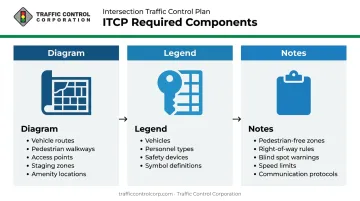
FHWA identifies three principal components every ITCP must include: the Diagram, the Legend, and the Notes. Together, they create a complete, communicable picture of how the site operates safely.
ITCP Diagram
The diagram is the visual centerpiece of the plan. It depicts the geometry of the activity area, showing:
- Vehicle and equipment travel routes
- Designated pedestrian walkways
- Access and egress points
- Staging and loading/unloading zones
- Equipment locations during active operations
- Locations of amenities (latrines, water stations, parking, break areas)
The diagram does not need to be drawn to scale. It does need to be clear enough that any worker or operator looking at it can understand how safety features function and where they are relative to each other.
ITCP Legend and Symbols
The legend decodes the diagram. It defines every symbol used, including:
- Vehicles — dump trucks, dozers, rollers, pavers, water trucks
- Personnel — pedestrian workers, spotters, flaggers
- Safety devices — barriers, cones, signs, delineators
Standard symbols may follow MUTCD conventions, but hand-drawn symbols are acceptable as long as they're applied consistently and explained in the legend. The goal is universal readability by everyone on site — including subcontractors and delivery drivers who may not be familiar with the project.
ITCP Notes
The notes section translates the diagram into enforceable operational rules. A thorough notes section covers:
- Designated pedestrian-free zones and buffer areas around specific equipment
- Right-of-way rules between workers and vehicles at conflict points
- Blind spot warnings for equipment in active use
- Site speed limits for construction vehicles
- Communication protocols between operators, spotters, and flaggers
- Timing and requirements for daily safety briefings
- Coordination procedures for truck arrivals and departures
- References to applicable OSHA standards (29 CFR 1926)
Amenity placement belongs in the notes section — not as a logistics afterthought. Where latrines, water stations, and break areas sit relative to vehicle paths is a safety decision. Routing workers away from active travel paths through deliberate placement eliminates one of the most preventable causes of worker-vehicle conflict on any site.
The devices your ITCP references — signs, barriers, beacons, channelizing equipment — require the right product for the specific site condition. TCC (Traffic Control Corporation) has supported Midwest contractors and agencies with that selection process for over 75 years, drawing on relationships with more than 40 manufacturers across Illinois, Indiana, Iowa, Minnesota, Missouri, and surrounding states.
How to Develop an ITCP: A Step-by-Step Guide
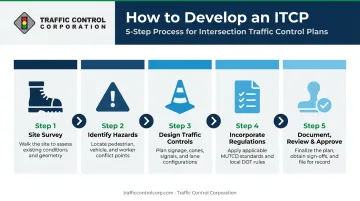
The following five steps move from initial observation through final distribution — producing a documented, approved plan that every worker on site can follow before the first piece of equipment rolls.
Step 1 — Conduct a Site Survey
Walk the activity area before putting anything on paper. Document:
- All access and egress points
- Natural pedestrian desire lines (the paths workers will instinctively take)
- Equipment staging areas and planned haul routes
- Hazardous adjacencies — narrow passages, blind corners, elevation changes
- Current and planned locations of amenities
What you observe in person will reveal conflicts that office-produced drawings never would.
Step 2 — Identify Hazards and Establish Priorities
Map where vehicle paths and pedestrian paths cross. For each intersection point, determine whether the conflict can be eliminated (rerouted away entirely) or controlled (managed with spotters, barriers, one-way routing, or timed separation).
Prioritize:
- Backing zones — highest fatality risk
- Blind corner areas and loading/unloading zones
- Informal paths to amenities
Step 3 — Design Traffic Controls and Site Layout
With hazard priorities established, design the controls:
- Route vehicles one-way wherever site geometry allows
- Separate pedestrian walkways physically — barriers or channelizers where vehicle speeds and volumes warrant it, not just painted lines
- Post speed limits and directional signage throughout the activity area
- Reposition amenities so workers have no reason to cross active vehicle paths
Phase the plan to align with construction sequences. A layout that works in the clearing phase may need significant revision once paving begins.
Step 4 — Incorporate Regulatory Requirements and Local Conditions
The ITCP must comply with FHWA guidance and relevant OSHA provisions. In Midwest states, seasonal conditions introduce planning challenges that need to be addressed explicitly:
- Snow and ice degrade sight lines, pedestrian footing, and access road conditions — winter visibility planning is non-negotiable
- Frozen ground can shift staging area locations and haul routes mid-project, requiring plan revisions
- State DOT requirements vary — no Midwest DOT currently mandates an ITCP by name, but project-specific special provisions may impose additional controls
Coordinate with your state DOT and local transportation agency early, particularly on Federal-aid projects where Transportation Management Plan requirements under 23 CFR 630 Subpart J apply.
Step 5 — Document, Review, and Gain Approval
Finalize the written ITCP with diagram, legend, and notes. Then:
- Review with the project safety officer and competent persons
- Submit critical elements (truck access points, staging areas) to the contracting agency for approval
- Distribute the complete plan to all personnel — operators, pedestrian workers, flaggers, subcontractors, and regular delivery drivers — before work begins
- Use the diagram as the centerpiece of the pre-construction safety meeting
OSHA and FHWA Regulatory Requirements for ITCPs
What OSHA Requires
No single OSHA construction standard is titled "Internal Traffic Control Plan." The obligation flows from broader provisions in 29 CFR 1926:
- Subpart C (1926.20, 1926.21) — Employers must maintain safety programs, conduct frequent inspections by competent persons, and instruct workers to recognize hazardous conditions
- Subpart O (1926.601, 1926.602) — Vehicles and earthmoving equipment with obstructed rear views may not reverse unless they have an audible alarm or an observer signals the backing is safe
- General Duty Clause (Section 5(a)(1)) — Employers must provide a workplace free from recognized hazards likely to cause death or serious harm
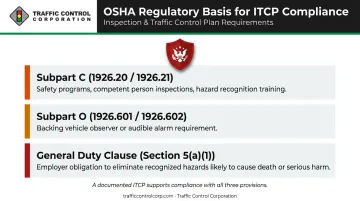
A documented ITCP directly supports compliance with all of these provisions. It demonstrates that the employer identified worker-vehicle hazards, implemented controls, assigned competent persons, and communicated the plan to affected employees.
What FHWA Requires
Where OSHA addresses worker-protection obligations, FHWA governs how traffic control is planned and documented at the project level. Three key references apply:
- FHWA-HOP-17-046 — The primary federal guidance document for ITCP development, covering structure, communication, and revision protocols. It's guidance rather than regulation, but it provides the most detailed treatment of ITCP requirements at the federal level.
- 23 CFR 630 Subpart J — For Federal-aid highway projects, this regulation requires a Transportation Management Plan (TMP) that includes a Temporary Traffic Control plan. The TMP addresses public traffic around the work zone; the ITCP addresses internal worker-equipment interactions and should be developed as a companion document.
- MUTCD 11th Edition (December 2023) — All traffic control devices referenced in the ITCP (signs, barriers, beacons) must conform to this standard. Section 6C.04 specifically calls for planning activity-area movements to minimize backing and operator blind spots.
Communicating and Maintaining Your ITCP
A plan that sits in a filing cabinet protects no one.
Every person on site must understand the ITCP — operators, pedestrian workers, spotters, flaggers, and delivery drivers included. Introduce it at the pre-construction meeting. Reinforce it at every daily safety briefing. Use the diagram as a physical handout in those meetings, not just a reference document.
Enforcement Roles
The safety officer and designated competent person for each shift are responsible for active monitoring. Their authority must extend to:
- Warning workers who leave designated pedestrian zones
- Stopping vehicles that exceed posted site speed limits
- Halting work entirely when the ITCP is being consistently disregarded
Active enforcement is what separates a functional ITCP from a document that gets filed and forgotten.
Keeping the Plan Current
The ITCP is a living document. Update it whenever:
- A new construction phase begins
- New or different equipment arrives on site
- Access routes or staging areas change
- Seasonal conditions alter footing, visibility, or route conditions
- A near-miss or incident reveals an unaddressed conflict
Every revision must be reviewed with the safety officer and approved where the contracting agency requires it. Communicate changes to all personnel before the next shift begins — not after.
FHWA guidance and the ARTBA/OSHA-funded training guide both reinforce this point: plan review is a before-each-shift discipline, not a one-time event at project kickoff.
Frequently Asked Questions
What is an internal traffic control plan?
An ITCP is a site-specific document that coordinates the movement of workers, construction vehicles, and equipment within the activity area of a work zone. It is distinct from external traffic control plans, which manage public road traffic flowing around the outside of the site.
What should be included in an internal traffic control plan?
Every ITCP needs three core elements:
- Site diagram showing vehicle routes, pedestrian pathways, staging areas, and amenity locations
- Legend explaining all symbols used on the diagram
- Safety notes covering pedestrian-free zones, blind spot warnings, communication procedures, and applicable regulatory references
What is the OSHA 1926 internal traffic control plan?
OSHA's 29 CFR 1926 does not define a standalone "ITCP" standard. Instead, struck-by hazard provisions in Subparts C and O, plus the General Duty Clause, require employers to control worker-vehicle interactions. A documented ITCP is the best-practice method for organizing and demonstrating that compliance.
How does an ITCP differ from a temporary traffic control plan?
A Temporary Traffic Control Plan manages public traffic around the outside of a work zone. An ITCP focuses exclusively on controlling how workers and equipment move inside the site's activity area. Both plans can coexist on the same project and should be coordinated with each other.
Who is responsible for developing an ITCP?
Development falls to the general contractor or project manager, in coordination with the designated safety officer and competent persons. For critical elements like truck access points and staging areas, contracting agency approval is typically required before work begins.
How often should an internal traffic control plan be updated?
Review and update the ITCP whenever site conditions change, including new construction phases, equipment changes, access route alterations, or seasonal factors. Any revised plan must be communicated to all site personnel before work resumes.