Introduction
A traffic light crash is a collision occurring at a signalized intersection — and these aren't rare events. According to IIHS, 1,119 people died in red-light-running crashes in 2024 alone, with roughly half of those fatalities involving pedestrians, cyclists, or occupants of vehicles that weren't even the ones running the light.
These crashes are preventable. Driver behavior gets most of the attention, but infrastructure factors — signal timing, equipment failures, intersection geometry — matter just as much.
Unlike driver behavior, infrastructure is something transportation agencies can directly control. This article breaks down the most common causes of traffic light crashes, what happens when high-risk intersections go unaddressed, and the prevention strategies that produce measurable results.
Key Takeaways
- Red-light running kills over 1,100 people annually, making it the leading cause of fatal angle crashes at signalized intersections.
- Short yellow phases and missing all-red intervals create conflict windows that proper signal timing can close.
- Equipment failures — dark signals, controller malfunctions — spike crash risk with no warning to drivers.
- Proactive maintenance and detection upgrades help agencies catch problems before they become fatalities.
- Audit trails and documentation protect agencies from liability when crashes occur.
Common Causes of Traffic Light Crashes
Traffic light crashes rarely have a single cause. Most result from driver behavior and infrastructure conditions colliding at exactly the wrong moment.
Running Red Lights
Red-light running is the leading trigger for angle crashes — the T-bone collisions that are among the deadliest collision types on any road. When a driver enters an intersection on a red indication, they're crossing a path where cross-traffic has legal right of way and is moving at full speed.
Drivers run red lights for several reasons:
- Distraction (phones, passengers, in-vehicle systems)
- Aggressive driving or deliberate disregard for signals
- Misjudging the yellow phase and committing to the intersection too late
- Fatigue or impairment slowing reaction time
The consequences are severe. In 2024, 1,119 U.S. deaths involved red-light running. Approximately half of those fatalities were people who weren't running the light at all.
Distracted and Impaired Driving
Intersections are high-cognitive-demand environments. Drivers must process signal state, pedestrian movements, cross-traffic, and their own speed — all within seconds. Distraction and impairment strip away exactly the attention margin that intersections require.
NHTSA's intersection crash data points to three distraction-related contributing factors: internal distraction (5.7% of driver-attributed critical reasons), external distraction (2.1%), and inattention or daydreaming (3.4%). Alcohol and drug impairment compound the risk, particularly at night and on weekends — creating predictable exposure windows agencies can plan around.
Signal Timing and Phase Conflicts
Poorly calibrated signal timing creates dangerous conditions even when drivers are paying full attention:
- Short yellow phases don't give drivers enough time to safely stop or clear the intersection
- Absent all-red intervals leave no buffer between conflicting green movements
- Outdated timing plans that don't reflect current traffic volumes create unexpected congestion and driver frustration
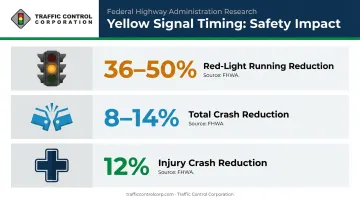
FHWA data shows that appropriately timed yellow intervals are associated with 36–50% less red-light running, 8–14% fewer total crashes, and 12% fewer injury crashes. That's a significant safety return from a relatively straightforward engineering adjustment. It's also entirely within agency control.
Signal Malfunctions and Outages
A dark signal intersection is a genuinely dangerous place. When signal heads fail — whether from power outages, controller errors, burned-out modules, or damaged detection sensors — drivers lose the right-of-way communication they depend on.
A NYSDOT study identified 310 crashes specifically linked to dark signals over a five-year period, with 77.7% classified as right-angle crashes. Dark intersections default to all-way stop rules under most state laws, but drivers often don't recognize or follow this convention correctly, particularly at high-speed approaches.
The equipment failures most likely to produce dark or erratic signals include:
- Burned-out signal heads or LED module failures
- Controller resets or communication errors
- Power outages (storms, utility failures)
- Detection sensor failures that disrupt signal actuation
What Happens When Traffic Light Crashes Are Left Unaddressed
Repeated crashes at the same intersection without intervention follow a consistent pattern: injuries, then fatalities, then media coverage, public pressure, and eventually legal exposure for the municipality.
The financial scale is significant. U.S. intersection crashes cost more than $40 billion annually in medical, legal, emergency, and property-related expenses.
When agencies have documented notice of a dangerous condition — through crash reports, maintenance logs, or driver complaints — and fail to act within a reasonable timeframe, that notice can become the basis for liability claims.
Warning Signs of High-Risk Signalized Intersections
Many dangerous intersections show predictable warning patterns before a fatal crash occurs. Agencies that track these patterns can act before a serious injury or fatality forces their hand.
Watch for:
- Repeated near-miss incidents or minor angle/rear-end collisions at the same location
- Driver complaints about confusing signal phasing, poor visibility, or unusually short yellow intervals
- Maintenance logs showing recurring sensor failures, controller resets, or communication errors at a specific location
- Observed driver behaviors such as frequent late stops, aggressive acceleration through yellow, or wrong-way movements
How to Prevent Traffic Light Crashes
Effective prevention combines enforcement technology, signal engineering, equipment reliability, and intersection design. No single intervention covers everything. The agencies that see the best results layer multiple strategies.
Install Red Light Enforcement and Detection Technology
Automated red-light cameras and video detection systems serve two purposes simultaneously: deterring violations and generating data that engineers can use to understand crash patterns and identify peak risk periods.
The numbers support this approach:
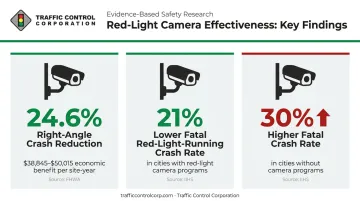
- FHWA's evaluation of 132 treatment sites found red-light cameras reduced right-angle crashes by 24.6%, with an economic benefit of $38,845–$50,015 per treated site-year
- Cities with camera programs had a 21% lower fatal red-light-running crash rate, per IIHS
- In 14 cities that discontinued programs, the fatal crash rate was 30% higher than projected if cameras had remained
One important caveat: cameras increase rear-end crashes at some locations (by roughly 14.9% in FHWA's study), so agencies should evaluate severity and economic effects, not just total crash counts.
Modern video detection and radar sensors extend this capability beyond enforcement. TCC distributes vehicle detection and signal control solutions from manufacturers like Image Sensing Systems and Econolite — including the Autoscope® OptiVu AI video detection system and the EPIQ RADAR™, which supports dilemma zone detection and red-light monitoring at the approach level.
Optimize Signal Timing Plans
Updating signal timing plans is one of the most cost-effective safety interventions available. Improving yellow phase durations and adding or extending all-red clearance intervals directly reduces the window where conflicting movements can occur.
When to update timing plans:
- After identifying a crash cluster at a specific intersection
- Following significant changes to traffic volumes or lane configurations
- As part of a periodic system-wide review (FHWA recommends every 3–5 years, with performance monitoring every 6–36 months where automated data is available)
Agencies using Econolite's Centracs® Signal Performance Measures platform — available through TCC — can monitor signal performance on a continuous basis rather than waiting for a scheduled review cycle, enabling earlier detection of timing degradation.
Establish a Proactive Signal Maintenance Program
Reactive maintenance — fixing equipment only after it fails — leaves intersections exposed. A preventive inspection schedule that covers signal heads, controllers, communications equipment, and detection systems catches failures before they create dangerous dark or malfunctioning signals.
FHWA's staffing model allocates 60 labor-hours per signal annually, including:
| Maintenance Type | Annual Hours |
|---|---|
| Preventive maintenance | 42 hours |
| Response maintenance | 15 hours |
| Design maintenance | 3 hours |
FHWA also sets a target of ≥95% accurate detector operation and critical-failure response times of 1 hour during business hours, 2 hours otherwise.
Maintenance logs do double duty: they catch problems early and create an audit trail that protects agencies from liability by demonstrating due diligence. TCC's annual MMU conflict monitor testing and certification — mandatory safety testing on Malfunction Management Units — is one example of how structured maintenance programs formalize this protection.
Improve Intersection Visibility and Geometry
Physical design factors amplify the consequences of driver error. Blocked sight lines (vegetation, signage, parked vehicles), poor street lighting, and confusing lane geometry all increase the probability that a mistake becomes a crash.
Targeted visibility improvements with documented safety effects include:
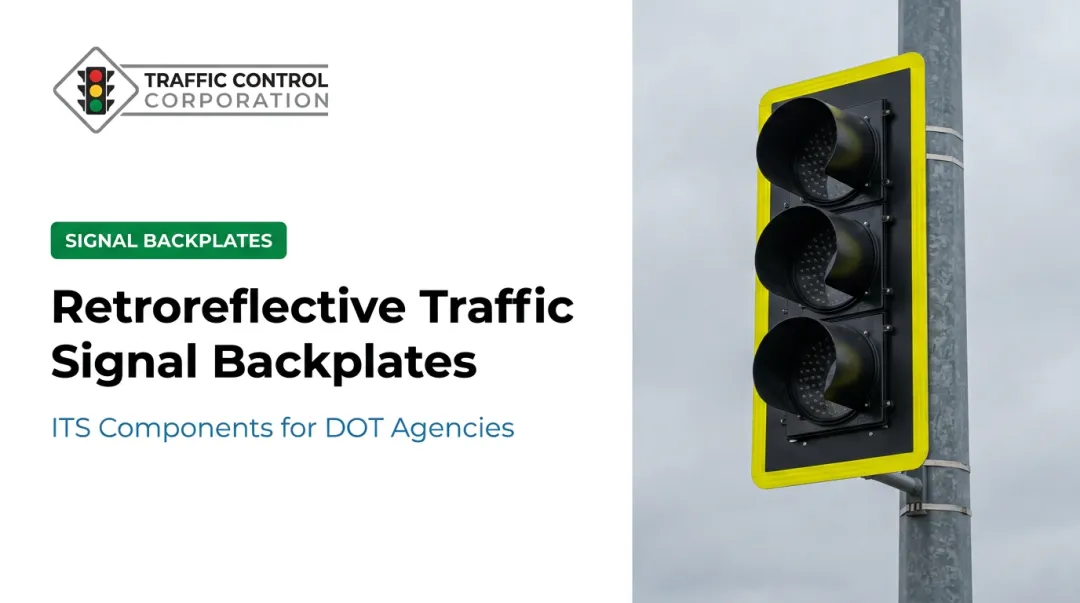
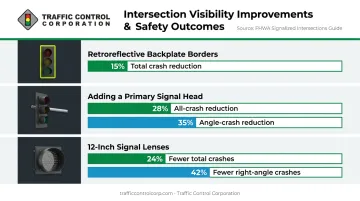
- Retroreflective backplate borders (1–3 inch yellow): Estimated 15% reduction in total crashes (FHWA)
- Adding a primary signal head: Estimated 28% reduction in all crashes, 35% in angle crashes (FHWA Signalized Intersections Guide)
- 12-inch signal lenses: Associated with 24% fewer total crashes and 42% fewer right-angle crashes
Each of these upgrades carries a well-established safety case, and the cost is modest relative to the liability exposure of a fatal crash. Coordination between traffic engineers and public works is typically required to move them forward.
Tips for Long-Term Prevention and Control
Sustained intersection safety improvement requires consistent operational discipline — not one-time fixes.
- Analyze intersection crash reports annually to identify emerging hotspots before they reach critical thresholds — don't wait for a fatality to confirm a pattern that minor crashes already indicated.
- Train field staff to rapidly diagnose controller, sensor, and communication failures; factory-trained technicians reduce the window of equipment-related crash exposure. TCC delivers training at their Woodridge, Illinois facility and on-site at agency locations, covering NEMA TS2 wiring, detection systems, and controller programming.
- Deploy adaptive signal control systems that respond to real-time traffic conditions to reduce conflict points and improve intersection flow. TCC's Econolite portfolio — Cobalt® controller, Centracs® ATMS, and EVO RADAR — supports this kind of modernization across Midwest agency networks.
- Maintain detailed maintenance histories, timing plan change logs, and incident reports for every signalized intersection to support safety analysis and provide liability defense when crashes occur.
Conclusion
Traffic light crashes have identifiable causes — red-light running, distracted and impaired driving, timing miscalibration, equipment failures, and poor intersection design. None of these are inevitable, and most are addressable with the right tools and operational discipline.
Proactive investment in signal technology, structured maintenance programs, and regular engineering review produces measurable results: fewer crashes, lower liability exposure, and safer intersections for the people who use them every day.
Achieving those results depends on having the right equipment partner behind you. TCC has served Midwest transportation agencies for over 75 years, with coverage across Illinois, Indiana, Iowa, Kansas, Michigan, Minnesota, Missouri, Nebraska, North Dakota, South Dakota, and Wisconsin.
That experience translates into practical support: detection systems, signal controllers, conflict monitors, backup power solutions, and field service capabilities that intersection safety programs depend on.
Frequently Asked Questions
Is the person who gets rear-ended ever at fault?
The rear driver is typically at fault, but the front driver can share liability for cutting off another vehicle, braking suddenly without cause, or having non-functioning brake lights. Most states treat rear-end fault as a rebuttable presumption — evidence and context determine the final outcome.
What are 90% of accidents caused by?
NHTSA's crash causation study assigned the critical reason to the driver in an estimated 94% of crashes — primarily distraction, impairment, speeding, and signal violations. NHTSA notes this isn't the same as assigning blame; infrastructure design and signal reliability also affect whether human errors result in collisions.
What is a light car crash called?
Minor low-speed crashes are commonly called "fender benders." Many transportation agencies and safety organizations — including NHTSA — now prefer the term "crash" or "collision" over "accident," since the terminology reflects that most incidents result from preventable factors rather than unavoidable events.
What should transportation agencies do immediately after a traffic light crash occurs at an intersection?
Immediately secure crash data and equipment malfunction logs, then pull signal controller records to check for timing anomalies or failures at the time of the crash. Flag the intersection for an engineering review and document the full response timeline — for both safety analysis and liability purposes.
How do traffic signal malfunctions contribute to intersection crashes?
Failed signal heads, sensor errors, and controller malfunctions eliminate right-of-way communication entirely. When drivers entering from different directions receive no clear indication, dark-signal crashes skew heavily toward right-angle collisions — the most severe crash type.
How does signal timing affect crash risk at intersections?
Inadequate yellow clearance intervals, absent all-red phases, or outdated timing plans that don't reflect current traffic volumes all create windows where conflicting movements are more likely. FHWA data shows properly timed yellow intervals reduce red-light running by 36–50% and total crashes by 8–14%, making timing optimization one of the highest-return safety interventions available.