Introduction
The U.S. has more than 330,000 traffic signals operating across its road network, according to the Institute of Transportation Engineers. What happens inside each signal controller cabinet determines whether an intersection moves traffic efficiently or creates a bottleneck. From the road, these systems look simple. Behind the cabinet door, they're a tightly coordinated combination of timing logic, detection inputs, and communication hardware.
The consequences of misconfigured or neglected systems are measurable. FHWA reports that outdated signal timing accounts for more than 10% of delay and congestion on major routes — and about one-third of intersection fatalities occur at signalized intersections.
This guide covers:
- How traffic lights are controlled and the mechanisms behind each approach
- How to set up a control system from scratch
- The timing parameters that most affect performance
- How to troubleshoot the most common signal failures
Key Takeaways
- Signal controllers trigger phase changes using fixed schedules, real-time detection, or predictive algorithms.
- Control methods range from pre-timed to fully adaptive — and the right choice depends on traffic variability, not just volume.
- Cycle length, green splits, detector sensitivity, and offset are the parameters that most directly affect intersection performance.
- Most signal failures trace back to detector malfunctions, outdated timing plans, or poor pre-activation testing.
- Setup requires a sequenced approach: traffic study, equipment selection, detection calibration, and field validation before go-live.
How Traffic Lights Are Controlled: Methods and Mechanisms
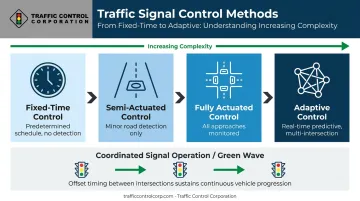
Every signalized intersection is governed by a traffic signal controller — a computerized unit housed in a roadside cabinet — which determines when each phase activates and for how long. There are four main control approaches, each suited to different traffic conditions.
Fixed-Time (Pre-Timed) Control
Fixed-time controllers run on a set schedule: each phase receives a predetermined duration regardless of actual traffic volume. This makes them predictable and easy to maintain, but completely inflexible.
Pre-timed control works well where demand is stable and consistent — tightly spaced urban grids, for example, where signal progression matters more than real-time response to individual vehicle arrivals.
Actuated Signal Control
Actuated systems use vehicle detectors to adjust phase durations in real time. There are two configurations:
- Semi-actuated: Only minor road approaches have detectors; the main road defaults to green and only changes when a side-street call is placed.
- Fully actuated: All approaches are monitored; timing adjusts dynamically based on detected demand at every movement.
Fully actuated control reduces unnecessary wait time on low-volume approaches and is the most common configuration at suburban intersections with variable demand patterns.
Adaptive Traffic Control
Adaptive systems go further: they use real-time data, predictive algorithms, and network-wide coordination to continuously modify timing plans across multiple intersections simultaneously. Systems like SCOOT and SCATS are deployed in large urban networks.
Performance results vary by deployment. A Caltrans review found 7%–32% travel-time improvement in Oakland County, Michigan with SCATS, while some deployments — including OPAC in Reston, Virginia — showed no meaningful improvement.
Adaptive control requires substantial investment in detection infrastructure, communications, software, and ongoing calibration. It's not an automatic upgrade over well-maintained actuated control.
Coordinated Control and the Green Wave
Multiple intersections can be linked through a master controller to create signal progression, known as a "green wave," that allows vehicle platoons to travel through a corridor without stopping. This requires:
- A common cycle length across all signals in the corridor
- Calculated offsets between intersections that account for expected travel speed and distance
FHWA identifies cycle length, offset, and split as the three fundamental parameters for coordinated systems. These parameters are interdependent — get the offsets wrong, and vehicles arrive on red despite perfect individual timing plans.
Step-by-Step: How to Set Up and Manage a Traffic Signal Control System
Setting up traffic light control is not plug-and-play. It requires a sequenced approach — skipping steps creates performance problems and safety liability.
Step 1: Conduct a Traffic Study and Intersection Assessment
Before any hardware decisions are made, collect:
- Turning movement counts for each approach
- Peak-hour volumes (AM, midday, and PM peaks)
- Pedestrian crossing demand
- Approach speeds and sight distance
This data drives every subsequent decision about control type and timing. It also determines whether a traffic signal is warranted at all.
The MUTCD 11th Edition (December 2023) lists nine signal warrants in Chapter 4C — covering vehicular volume, pedestrian volume, crash experience, school crossings, and more. Meeting a warrant doesn't automatically require installation; it requires engineering judgment.
Step 2: Select the Control Type and Configure the Controller
Traffic study results determine whether fixed-time, actuated, or adaptive control fits the location. Controller configuration then involves:
- Programming phase sequences
- Setting minimum and maximum green intervals
- Defining pedestrian WALK and clearance intervals
- Establishing timing plans for AM peak, PM peak, off-peak, and overnight periods
Agencies in TCC's Midwest territory frequently deploy Econolite controllers — including the ASC/3® (NEMA platform) for fixed-time and actuated applications and the Cobalt® for actuated and adaptive deployments integrated with Centracs® ATMS.
Step 3: Install and Calibrate Detection Equipment
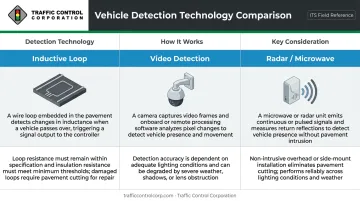
Three main detection technologies are used in actuated and adaptive systems:
| Technology | How It Works | Key Consideration |
|---|---|---|
| Inductive loop | Pavement loop senses vehicle-induced inductance change | Verify continuity, resistance < 1 ohm/1,000 ft, insulation > 100 megohms before sealing |
| Video detection | Camera analyzes defined detection zones | Performance depends on lighting, weather, and camera stability |
| Radar/microwave | Reflected microwave energy identifies vehicles | Non-intrusive installation; capability varies by mounting and radar type |
Sensitivity settings must cover all approach lanes. Extension time must reflect approach speed — a setting calibrated for 35 mph will miss vehicles or generate false calls at 55 mph.
Step 4: Test the System and Validate Timing Plans
Field commissioning requires systematic verification before the intersection handles live traffic. Technicians should confirm:
- Conflict monitor unit (CMU/MMU) function and fault response
- All phase outputs activate correctly
- Pedestrian pushbutton activation triggers appropriate intervals
- The system enters flash mode on a CMU fault
Timing plans should then be observed in the field during actual peak periods — not just in a simulation. Queue lengths and delay on each approach tell you whether splits are calibrated correctly before the intersection is commissioned.
When agencies need outside support for this phase, TCC's Certified Traffic Signal Turn-On Service deploys factory-trained technicians to handle detection calibration, MMU certification, controller programming verification, and EVP system validation before any intersection goes live.
What You Need Before Setting Up Traffic Light Control
Preparation determines whether a signal system performs reliably from day one. Skipping steps in the planning phase leads to field corrections that are far more expensive than front-end planning.
Site and Data Requirements
Before procurement begins, have the following in hand:
- Intersection geometry and lane configurations
- Approach grades and sight distance assessments
- Existing utility locations — utility conflicts are a leading cause of installation delays
- Signal warrant documentation confirming the intersection qualifies
Equipment and System Components
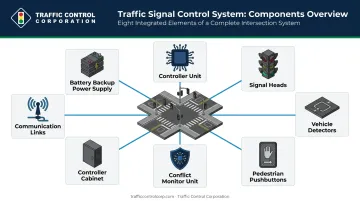
A complete traffic signal control system requires:
- Traffic signal controller unit
- Signal heads (vehicle and pedestrian)
- Vehicle detector systems
- Pedestrian pushbuttons
- Conflict monitor unit (CMU/MMU)
- Controller cabinet
- Communication links (wired or wireless)
- Power supply with battery backup capability
Agencies that source from a multi-manufacturer distributor have more flexibility to match the right components to each intersection's specific requirements. TCC distributes from over 40 manufacturers — including Econolite, Alpha Technologies, EDI/Reno A&E, and Intuicom — rather than locking agencies into a single-vendor configuration.
Compliance and Approval Requirements
- MUTCD 11th Edition governs signal design, operation, and indication requirements across the U.S.
- NEMA TS 2-2021 sets the hardware standard for controller assemblies, MMUs, and cabinet interfaces
- State DOT approval is required before installation on state or federal routes; processes vary by jurisdiction — TxDOT approval runs through the district engineer, while Ohio DOT approval covers state/federal routes through villages
Failure to meet warrant criteria or follow MUTCD guidance creates liability for agencies if an unwarranted signal contributes to a crash.
Key Parameters That Affect Traffic Signal Timing
Even a well-installed system fails to perform if timing parameters are configured incorrectly. These four variables have the greatest impact on intersection efficiency.
Cycle Length
Cycle length is the total time for all phases to complete one sequence. FHWA's Timing Manual notes that shorter cycles generally reduce delay, while longer cycles add only marginal capacity — increasing a cycle from 120 to 180 seconds adds roughly 2% theoretical capacity while significantly increasing pedestrian and side-street wait times. Cycle length must balance capacity needs with pedestrian crossing requirements, which can constrain the minimum feasible cycle.
Phase Timing (Green Splits)
Green splits determine how available green time is allocated across competing movements. Imbalanced splits — too much green to a low-volume approach, too little to a high-volume one — directly cause queue buildup and unnecessary delay.
Splits must be re-evaluated:
- Seasonally at locations with significant demand variation
- After land use changes near the intersection
- After major roadway modifications
- Every 3–5 years at minimum per FHWA guidance, or sooner when demand conditions change materially
Detection Sensitivity and Extension Time
Vehicle detection triggers a phase extension when a vehicle is present in an approach. Extension settings that are too sensitive produce false calls (giving green to empty lanes); settings too low cause missed detections (holding red unnecessarily on occupied approaches).
Passage time — the maximum allowed gap between actuations before a phase gaps out — must reflect the approach speed and detection zone length. On high-speed approaches, standard extension settings are typically insufficient and require site-specific adjustment.
Offset (for Coordinated Systems)
Offset is the time relationship between a local signal's phase reference and the master cycle clock. A miscalculated offset breaks the green wave and forces vehicles to stop at every intersection in a corridor, regardless of how well each individual signal is timed.
Offset selection must account for actual travel speed between signals, distance, volumes, and directional priority — not just the speed limit. not just the speed limit. Getting these four parameters right — cycle length, splits, detection, and offset — is what separates a functional signal from one that actively moves traffic.
Common Mistakes in Traffic Light Control
Most signal performance failures are preventable. These four mistakes show up consistently across agencies managing signalized intersections:
- Running outdated fixed-time plans: FHWA guidance calls for timing reviews every 3–5 years. Plans left past that threshold produce measurable delay increases as traffic patterns shift away from when the timing was set.
- Detector miscalibration or improper placement: Missed detections cause unnecessary red holds; false calls give green time to empty lanes. Either condition degrades throughput and erodes driver confidence.
- Skipping CMU testing after controller replacement: The CMU prevents simultaneous conflicting greens — assuming it functions correctly after a cabinet swap, without verifying, creates direct safety liability.
- Single timing plan running 24/7: At minimum, intersections need separate AM peak, PM peak, off-peak, and overnight plans. A PM-optimized plan will underperform — and may actively fail — during other periods.
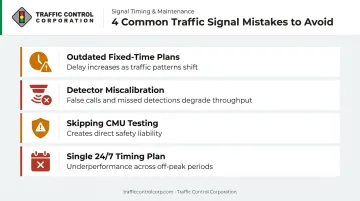
Each of these mistakes compounds over time. Catching them early through routine audits and scheduled timing reviews prevents the kind of performance degradation that's expensive to diagnose and politically difficult to explain.
Troubleshooting Common Traffic Signal Issues
Signal problems rarely announce themselves clearly — they show up as complaints, near-misses, or failed audits. The three scenarios below cover the most common failure modes, along with where to start your diagnosis.
Problem: Signal Stuck in One Phase or Failing to Serve a Minor Approach
Likely cause: Vehicle detector failure — broken loop wire, degraded inductance, or camera obstruction — resulting in no call being placed for that phase.
What to check:
- Inspect detector amplifier readings in the controller cabinet
- Verify loop continuity and inductance if inductive loops are used
- Confirm camera field of view is unobstructed for video detection systems
- Manually place a call to verify the phase outputs correctly
Problem: Intersection Enters Flash Mode Unexpectedly
Likely cause: CMU fault triggered by a conflicting output — often caused by a power surge, damaged wiring, or controller software error — or loss of primary power.
What to check:
- Review CMU fault logs for conflict, red-fail, voltage, or clearance faults
- Inspect the cabinet for electrical damage or moisture intrusion
- Verify power supply and battery backup status
- Reset only after identifying and resolving the root cause
When individual intersections check out but the corridor still underperforms, the problem is usually systemic rather than hardware-based.
Problem: Coordinated Corridor Performing Poorly Despite Correct Individual Timing Plans
Likely cause: Offset miscalculation, controller clock drift causing signals to fall out of sync, or congestion breaking up platoons faster than the timing plan anticipates.
What to check:
- Verify all controllers in the corridor share the same time reference
- Re-check offset values against actual measured travel times between intersections
- Review detector data to confirm actual vehicle speeds match the design speed assumption used in offset calculations
Conclusion
Effective traffic light control requires matching the right method to the intersection's actual traffic characteristics, configuring timing parameters with precision, and treating signal management as an ongoing process — not a one-time installation. Most performance failures trace back to skipped detection calibration, timing plans that haven't been updated in years, or inadequate testing before commissioning.
TCC has supported transportation agencies across the Midwest since 1946, giving agencies direct access to factory-trained field staff who can diagnose and resolve these issues fast. That support covers the full range of equipment agencies rely on:
- Controllers and cabinets: Econolite NEMA, 2070, and ATC platforms
- Backup power: Alpha Technologies UPS systems and batteries
- Safety and detection: EDI conflict monitors, Intuicom wireless interconnects, and video/radar detection
Whether you need equipment, field services, or hands-on technical expertise, TCC provides the resources to keep intersections operating safely and efficiently.
Frequently Asked Questions
How are traffic lights controlled?
Traffic lights are controlled by a signal controller unit in a roadside cabinet, which triggers phase changes based on pre-set timing schedules (fixed-time), real-time vehicle detection inputs (actuated), or predictive algorithms (adaptive). The control method deployed depends on the intersection's traffic volume, variability, and available infrastructure.
What are the lights called that control traffic?
The signal devices themselves are called traffic signal heads. The governing hardware is the traffic signal controller. The broader system — including detectors, communication links, cabinets, and software — is referred to as the traffic signal control system or traffic light control system.
What is signal preemption and how does it work?
Signal preemption interrupts the normal signal cycle to give priority to emergency vehicles or trains. It's typically triggered by an optical or radio emitter on the vehicle. The intersection's receiver detects the signal and commands the controller to clear the intersection before the emergency vehicle arrives.
Can traffic lights be controlled remotely?
Yes. Modern traffic signal systems connected to a central management platform (such as Econolite's Centracs® ATMS) can be monitored and adjusted remotely, allowing engineers to update timing plans, respond to incidents, or troubleshoot faults without a field visit.
How long does a standard traffic light cycle take?
Cycle length varies based on intersection size, traffic volume, and number of phases. The FHWA provides guidance rather than fixed national ranges; in practice, most intersections run cycles between 60 and 120 seconds. Actuated systems adjust cycle length in real time based on detected demand.
What happens to traffic lights during a power outage?
Most modern systems with battery backup either continue full operation for a limited duration or enter flashing red mode, treating the intersection as an all-way stop. Without backup power, the signal goes dark and drivers must treat it as an all-way stop per applicable state law.