Key Takeaways
- PIR sensors detect infrared radiation passively — they receive energy emitted by objects, never emit any themselves
- Differential dual-element design is what enables motion detection by canceling uniform background shifts
- PIR trades data richness for simplicity: no speed measurement, no object classification, no stationary-target detection
- Mounting orientation is critical: lateral movement across detection zones is required for reliable triggering
What Is Passive Infrared Detection and How Does It Work?
A PIR sensor is an electronic device that measures infrared radiation emitted by objects within its field of view. "Passive" is the operative word: the sensor emits no energy of its own. It only receives.
The Physics Behind It
Every object above absolute zero emits electromagnetic radiation. At the temperatures typical of humans, vehicles, and pavement, that radiation falls in the infrared spectrum — invisible to the human eye but detectable by the right sensing material. FHWA's Traffic Detector Handbook identifies the 8–14 micrometer long-wave infrared band as the operating range for traffic PIR sensors, chosen specifically to reduce interference from sun glint and visible-light variation.
That 8–14 μm range is the detection band the sensor is tuned to — not a claim that humans and vehicles emit exclusively within that range. The sensor is optimized for it.
Motion Detection, Not Heat Detection
PIR sensors don't measure static temperature — they detect changes in infrared flux as a warm object moves through the detection zone. A pedestrian crossing from cooler pavement into the sensor's field creates a thermal transition that triggers a response. Once that pedestrian stops moving, the flux change stops too, and the sensor eventually stops detecting.
Differential (Dual-Element) Design
The pyroelectric element inside the sensor is split into two halves, wired as opposing inputs to a differential amplifier:
- No motion present: Both halves register equal IR levels; signals cancel out, output stays quiet
- Motion detected: One half receives more IR than the other; the imbalance produces a signal that triggers output
This design is deliberate. A slow, uniform temperature rise — an approaching thunderstorm, a warming morning — affects both halves equally and cancels out. Only spatially asymmetric change, meaning something actually moving through the field, registers as a detection event.
The differential output is amplified, conditioned through onboard electronics, and converted to a clean digital pulse (high/low) that interfaces directly with traffic signal controllers and detection input channels.
Key Components of a PIR Sensor
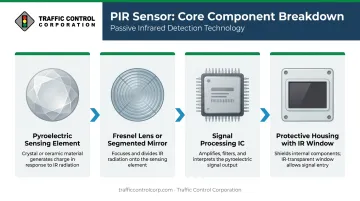
Four physical components define how any PIR sensor performs:
- Pyroelectric sensing element — A crystal or ceramic material (lithium tantalate, LiTaO₃, is one documented option used in commercial detectors) that generates a small voltage when IR flux changes across it
- Fresnel lens or segmented parabolic mirror — Concentrates incoming infrared energy onto the small sensing element and defines the detection zone pattern; as Murata explains, multiple lens sections create discrete detection areas rather than a single continuous cone
- Signal processing IC — Amplifies and interprets the differential signal, applying threshold logic before producing output
- Protective housing with IR-transparent window — Blocks dust, moisture, and insects while allowing IR to pass through; contamination on this window is a common field performance issue
Detection Zones and Beam Patterns
The Fresnel lens or mirror doesn't create a smooth, continuous detection cone. It creates a structured field of discrete sensitivity zones. A target moving through these zones generates a rapidly alternating signal (present, absent, present, absent) that the processing IC reads as a confirmed detection event.
This architecture has a direct implication for installation. Panasonic's PIR motion sensor documentation explicitly recommends arranging the field so targets move across detection zones rather than directly toward the sensor. Head-on approach compresses the zone transitions and weakens the signal.
Adjustable Parameters
Most PIR modules include three user-configurable parameters:
- Sensitivity threshold — Controls how large an IR differential triggers output; tune this to match seasonal thermal contrast conditions in the field
- Time delay — How long the output stays active after the last detection event; in traffic applications, this is the difference between a pedestrian hold that clears promptly and one that unnecessarily extends a phase
- Segment masking — Some models allow portions of the detection zone to be blocked, useful for excluding HVAC vents or other heat sources from the coverage area
PIR Sensors vs. Other Traffic Detection Technologies
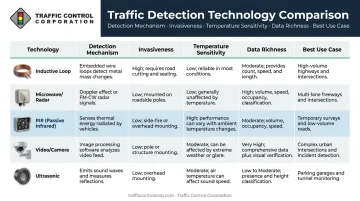
Traffic engineers selecting detection for intersections, crosswalks, or advance detection zones routinely weigh PIR against four other technologies. Each has a legitimate role. The question is fit.
| Technology | Detection Mechanism | Invasiveness | Extreme Temps | Data Richness | Best-Fit Use Case |
|---|---|---|---|---|---|
| Inductive Loop | Electromagnetic inductance change | High (pavement cuts) | Resistant | Volume, presence, occupancy, speed | High-volume arterials, permanent installations |
| Microwave/Radar | Active RF emission and return | Low (above-ground) | Resistant | Speed, volume, presence, length | Advance detection, high-speed approaches |
| Video/Camera | Image processing | Low (above-ground) | Moderate (glare, snow affect image) | Highest (counts, classification, queue) | Full intersection management, classification |
| Ultrasonic | Sound wave reflection | Low | Sensitive to air turbulence | Presence, distance | Close-range presence detection |
| PIR | Passive IR reception | Low (above-ground) | Sensitive (thermal contrast-dependent) | Limited (motion/presence only) | Pedestrian detection, low-volume side streets |
PIR vs. Inductive Loops
Loops are proven for vehicle detection and weather-resistant, but they require cutting into pavement — costly, disruptive, and vulnerable to road wear and freeze-thaw damage. PIR sensors install above ground with no pavement disturbance.
The trade-off is thermal sensitivity: loops perform reliably in summer heat, while PIR performance degrades when the temperature difference between vehicle and pavement shrinks.
PIR vs. Microwave/Radar
Where PIR depends on thermal contrast, microwave sensors actively emit energy and detect speed, presence, and range regardless of ambient temperature. That distinction matters on hot summer days, when ambient temperatures approach vehicle surface temperatures and PIR detection reliability drops.
For high-speed advance detection, microwave is the stronger choice. PIR suits lower-speed presence detection where cost and simplicity take priority.
PIR vs. Video Detection
Video detection offers the richest data set (counts, classification, queue length, pedestrian presence), but it comes with real overhead: lighting requirements, camera hardware, image processing infrastructure, and ongoing calibration.
PIR functions in complete darkness with no camera hardware. That makes it well-suited for pedestrian push-button confirmation and simple presence detection where video's infrastructure cost isn't justified.
Advantages and Limitations of PIR Detection
Advantages
- Extremely low power draw — Panasonic's low-current PaPIRs series specifies 1 μA current consumption, making PIR viable for battery or solar operation at remote or temporary sites
- No emitted radiation — Safe, passive, creates no RF interference with nearby equipment
- Low cost — Significantly less expensive than radar or video systems for simple presence detection tasks
- Effective in zero light — Unlike cameras, PIR doesn't care whether it's noon or midnight
- Simple digital output — High/low pulse integrates directly with NEMA TS1/TS2 and ATC controller detection inputs without complex processing hardware
Limitations
These limitations aren't edge cases — they're operational realities practitioners must plan around:
- Thermal contrast dependency: Detection degrades when ambient temperature approaches the target's surface temperature. Hot summer pavement is the most common culprit in traffic deployments.
- HVAC exhausts, direct sunlight, headlights through windows, animals, and heat-radiating equipment can all trigger false detections. Placement is the primary mitigation.
- PIR tells you something moved — not how fast, how many, or what type. It provides no speed or classification data.
- Stationary target limitation: This is the most operationally significant constraint. Standard PIR sensors stop detecting a target once it stops moving. For traffic signal applications where stopped-vehicle detection is required, this is a fundamental gap.
That last point warrants emphasis. FHWA documents an Eltec 842 traffic PIR capable of holding stopped-vehicle presence detection for up to 5 minutes, meaning the limitation isn't absolute across every product. It is product-specific and configuration-dependent, not a given. Radar and FMCW microwave sensors can detect stationary presence without this constraint.
PIR Detection in Traffic Signal and Transportation Applications
Pedestrian Detection at Crosswalks
Pedestrian detection is where PIR earns its clearest use case in traffic applications. The thermal contrast between a walking pedestrian and cooler pavement or air background is typically sufficient for reliable triggering. The 2023 MUTCD explicitly permits passive detection — including infrared — as an activation method for Rectangular Rapid Flashing Beacons (RRFBs) and accessible pedestrian signal systems.
Per MUTCD Section 4K.04, a passive detection system can activate a locator tone while a pedestrian is within a 12-foot radius of a pushbutton location. PIR sensors used in these applications verify pedestrian presence in the crossing zone without requiring button actuation — a real improvement for both accessibility and user convenience.
Vehicle Presence Detection at Low-Volume Approaches
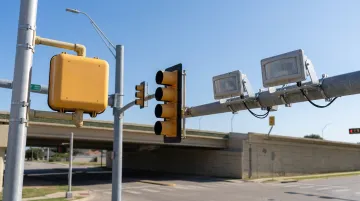
PIR sensors can serve as above-ground alternatives to loop detectors for low-volume side-street approaches. FHWA specifically identifies the Eltec 842 PIR for vehicle presence detection at signalized intersections — calling a phase when a stopped vehicle occupies the detection zone. Installers typically mount these sensors 15–20 feet above the roadway on an overhead mast arm or side pole.
This application suits temporary installations, construction zones, and locations where pavement cuts are impractical. The thermal contrast requirements and stationary-target limitations apply, so this isn't a universal loop replacement.
Solar-Powered and Remote Deployments
PIR's low current consumption makes it genuinely practical for solar-powered field deployments. Yunex Traffic identifies PIR as the technology of choice for solar-powered traffic counting and monitoring systems. For temporary work zone monitoring, remote rural intersections, or any location without reliable grid power, PIR's energy profile gives it a clear edge over radar or video systems.
TCC's Role in PIR Selection and Support
Traffic Control Corporation has distributed traffic signal equipment and ITS solutions across the Midwest for over 75 years. PIR detection sits within TCC's broader detection portfolio alongside video, radar, lidar, loop, and Bluetooth systems.
TCC's factory-trained technical staff support agencies evaluating PIR across their 11-state territory with:
- Product selection and application guidance
- Site-specific configuration recommendations
- Field support and troubleshooting
Because PIR availability and application fit vary by site conditions and regional requirements, TCC handles these inquiries on a consultative basis. Direct engagement with their technical team yields the most accurate product and configuration guidance.
Installation and Configuration Best Practices
Mounting Height, Angle, and Orientation
Mount PIR sensors so targets move laterally across the detection zone, not directly toward or away from the sensor. Head-on approach collapses the zone transitions that generate the differential signal. Lateral crossing maximizes them.
General mounting guidance by application:
- Pedestrian detection: Lower mounting heights that position the zone at pedestrian body height; exact height depends on the coverage area required
- Vehicle detection: FHWA guidance for traffic PIR places sensors 15–20 feet above the roadway for side-street presence detection applications
Placement Rules to Minimize False Triggers
Before finalizing a mounting location, check for:
- HVAC exhaust vents within the detection zone — these generate persistent thermal noise that can saturate the sensor
- Direct sun exposure paths during morning or afternoon hours
- Windows or reflective surfaces that channel vehicle headlights into the sensor's field
- Standing water or snow/ice accumulation potential on the lens surface
- Heat-radiating equipment or animals near the coverage area
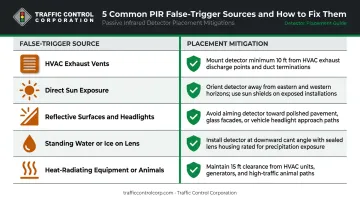
The 2025 National Academies guide identifies low thermal contrast, hot pavement, precipitation, and sunlight glare as the primary error drivers for PIR in traffic settings — most of which are addressable through deliberate placement decisions.
Sensitivity and Timing Adjustments
Addressing placement variables gets you partway there — the rest comes from deliberate parameter tuning at each deployment.
Sensitivity threshold requires seasonal adjustment. Summer conditions reduce vehicle-to-pavement thermal contrast, so higher sensitivity settings are often needed to maintain reliable detection. Don't set it once and walk away.
Time delay (hold time) should match actual use. Pedestrian detection needs shorter hold times than vehicle presence detection — an unnecessarily long hold extends signal phases after the pedestrian has already cleared. Configure this to match actual crossing times at the specific location.
A third parameter worth checking is pulse count or filter setting, where available. Higher pulse counts reduce false triggers from transient heat sources but can slow response time. Calibrate based on the dominant false-trigger source at the site.
Frequently Asked Questions
What is a passive infrared (PIR) detector?
A PIR detector is an electronic sensor that detects infrared radiation naturally emitted by objects in its field of view. It contains no emitter — only a receiver — making it "passive." Most commonly used to detect movement of warm objects like people or vehicles against a cooler background.
What is the difference between infrared and passive infrared?
"Infrared" refers broadly to a band of the electromagnetic spectrum used by many sensor types, including both active and passive systems. "Passive infrared" specifically describes sensors that only receive naturally emitted IR radiation, distinguishing them from active IR systems that project their own beam and measure its reflection or disruption.
What is the difference between a passive and active infrared detection device?
Active infrared devices emit a beam and detect when something disrupts or reflects it — requiring both an emitter and a receiver. Passive infrared devices contain only a receiver and depend entirely on the thermal radiation objects naturally emit. PIR is simpler, lower-cost, and more energy-efficient, but requires sufficient thermal contrast between the target and its background to function reliably.
Can PIR sensors detect stationary vehicles or pedestrians?
Standard PIR sensors respond to changes in infrared flux, so they detect movement. Once a target stops, most PIR sensors will eventually stop detecting it — a critical limitation for traffic signal applications requiring stopped-vehicle detection. Some traffic-grade products, like the Eltec 842, can hold presence detection for up to 5 minutes after a vehicle stops, though this capability is product-specific rather than a universal PIR characteristic.
How far can a passive infrared sensor detect?
Detection range varies significantly by model and lens design. Industrial PIR elements like Panasonic's PaPIRs cover 5–24 meters depending on lens, while outdoor segmented-mirror products from Optex can exceed 30–50 meters. Actual performance in traffic deployments depends on thermal contrast, mounting angle, and ambient temperature, so treat any range figure as product- and context-specific.
What causes false alarms in PIR sensors?
Common false-trigger sources include rapid ambient temperature changes, direct sunlight or vehicle headlight exposure into the sensor's field, HVAC airflow across or near the housing, heat-emitting equipment within the detection zone, and animals moving through the coverage area. Careful placement and appropriate sensitivity calibration address the majority of these issues in most deployments.