Many agencies and logistics teams struggle when evaluating these platforms precisely because the term is so broad. Choosing the wrong category of software wastes budget and creates implementation headaches that take years to untangle.
This guide breaks down what transportation management software actually is, how the two primary categories differ, what features matter most, and how public agencies — including state DOTs, county transportation departments, and municipalities — can select the right platform for their infrastructure needs.
Key Takeaways
- Transportation management software falls into two distinct categories: freight logistics systems and public agency traffic/infrastructure platforms
- Core benefits include reduced operational costs, real-time visibility, data-driven decision-making, and compliance support
- 88% of surveyed freeway-management agencies used a Traffic Management Center in 2023
- Match software to your organization's operational context, not just feature lists, to ensure successful deployment
What Is Transportation Management Software?
Transportation management software is a digital platform that helps organizations plan, execute, monitor, and optimize transportation operations. That definition sounds clean until you realize it covers everything from coordinating a retailer's freight carriers to managing 500 traffic signals across a metro corridor.
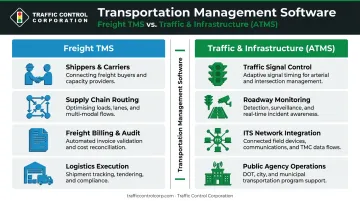
The two primary categories are fundamentally different:
- Transportation Management Systems (TMS) — used by shippers, carriers, and logistics providers to manage freight movement through supply chains
- Traffic and infrastructure management platforms (ATMS) — used by public agencies, DOTs, and municipalities to manage roadway operations, traffic signals, and ITS networks
Transportation Management Systems for Freight and Logistics
Freight-focused TMS platforms handle inbound and outbound shipments, carrier selection, route optimization, and freight billing. Manufacturers, distributors, retailers, e-commerce companies, and third-party logistics (3PL) providers are the primary users.
These platforms are available as cloud-based SaaS solutions or on-premise installations. Cloud deployment has made TMS accessible to organizations that previously couldn't justify the infrastructure investment — Mordor Intelligence reports that cloud deployments accounted for 61.23% of global TMS revenue in 2025, with the market projected to reach $14.89 billion by 2031.
Transportation Management Software for Public Agencies
State DOTs, county transportation departments, and municipal governments use specialized platforms to:
- Oversee traffic signal systems across road networks
- Monitor roadway conditions and manage incidents in real time
- Integrate ITS technologies like adaptive signal control, video detection, and connected vehicle infrastructure
This category includes Advanced Traffic Management Systems (ATMS), signal management platforms, and ITS integration software — tools built for operational control centers, not supply chain coordination. FHWA defines Traffic Management Centers as the operational hub of freeway-management systems — the point where field data, incident reports, and signal status converge into active roadway decisions.
Key Features of Transportation Management Software
Planning and Route Optimization
Transportation management software provides planning tools to determine optimal routes, modes, and resource allocation. For freight TMS, this means carrier selection and load optimization. For agency platforms, it means signal timing plans, corridor management, and adaptive control strategies that reduce travel time and fuel consumption across a network.
Real-Time Tracking and Visibility
Real-time monitoring looks different across the two categories:
- Freight TMS: tracks shipment location, carrier status, and estimated delivery windows
- Agency platforms: monitors live traffic conditions, signal status, incident alerts, and detector feeds from CCTV cameras and roadside sensors
Both provide the operational awareness needed to respond to disruptions before they compound.
Data Analytics and Reporting
Built-in dashboards surface performance metrics, cost trends, compliance status, and throughput data in one place. For public agencies, this includes signal performance measures (SPM) — continuous analytics that replace manual data collection and drive performance-based signal re-timing.
Econolite's Centracs® SPM, distributed by Traffic Control Corporation (TCC) across the Midwest, was developed specifically in support of the FHWA's Every Day Counts program. It enables traffic engineers to monitor and re-optimize signals continuously, rather than waiting for the USDOT-recommended cycle of every three to seven years.
Integration with Other Systems
Transportation management software doesn't operate in isolation:
- Freight TMS integrates with ERP and Warehouse Management Systems (WMS) to align fulfillment, loading, and carrier planning
- Agency ATMS platforms integrate with ITS field devices — traffic controllers, video detection sensors, dynamic message signs, and CCTV cameras — using standards like NTCIP to enable multi-vendor interoperability
NTCIP compliance means agencies aren't locked into a single vendor — equipment from different manufacturers can communicate through a shared protocol, which matters when upgrading infrastructure piece by piece over time.
Document and Compliance Management
Automated documentation reduces human error and missed requirements:
- Freight applications: shipping records, customs documentation, delivery confirmations
- Public infrastructure platforms: maintenance records, performance target reporting under 23 CFR Part 490, and federally required documentation for MAP-21 compliance
Software supports the audit trail — but legal responsibility remains with the agency or organization.
Benefits of Transportation Management Software
Cost Reduction and Operational Efficiency
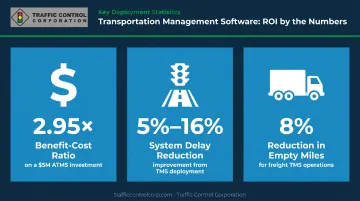
USDOT modeling of one ATMS software and ITS-hardware upgrade estimated a 2.95 benefit-cost ratio on a $5 million investment. Combined traffic management strategies — ramp metering, variable speed limits, and hard-shoulder running — improved modeled system delay by 5% to 16% in recurring-congestion scenarios.
On the freight side, one documented TMS deployment reduced empty miles by 8% and total miles by 7.7% — meaningful gains for any high-volume shipper.
Improved Visibility and Decision-Making
Real-time data access turns reactive operations into proactive ones. Agencies can identify bottlenecks, reroute around disruptions, and deploy resources more strategically when they have a live view of their entire network.
USDOT's incident-response evidence shows that one deployment improved average notification time by 12 minutes, while a next-generation TIM deployment achieved a 32% reduction in incident-clearance time. Faster clearance means faster traffic restoration — and measurable safety improvements.
Enhanced Compliance and Documentation Accuracy
Automated documentation tools reduce the risk of missed regulatory requirements or delayed paperwork. For public agencies managing federally funded infrastructure, this matters: performance target reporting under 23 CFR Part 490 requires specific data, timelines, and documentation that manual processes struggle to maintain consistently.
Key areas where TMS documentation support is most valuable:
- Performance reporting — structured data collection aligned to 23 CFR Part 490 requirements
- Incident logs — timestamped records that support after-action reviews and liability documentation
- Asset records — maintenance histories and inspection logs tied to individual field devices
Better Community and Customer Outcomes
Improved delivery accuracy and real-time tracking give freight operators a concrete edge with customers — fewer missed windows, fewer status calls, more repeat business. For public agencies, better-managed traffic flow and faster incident response reduce delays and improve safety outcomes for drivers and pedestrians alike. When software performs well, communities notice.
Who Uses Transportation Management Software?
Freight TMS Users
- Manufacturers and distributors managing inbound and outbound shipments
- Retailers and e-commerce companies with high-volume logistics needs
- Third-party logistics (3PL) providers coordinating on behalf of multiple clients
Traffic and Infrastructure Management Software Users
- State Departments of Transportation (DOTs)
- County and municipal transportation departments
- Regional planning agencies and traffic operations centers
Contractors and consulting service providers also interact with these platforms, often designing or maintaining transportation infrastructure on behalf of government clients.
TCC's customer base includes this full range of public-sector users. We serve state and local agencies, DOTs, municipal governments, and the contractors who support them across eleven Midwest states.
How to Choose the Right Transportation Management Software
Define Your Operational Needs First
The most common selection mistake is evaluating software before clearly defining what the organization actually needs to manage.
- A freight shipper needs carrier management, freight billing, and route optimization
- A municipal traffic agency needs signal control integration, incident management, and ITS device compatibility
Misidentifying needs at this stage leads to investing in the wrong platform entirely — a costly error that's difficult to reverse.
Evaluate Deployment Options
| Deployment Type | Best For | Trade-offs |
|---|---|---|
| Cloud-based (SaaS) | Smaller agencies, limited IT staff | Lower upfront cost, automatic updates, less data control |
| On-premise | Complex organizations, strict data requirements | Greater control and customization, higher infrastructure cost |
FHWA's 2024 transition guidance notes that moving an on-premise traffic management system to cloud hosting introduces security, privacy, integration, and operational considerations that require careful contract and jurisdiction review.
Assess Vendor and Partner Capabilities
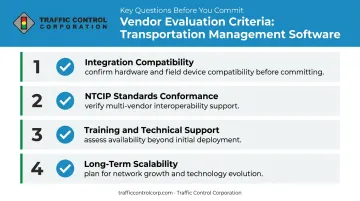
Deployment type determines your infrastructure constraints, but vendor capabilities shape whether the system actually works in the field. Beyond the software itself, evaluate:
- Confirm integration compatibility with existing hardware and field devices before committing
- Verify NTCIP standards conformance for agency deployments requiring multi-vendor interoperability
- Assess training and technical support availability — not just at deployment, but for the life of the system
- Plan for long-term scalability as your network grows or technology evolves
Selecting the right partner alongside the right software reduces procurement risk. TCC has supported Midwest transportation agencies for over 75 years, representing 40+ manufacturers including Econolite and Applied Information.
TCC's advisory service — formally structured as Traffic Signal Equipment Selection Assistance for DOT Specifications — guides agencies in choosing compliant hardware and software aligned with DOT standards. Factory-trained technical staff provide hands-on guidance on how different platforms integrate with existing infrastructure.
Frequently Asked Questions
What is transportation management software?
Transportation management software is a digital platform used to plan, execute, monitor, and optimize transportation operations. It encompasses both freight logistics systems (used by shippers and carriers) and traffic infrastructure management platforms used by public agencies to manage road networks, traffic signals, and ITS.
What is the difference between a TMS and traffic management software?
Freight TMS is used by shippers and logistics providers to manage goods movement through supply chains — covering carrier selection, routing, and freight billing. Traffic management software (ATMS) is used by public agencies to manage road networks, traffic signals, incident response, and ITS field devices.
What features should transportation agencies look for in management software?
Key features for public sector agencies include real-time traffic monitoring, signal control integration, incident management tools, ITS device compatibility (with NTCIP standards support), signal performance measures analytics, and compliance reporting for federal performance management requirements.
What is the difference between cloud-based and on-premise transportation management software?
Cloud-based software is hosted remotely with lower upfront costs and automatic updates. On-premise software is installed on the organization's own servers, offering greater control over data security and customization. Agencies should evaluate security, data residency, and integration requirements before choosing.
How does transportation management software integrate with other systems?
Most platforms integrate through APIs and standardized protocols. Freight TMS connects with ERP and WMS systems; traffic management software integrates with ITS field devices, traffic controllers, video detection sensors, dynamic message signs, and regional traffic networks using standards like NTCIP.
How do municipalities and DOTs benefit from transportation management software?
Key benefits include improved traffic flow, faster incident detection and clearance, and better data for infrastructure investment decisions. Agencies also gain enhanced pedestrian and driver safety, more efficient use of public budgets, and automated compliance reporting for federal performance requirements.