Introduction
Picture an ambulance running lights and sirens through a busy urban corridor. The crew is managing a cardiac arrest patient. Every second counts — and then the vehicle hits a red light. The intersection has no idea an emergency is unfolding. It simply runs its preset cycle, same as always.
This happens daily at thousands of intersections across the U.S. that still operate on fixed-time signal plans: green-light durations set by a schedule written months or years ago, with no awareness of what's actually happening on the road.
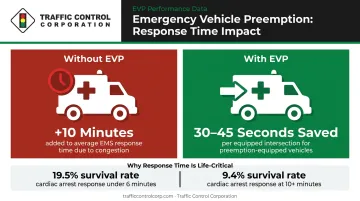
The clinical stakes are real. Research published in the Journal of the American Heart Association found that 30-day survival from witnessed out-of-hospital cardiac arrest was 19.5% with EMS response under six minutes, dropping to 9.4% at ten minutes or longer. Minutes matter. Signal timing affects minutes.
This article covers how smart traffic control systems with ambulance detection work: the sensing technologies used, how intersections respond when an emergency vehicle is detected, and what transportation agencies need to evaluate before deploying these systems.
Key Takeaways
- Fixed-time signals treat every lane identically, regardless of actual vehicle density or approaching emergency vehicles
- IR, acoustic, GPS, RFID, and V2X detection methods each carry distinct trade-offs in range, cost, and reliability
- When a system detects an emergency vehicle, it overrides normal sequencing to clear a path, then automatically restores optimized timing
- Modern EVP and adaptive signal components typically integrate with existing signal cabinets — no full intersection replacement required
- Starting with a single intersection is a proven, low-risk deployment path for agencies new to adaptive systems
Why Fixed-Time Traffic Signals Create Dangerous Delays
The Core Problem with Preset Timing
A fixed-time signal operates on a predetermined cycle. It doesn't know whether ten cars are waiting on the cross street or zero. It allocates green time based on historical averages — useful when traffic is predictable, but a poor fit for urban environments where conditions shift hour by hour.
The result: lanes with two vehicles waiting receive the same green duration as lanes with twenty. Vehicles idle unnecessarily. Intersections become bottlenecks even when they don't need to be.
For emergency vehicles, this limitation becomes a direct safety issue. An ambulance traveling during peak-hour traffic encounters red lights like any other vehicle. The signal controller has no mechanism to recognize the approaching emergency — and no ability to respond to it.
What the Data Shows
Two studies illustrate the scale of the problem:
- A survey of 112 Alabama EMS providers found that congestion added nearly 10 minutes to average response time — self-reported, but consistent with operational realities crews face without signal priority
- A FHWA field study on Fairfax County's U.S. 1 corridor found that emergency vehicle preemption (EVP) systems saved 30 to 45 seconds per equipped intersection — savings that compound across a multi-intersection corridor
Rising vehicle counts have widened the gap between infrastructure capacity and actual demand across most Midwest metros. For municipal transportation planners, adaptive signal control and EVP deployment have shifted from optional upgrades to measurable operational needs.
How Smart Traffic Control Systems Work
Density-Based Signal Timing
Instead of running a preset green-light schedule, smart traffic control systems use vehicle detection sensors positioned at each lane approach to count vehicles in real time. That data feeds continuously to a signal controller, which adjusts green-light duration dynamically based on what's actually present.
The logic is straightforward:
- High-density lanes receive proportionally longer green phases
- Low-density lanes receive shorter ones
- The system continuously re-evaluates conditions rather than cycling through a fixed plan
Detection sensors commonly used in these deployments include:
- Inductive loop detectors — embedded in pavement, reliable for presence and volume detection
- Video detection systems — camera-based with configurable detection zones, no pavement cuts required
- FMCW radar — weather-resilient, detects both moving and stopped vehicles
- Active/passive infrared — effective for close-range detection, sensitive to environmental conditions
FHWA reports that adaptive signal control technology (ASCT) improves travel time, delay, emissions, and fuel consumption by 10% or more on average, with eight Florida corridors recording a 9.36% reduction in travel time in a documented deployment.
The Role of the Signal Controller
The controller is the decision-making hub. It receives inputs from all lane sensors simultaneously, runs the routing algorithm, determines which lane gets priority and for how long, and transmits those decisions to the physical signal heads.
After any override event (including emergency vehicle preemption), the controller reads current sensor data and resumes density-optimized sequencing automatically. No manual reset required.
Modern controllers also support integration with centralized traffic management software. Econolite's Centracs® ATMS platform, for example, enables traffic engineers to monitor intersection performance remotely, configure timing plans across a full network, and generate performance reports from a single interface.
DuPage County, Illinois expanded its Centracs-based system from 72 to approximately 200 signals — a practical illustration of how corridor-level management scales in practice. TCC distributes Econolite's controller lineup, including the ASC/3®, Cobalt®, and 2070 Series platforms, all of which support EVP module integration and ATMS connectivity.
Ambulance Detection Technologies: From Sensors to V2X
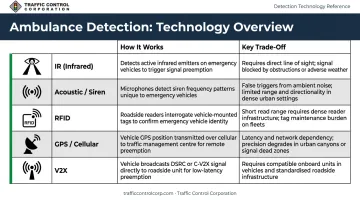
No single detection method fits every deployment. Here's a practical breakdown of the main technologies, their mechanisms, and their trade-offs:
| Technology | How It Works | Key Trade-Off |
|---|---|---|
| IR (Infrared) | Emitter on vehicle sends coded optical signal to intersection receiver | Line-of-sight required; simple and cost-effective |
| Acoustic/Siren | Roadside microphone detects siren frequency signature | No vehicle hardware needed; urban noise can affect performance |
| RFID | Tag on vehicle communicates with intersection reader | Can operate offline; no verified broad U.S. EVP deployment data |
| GPS/Cellular | Fleet location transmitted to server, signals adjusted along route | Enables multi-intersection "green wave"; depends on connectivity |
| V2X | Direct wireless exchange between vehicle and intersection controller | Best long-term interoperability; deployment remains phased |
IR and GPS: The Most Deployed Approaches
IR-based preemption has the longest operational record in U.S. deployments. GTT's Opticom™ system (available through TCC across Illinois, Wisconsin, Minnesota, and surrounding states) is one of the most widely deployed EVP platforms in the world, with connections at more than 90,000 intersections, 90,000 vehicles, and 3,100 municipalities.
GPS-based systems extend detection beyond line-of-sight, enabling proactive signal clearing across multiple consecutive intersections. Applied Information's Glance EVP system, also distributed by TCC, builds on this with several field-relevant capabilities:
- Green to Scene™ clears intersections ahead of the vehicle's arrival, not just the nearest one
- Dead reckoning maintains GPS accuracy in tunnels and underpasses
- 900MHz radio backup supplements cellular communication in low-coverage areas
- Documented response time reductions of up to 20%
GTT's Opticom Multimode Phase Selector (a patented technology) supports hybrid IR/GPS operation, allowing agencies to maintain existing IR infrastructure while migrating toward GPS-based systems incrementally.
V2X: The Long-Term Trajectory
V2X enables direct, low-latency communication between the emergency vehicle and the intersection controller without cellular network dependency. Federal deployment targets set in 2024 call for V2X on 20% of the National Highway System and 25% of signalized intersections in the top 75 metro areas during the first phase — though these are aspirational targets, not completed deployments.
Applied Information has also announced C-V2X roadside and onboard units with a guaranteed 5G upgrade path, making it a practical choice for agencies planning long-term ITS investments.
How the System Responds When an Emergency Vehicle Is Detected
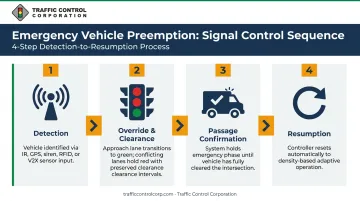
The detection-to-clearance sequence follows a consistent structure. Timing at each step varies by site — controller type, cycle offset, and detection range all factor in.
Detection — The sensor array or communication module identifies the approaching ambulance — via siren frequency, IR pulse, RFID signal, GPS proximity alert, or V2X broadcast — and sends a trigger to the intersection controller.
Override and clearance — The controller overrides the active signal phase: the ambulance's approach lane goes green, all conflicting lanes switch to red. Required yellow and all-red clearance intervals are preserved before the emergency phase activates — this is a safety requirement, not a delay.
Passage confirmation — The system holds the emergency phase until the ambulance has fully cleared the intersection. No state change initiates while the vehicle is still present.
Resumption of normal operations — Once passage is confirmed, the controller resets to density-based operation using live sensor data. Recovery time varies: FHWA notes coordination can take 30 seconds to 7 minutes, depending on controller strategy and where in the cycle the preemption occurred.
That recovery window is worth planning for. Intersections on coordinated arterials may experience brief ripple effects downstream — which is why some agencies pair preemption hardware with centralized ATMS monitoring to restore progression faster.
Benefits for Cities, Agencies, and Emergency Responders
Emergency Response Outcomes
The Fairfax County field study found 30 to 45 seconds saved per equipped intersection along 37 signals. In Plano, Texas, 194 equipped signals produced an estimated 10 to 20% reduction in response times, and intersection crashes near hospitals fell from 2.3 per year to fewer than one per five years. In St. Paul, Minnesota, emergency vehicle crashes dropped from a high of 8 per year to an average of 3.3 per year after EVP deployment.
These results are site-specific, not universal guarantees — but they represent documented operational outcomes from real deployments.
Congestion and Efficiency Gains
Density-based signal control reduces unnecessary red-light delays across all lanes, regardless of whether an emergency vehicle is present. For DOTs and municipal planners, measurable benefits include:
- Lower vehicle idle time and fuel consumption
- Reduced vehicle emissions at signalized intersections
- Improved intersection throughput during peak periods
- Better corridor-level travel time reliability
TCC's Role for Midwest Agencies
Transportation agencies across Illinois, Indiana, Minnesota, Wisconsin, Iowa, Missouri, and surrounding states can access smart traffic control solutions through Traffic Control Corporation (TCC). TCC represents over 40 manufacturers — including Econolite, GTT, and Applied Information — and provides:
- Product selection and application assistance for EVP and signal priority systems
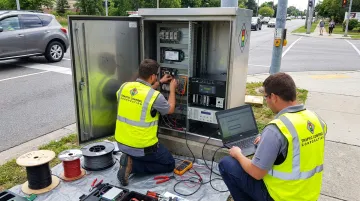
- Factory-trained technical field staff for installation and commissioning
- EVP system audits and onsite troubleshooting support
- Guidance on matching system components to specific intersection configurations
With over 75 years of regional expertise, TCC helps agencies evaluate and deploy the right solution for their corridor and operational requirements.
Implementation Considerations for Transportation Agencies
Infrastructure Compatibility
Most smart traffic control components — signal controllers, detection sensors, EVP modules — are designed to integrate with existing signal cabinets rather than requiring full intersection replacement. NEMA TS2 cabinets, 2070 Series controllers, and ATC-compliant platforms all support EVP module integration. Compatibility ultimately depends on the age and type of installed hardware.
TCC offers Traffic Signal Cabinet Audits and EVP System Health Checks as formal service offerings — a practical first step for agencies assessing whether existing infrastructure can support an upgrade without a full replacement.
Technology Selection Trade-Offs
The right detection method depends on several factors:
- Budget constraints — IR and RFID-based systems offer lower-cost entry points than GPS/cellular or V2X
- Urban noise environment — acoustic detection is viable where background noise is manageable
- Vehicle-side hardware feasibility — IR and GPS require emitters on the vehicles; acoustic detection does not
- Connectivity dependence — GPS/cloud systems require reliable network access; RFID can operate offline
- Multi-intersection coordination priority — GPS-based systems like Glance EVP support corridor-wide green waves; IR is intersection-by-intersection
A phased approach — starting with a single intersection prototype before corridor-wide deployment — is a proven, low-risk path. GTT's Opticom multimode technology is specifically designed to support incremental migration, allowing agencies to place legacy IR and newer GPS systems in operation simultaneously.
Ongoing Maintenance and Support
Smart traffic systems require periodic sensor calibration, firmware updates, and staff training to sustain performance. TCC offers training programs at its Woodridge, Illinois facility, including:
- Traffic Detection 101
- Basic and Advanced Controller Programming
- ATMS courses
On-site training at agency facilities is also available upon request.
Selecting manufacturers and distributors who offer certified technical support and field service matters as much as the initial equipment selection.
Frequently Asked Questions
What is traffic signal preemption for emergency vehicles?
Signal preemption interrupts the normal signal cycle to give an approaching emergency vehicle a green light on its travel lane while switching all conflicting movements to red. Once the vehicle clears the intersection, the controller restores normal operation automatically.
How does ambulance detection differ from standard vehicle detection?
Standard vehicle detection counts all vehicles to manage signal timing based on density. Ambulance detection specifically identifies emergency vehicles through dedicated methods: IR emitters, GPS/cellular, RFID, acoustic sensors, or V2X. It then triggers a priority override rather than a timing adjustment.
Can these systems integrate with existing signal infrastructure?
Most modern EVP and adaptive signal components are designed for compatibility with existing NEMA TS2 cabinets and ATC-compliant controllers. The degree of integration depends on the age and configuration of installed hardware — a site assessment is typically the right starting point.
Which ambulance detection technology is most reliable for urban deployments?
Reliability depends on deployment context. IR provides deterministic, coded detection but requires line-of-sight. GPS/cellular enables multi-intersection coordination but depends on connectivity. RFID is resilient and can operate offline. Many agencies use hybrid approaches — for example, GTT's Opticom Multimode supports simultaneous IR and GPS operation.
Are these systems cost-effective for smaller municipalities?
A TxDOT planning estimate put one EVP configuration at approximately $4,000 per signal plus $250 annually for operations and maintenance — a useful reference point, though costs vary significantly by technology type and deployment scope. IR and RFID-based systems offer lower-cost entry points, and the cost of delayed emergency response typically strengthens the ROI case regardless of agency size.