Yet many DOT staff, contractors, and municipal buyers hear terms like "loop detector" or "vehicle actuation loop" without ever seeing what the device physically looks like, how it senses a vehicle, or how it compares to radar, video, and lidar alternatives.
This guide breaks the technology down in plain language: what a loop is made of, the physics behind detection, the shapes and sizes engineers specify, and where loops still fit in a modern detection toolkit.
Key Takeaways
- Inductive loops sense vehicles by measuring drops in electrical inductance, not weight or pressure.
- A vehicle's metal body creates eddy currents that shrink the loop's magnetic field.
- Loop shapes range from 6-ft squares to diamond-shaped bicycle designs, each suited to a specific job.
- Well-installed loops often last over a decade, though lifespan depends on pavement condition and sealant quality.
What Is a Traffic Inductive Loop Detector?
A traffic inductive loop detector is an in-pavement electromagnetic sensor system that detects the presence or passage of vehicles by measuring changes in electrical inductance.
Rather than weighing a vehicle or photographing it, the system reads a shift in the loop's magnetic field caused by nearby metal.
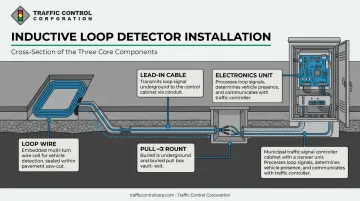
Every installation, regardless of manufacturer, comes down to three physical parts:
- Loop wire: insulated wire wound in one or more turns inside a shallow saw-cut slot in the pavement.
- Lead-in cable: a twisted-pair conductor that runs from the loop to a nearby pull box and on to the cabinet.
- Electronics unit: housed inside the traffic signal controller cabinet, this component drives current through the loop and interprets the resulting signal.
What Do Inductive Loops Look Like?
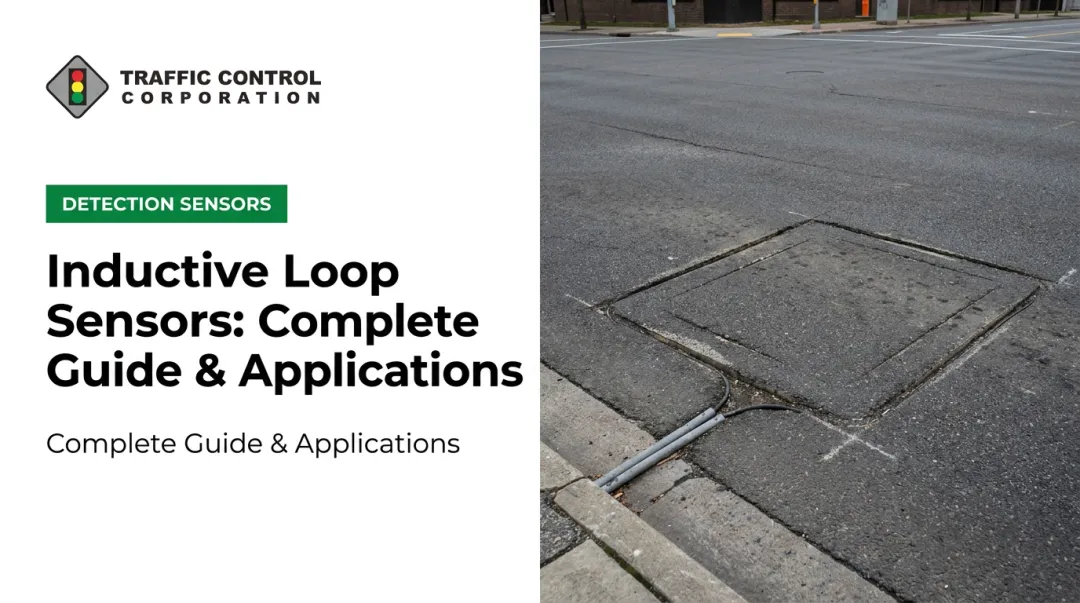
If you've noticed a dark, sealed line cut into the asphalt near a stop bar, bike lane, or intersection approach, that's a loop.
The visible seam is sealant, usually black or gray, poured over the saw cut once the wire is embedded. The wire itself sits invisible below the surface; only the sealant line reveals whether the loop is square, rectangular, or diamond-shaped.
Why Loops Became the Industry Standard
Agencies adopted loop detection in the early 1960s because it worked reliably with the actuated signal controllers being deployed at the time.
A wire loop could be installed under nearly any pavement type without complex power runs or line-of-sight requirements, which made it the default choice for decades of signal design.
Sourcing Replacement Components
That same reliability still matters today. Agencies replacing worn electronics or resealing old cuts don't need to reinvent the process.
TCC distributes EDI loop detector electronics units in single, dual, and four-channel configurations, compatible with NEMA TS-1, NEMA TS-2, ATC, and ITS cabinets. For the pavement side of the job, TCC also carries Chemque loop sealant in black and gray formulations, sized to match the surrounding roadway surface.
How Does a Traffic Inductive Loop Detector Work?
Once installed, the electronics unit sends alternating current through the loop wire, typically in a 10-200 kHz range according to FHWA's Traffic Detector Handbook, creating a magnetic field that surrounds the loop. That field stays stable until something conductive enters it.
The Physics Behind Detection
Two competing electromagnetic effects occur the moment a vehicle rolls over the loop:
- Ferromagnetic effect: the vehicle's iron mass slightly increases the loop's inductance.
- Eddy current effect: conductive metal in the vehicle body generates opposing currents that decrease inductance by a wider margin.
The eddy current effect wins for every road vehicle, so the net result the electronics unit measures is always a reduction in inductance, never an increase. That drop, however small, is what the system reads as a detection event.
What Triggers a Loop
Any sufficiently large metallic object passing over or resting within the loop's detection zone can trigger a measurable inductance drop. That includes:
- Cars, trucks, and buses
- Motorcycles, once sensitivity is properly calibrated
- Bicycle wheel rims, when a diamond-shaped loop is used
Presence vs. Pulse Output
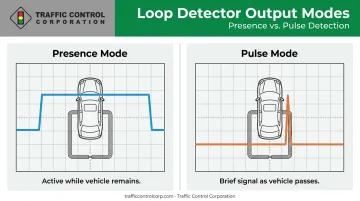
Once triggered, controllers rely on one of two output modes:
- Presence mode: holds the detection output active for as long as the vehicle remains over the loop, common at stop bars.
- Pulse (passage) mode: fires briefly, often somewhere in the 100-150 millisecond range depending on the electronics model, as a vehicle crosses the loop.
Sensitivity is inversely related to loop size: a smaller loop relative to a vehicle's undercarriage generally produces a stronger percentage change in inductance, meaning more reliable triggering. That's part of why narrow-lane installations often shrink from the standard 6-ft square down to a 5-ft footprint.
Once the electronics unit registers the shift, it converts that signal into an output the controller can act on, whether that's calling a green phase or logging another vehicle in a count.
Types and Shapes of Inductive Loop Detectors
Loop dimensions and shapes aren't arbitrary. Each geometry solves a specific detection problem.
Standard Squares and Narrow-Lane Variants
The 6 ft x 6 ft square is the most common loop configuration at signalized intersections, sized to reliably catch passenger vehicles and trucks across a standard lane. On narrower lanes, agencies often drop to a 5 ft x 5 ft square to reduce crosstalk, meaning false detection triggered by vehicles in the adjacent lane.
Long Rectangular Loops
Rectangular loops stretching 6 ft wide by 20 to 80 ft long are used where an agency needs large-area stop-bar presence detection rather than a single point measurement. The trade-off: these long loops can undercount volumes in stop-and-go traffic compared to short advance loops, since several vehicles queued within one footprint may register as a single continuous call.
Specialized Geometries
Beyond standard squares and rectangles, a few specialized shapes handle niche detection needs:
- Diamond-shaped loops are purpose-built for bicycle detection in dedicated bike lanes, where a standard vehicle loop might miss a bike's smaller metal mass.
- Quadrupole loops, wound in a 3-6-3 pattern, use a diagonal wire crossing that picks up a bike's smaller metal mass more consistently than a single-loop diamond design.
- Dual-loop "speed trap" setups pair two loops at a known spacing so the system can calculate speed from travel time between them, adding classification data beyond simple presence.
Where Are Inductive Loop Detectors Used?
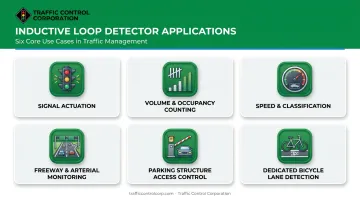
Inductive loops support several distinct traffic management functions:
- Signal actuation: Loops feed real-time presence and passage data to actuated controllers, letting agencies optimize phase timing based on actual demand instead of fixed timing plans.
- Volume and occupancy counting: Single loops provide data for planning and performance monitoring.
- Speed and classification: Dual-loop configurations calculate speed from travel time between two detectors and can classify vehicle types based on effective length.
- Freeway and arterial monitoring: Fixed loops feed point volume, occupancy, and speed data into incident detection systems.
- Parking structure access control: Loops trigger gates and access points as vehicles approach.
- Dedicated bicycle lane detection: Diamond-shaped loops give agencies a reliable way to actuate signals for cyclists.
Advantages and Limitations of Inductive Loop Detectors
Core Strengths
Loops remain a workhorse technology for good reason:
- Weather- and lighting-independent: rain, fog, snow, and darkness don't affect detection accuracy the way they can with camera-based systems.
- Reliable occupancy accuracy: a direct electromagnetic reading tends to be more consistent than systems inferring presence from an image.
- Long service life when installed correctly: Washington State DOT's evaluation puts realistic service life at 8 to 12 years, varying with sealant quality, pavement stress, and splice protection.
Core Limitations
These strengths come with trade-offs that matter as data needs evolve:
- Pavement cuts and lane closures disrupt traffic and expose crews to risk during installation and most repairs, a burden above-ground sensors avoid.
- No pedestrian detection: loops only respond to sufficiently large metal objects.
- No trajectory or turning-movement data: a loop indicates only that a vehicle passed, not where it came from or where it's headed.
When Agencies Look Beyond Loops
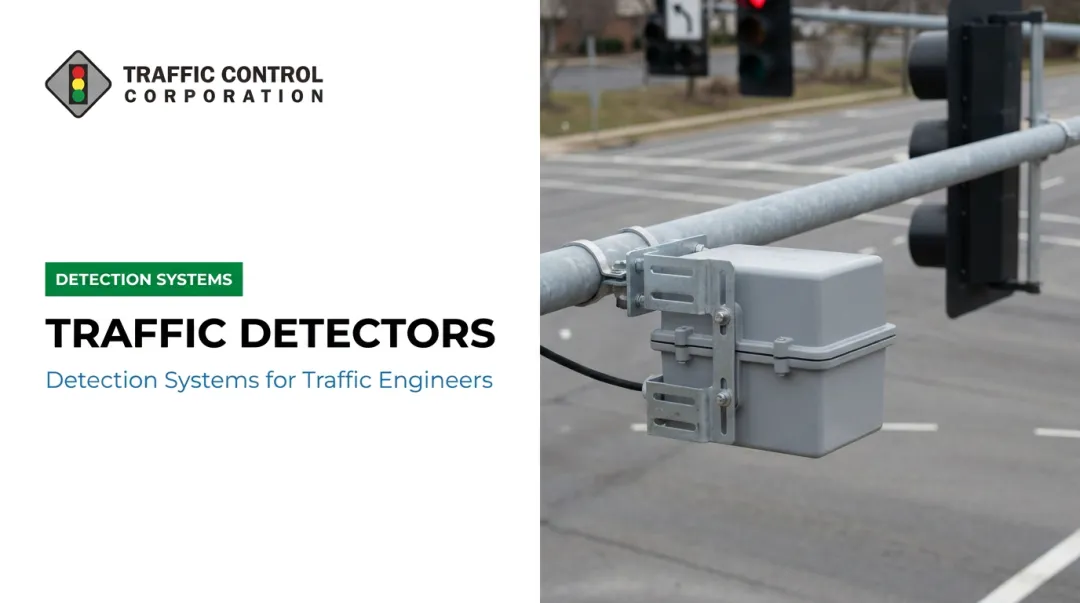
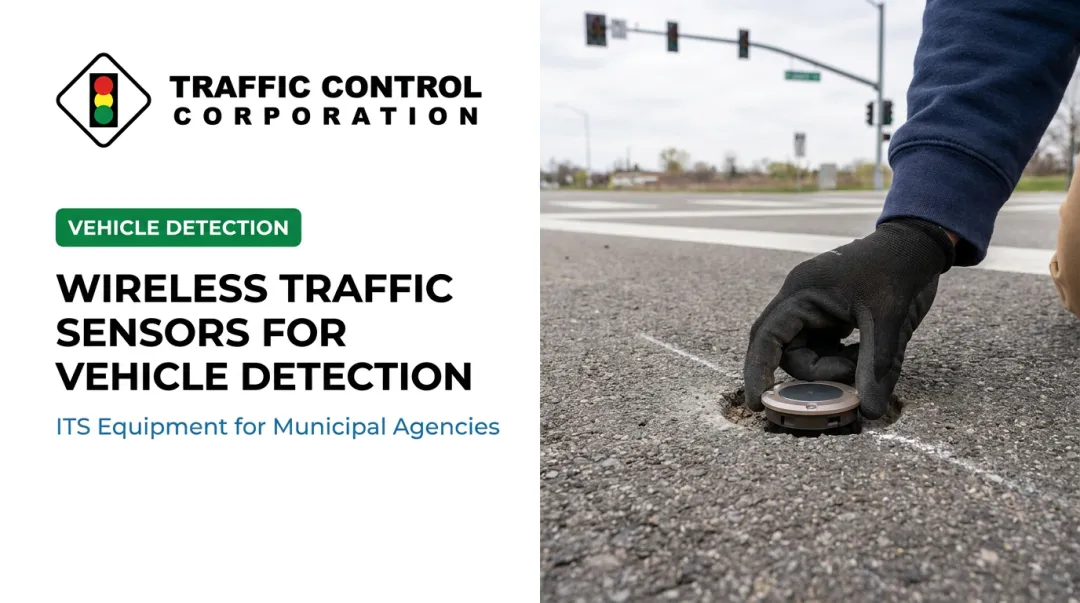
When multimodal data, pavement-cut restrictions, or trajectory and safety analysis become priorities, agencies increasingly evaluate above-ground alternatives alongside traditional loops:
- Video/AI systems such as Econolite's Autoscope OptiVu
- Radar sensors such as Econolite's EPIQ Radar or Sensys Networks' RTMS Echo
- Lidar platforms such as Ouster's BlueCity system
TCC distributes all three categories, alongside the loop electronics and sealant products covered earlier, giving agencies a single point of comparison when weighing detection options across a project.
Frequently Asked Questions
How does an inductive loop work?
An electronics unit passes alternating current through wire embedded in the pavement, creating a magnetic field. A vehicle's metal mass generates eddy currents that reduce the loop's inductance, which the unit reads as a detection event.
How do you trigger an inductive loop?
Any sufficiently large metallic object, such as a car, truck, motorcycle, or bicycle wheel rim, triggers the loop when it passes over or rests within the detection zone. The resulting inductance drop is measurable enough for the controller to register a vehicle's presence.
What do inductive loops look like?
At the surface, they appear as dark sealant lines forming a square, rectangle, or diamond cut into the pavement. The wire and lead-in cable stay hidden beneath the sealed slot.
How long do inductive loop detectors last?
Some well-installed loops exceed 15 years of service, but agency field data shows realistic averages closer to 8-12 years. Sealant quality, pavement condition, and splice protection all affect actual lifespan.
Can inductive loops detect bicycles and motorcycles?
Standard loops can detect motorcycles once sensitivity is properly calibrated. Diamond-shaped and quadrupole loops are specifically designed for reliable bicycle detection in dedicated lanes.
What is the difference between an inductive loop and other vehicle detection technologies?
Loops require pavement cuts but offer proven, weather-independent accuracy. Video, radar, and lidar avoid pavement intrusion and add multimodal data, with different installation and cost trade-offs.