Introduction
You're sitting at a red light. Cross-traffic cleared 45 seconds ago. The signal hasn't noticed. Meanwhile, a mile down the corridor, three other signals are cycling through their fixed sequences with no idea what's happening upstream.
This is the daily reality of uncoordinated — or poorly coordinated — traffic signal infrastructure. And it's not just a driver frustration problem. It translates directly into wasted fuel, excess emissions, reduced corridor throughput, and preventable intersection conflicts.
The flexible progressive traffic signal system is the most operationally capable coordination approach currently in widespread deployment. Unlike earlier signal coordination approaches that operate on rigid, predetermined schedules, the flexible progressive system uses computer-controlled coordination to vary cycle lengths, timing splits, and inter-signal offsets in real time — across an entire network simultaneously.
This article is written for transportation engineers, DOT staff, and municipal traffic managers. It covers what the flexible progressive system is, how its core parameters work, what measurable benefits it delivers, and how it's evolving toward fully adaptive and AI-enabled control.
Key Takeaways
- The flexible progressive system is the most advanced coordination type, automatically adjusting cycle length, splits, and offsets via central computer
- A TUM/BMW/TRANSVER project reported mean waiting time dropping from ~60 seconds to just 7 seconds under dynamic progressive control
- Cycle length, splits, and offsets are the three parameters underlying every coordinated signal system
- Adaptive and AI-enabled systems are the logical evolution of flexible progressive principles
- Legacy infrastructure can often be integrated into a coordinated network without full replacement
The Four Types of Traffic Signal Systems
Where Flexible Progressive Fits
Traffic signal systems are generally classified into four types, each representing a step up in coordination sophistication. Understanding this hierarchy makes clear why flexible progressive sits at the top.
The first three types share a fundamental weakness: they operate on predetermined, fixed timing that cannot respond to real-time traffic conditions.
| System Type | How It Works | Key Limitation |
|---|---|---|
| Simultaneous | All signals show the same indication at the same time | Ignores directional flow; poor throughput performance |
| Alternate | Adjacent signals show opposite indications | Marginally better flow, but still completely rigid |
| Simple Progressive | A time schedule allows vehicle groups to move along the main road at reasonable speed | Fixed cycle — the "wave" doesn't change with demand |
| Flexible Progressive | Computer dynamically adjusts cycle, splits, and offsets in real time | Adapts continuously; no fixed constraint on timing or offsets |
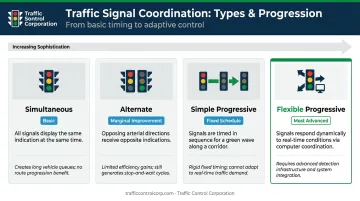
Simple progressive systems introduced the concept of the "green wave" — timing signals so a vehicle traveling at a target speed can move through successive intersections without stopping. The limitation is that the wave is locked to a predetermined schedule, unable to adjust when traffic is light, heavy, or shifted in direction. Flexible progressive removes that constraint by continuously recalculating timing based on actual demand.
What Is the Flexible Progressive Traffic Signal System?
The Core Definition
A flexible progressive system is a computer-controlled coordination strategy in which cycle length, phase splits, and offsets at each signalized intersection can all be varied automatically in response to real-time traffic conditions — not just along a single corridor, but across an interconnected network of intersections.
The "progression" concept still applies: signals are timed so a vehicle or platoon traveling at a target speed encounters successive green phases — the green wave. But in a flexible progressive system, the wave itself is dynamic. It shifts based on actual traffic demand on both the main road and cross streets.
The Role of the Central Computer
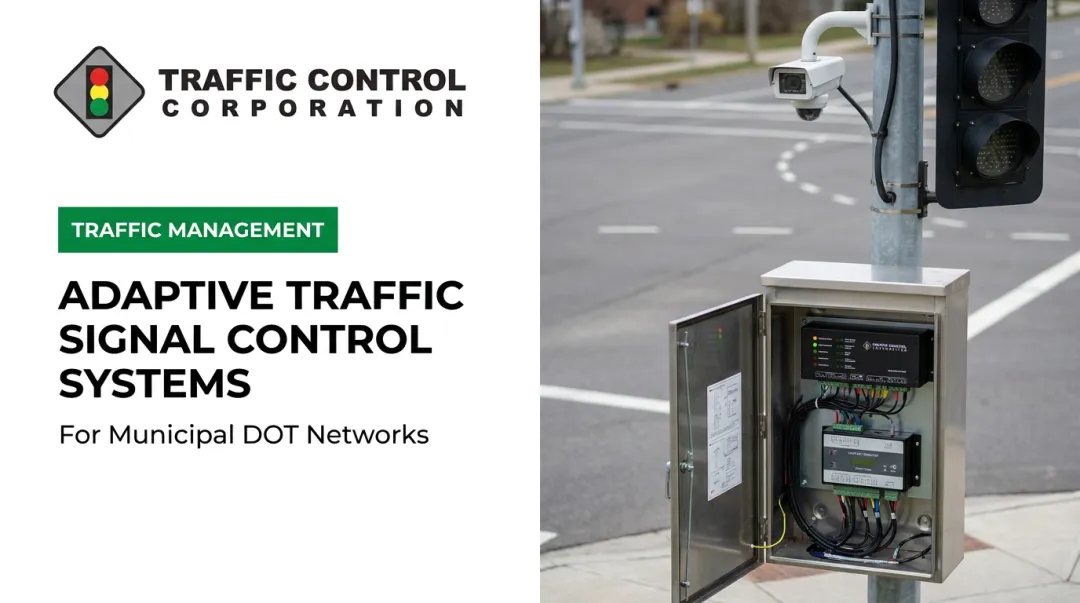
Unlike fixed-time or basic actuated systems, flexible progressive depends on a central processing system — often housed in a traffic management center — that:
- Receives real-time input from detectors at all intersections in the network
- Calculates optimal timing parameters based on current conditions
- Pushes updated coordination plans to individual field controllers in near real-time
This central coordination is what separates flexible progressive from a basic traffic-actuated signal. An actuated signal responds to demand at a single isolated intersection. Flexible progressive optimizes timing relationships across multiple intersections simultaneously — the entire corridor, not one node.
Fixed Core, Dynamic Edges
That central coordination framework takes a specific architectural form in practice. Research conducted by TUM (Technical University of Munich) in partnership with BMW and TRANSVER GmbH on arterial roads near Munich demonstrated this clearly: their model separated the network into a static "core area" of fixed signal timings and dynamic "adjoining areas" adjusted in response to differing traffic loads on the main road and cross streets.
The distinction matters in deployment:
- Fixed core: Maintains a predictable green band, giving drivers a reliable baseline progression
- Dynamic edges: Absorb variability from cross-street demand without destabilizing the broader network
This hybrid structure is the practical answer to a real tension in corridor management — predictability for through traffic versus responsiveness to local conditions.
Key Technical Parameters That Enable Flexibility
Three parameters are the engineering foundation of every coordinated signal system. FHWA's Traffic Signal Timing Manual identifies cycle length, split, and offset as the core coordination variables. In a flexible progressive system, all three can be adjusted dynamically.
Cycle Length
Cycle length is the time required for one complete signal sequence at an intersection. In a flexible progressive system, it isn't fixed: it adjusts to reflect changing traffic volumes throughout the day.
Two rules govern cycle length in coordinated networks:
- All intersections in a coordinated group must share the same cycle length, or a harmonic multiple of it, to maintain time-based synchronization
- FHWA recommends keeping cycles under 120 seconds for conventional four-leg intersections, though larger intersections may warrant longer cycles. Shorter cycles tend to reduce overall motorist delay
Splits
A split is the proportion of each cycle assigned to each signal phase. In a flexible progressive system, the computer redistributes split time based on real-time demand, giving more green to heavily loaded movements without creating indefinite red on others.
There's an important distinction between two types of phases:
- Coordinated phases receive a guaranteed minimum green on the main-street through movement to maintain progression
- Non-coordinated phases cover cross-street movements, adjusted dynamically based on detected demand
Offsets
Offset is the time relationship between the coordination reference point at one intersection and that of the next: it determines whether a platoon released from one signal arrives at the next signal during its green phase.
Properly optimized offsets create the green wave. In a flexible system, offsets can be recalculated as traffic patterns shift, enabling multiple coordination plans to activate automatically on a time-of-day schedule:
- Morning peak
- Midday
- Evening peak
- Overnight
Detection Technology
Real-time vehicle detection is what allows the system to act on changing conditions. FHWA's Traffic Detector Handbook describes three primary technologies:
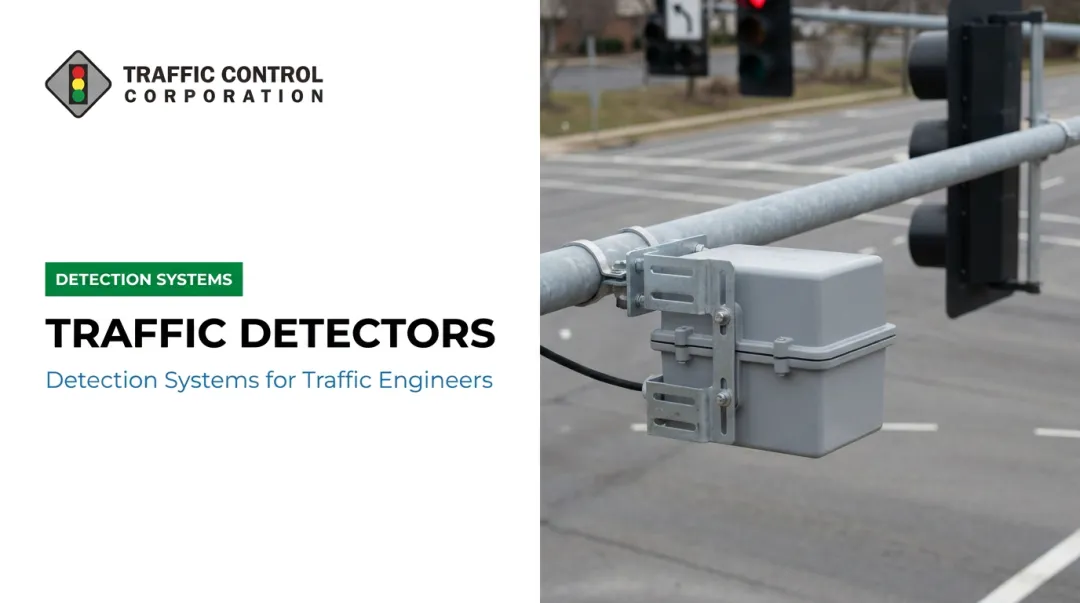
- Inductive loop detectors — embedded wire loops that sense the electromagnetic change caused by a passing vehicle; provide presence, count, and occupancy data
- Video detection cameras — processors identify vehicles from pixel changes; provide volume, speed, and classification data, though weather and lighting affect performance
- Microwave radar — FMCW units can detect both stopped and moving vehicles; effective in adverse weather conditions
TCC distributes all three detection types through its manufacturer partnerships, including Econolite's Autoscope OptiVu (AI-powered video detection), EPIQ RADAR (FMCW radar with integrated 1080p camera), and EDI/Reno A&E loop detectors. Each feeds live demand data directly into coordinated signal controllers.
Transition Logic
When the system switches from one timing plan to another, such as from an off-peak plan to a morning peak plan, controllers must resynchronize without abruptly disrupting traffic. FHWA recognizes three standard transition modes:
- Add — lengthens cycles to shift the reference point forward toward the new offset
- Subtract — shortens phase time to shift the reference point earlier
- Shortway/Smooth — evaluates both paths and selects the faster route to synchronization
FHWA notes that worst-case transitions typically complete within 3-5 cycles, and that the system operates at reduced efficiency during that window. The practical implication: plan transitions should complete before peak traffic arrives, not during it.
Real-World Benefits: What Flexible Progressive Actually Delivers
Travel Time and Stop Reduction
The TUM/BMW/TRANSVER project on arterial roads near Munich produced some of the most cited results in this space. As TUM reported, the dynamic flexible progressive system:
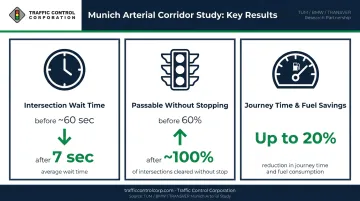
- Reduced mean waiting time at signalized intersections from approximately 60 seconds to just 7 seconds
- Increased the share of intersections passable without stopping from roughly 60% to nearly 100%
- Achieved journey time and fuel consumption reductions of up to 20% on test routes
Even an optimized fixed-time control scheme under the same framework halved waiting times — demonstrating that any meaningful level of progressive coordination outperforms uncoordinated operation.
Fuel and Emissions Impact
The fuel savings result follows directly from fewer stops. Every time a vehicle decelerates to a stop and re-accelerates to speed, it consumes significantly more fuel than maintaining steady motion. The TUM project's 20% figure reflects this relationship across full route journeys, not just at individual intersections.
A USDOT synthesis of U.S. and Canadian signal retiming projects found fuel use decreased 2–9% across a range of projects — with individual results as high as 9.1% in one Texas deployment. These figures reflect retiming projects broadly, not exclusively flexible progressive implementations.
Throughput Without New Lanes
Flexible progressive systems allow agencies to extract more capacity from existing infrastructure. By dynamically allocating green time across a corridor based on live demand, the system reduces residual queue buildup — the cycle-over-cycle queue carryover that plagues oversaturated fixed-time systems.
The result: more vehicles clear each cycle, and that improvement compounds intersection by intersection across the full corridor.
Safety Considerations
The throughput gains above come with a safety dimension as well. Coordinated signal systems reduce the stop-and-go unpredictability that triggers aggressive driver behavior — but outcomes vary by site. A 2021 FHWA adaptive signal control study found that Virginia's InSync system produced:
- 13.3% reduction in total crashes
- 35.8% reduction in fatal/injury crashes
- 39.6% reduction in angle crashes
Other deployments showed mixed results — some sites saw no significant change, others saw increases in specific crash types. What holds across deployments: reducing red-light running and hard-stop acceleration events is more achievable when signal timing is predictable and consistent.
How Flexible Progressive Is Evolving: Adaptive Control and AI
From Scheduled Plans to Continuous Optimization
Flexible progressive systems typically operate by activating pre-optimized timing plans on a time-of-day schedule, with real-time detection adjustments within each plan. Fully adaptive systems go further: technologies like SCOOT (Split Cycle Offset Optimization Technique) continuously recalculate timing parameters every cycle based on live network-wide data, reducing reliance on pre-programmed plans.
FHWA describes adaptive signal control as collecting current traffic data, evaluating flow conditions, and updating timing to accommodate changing patterns rather than relying solely on time-of-day schedules. The distinction from flexible progressive is the recalculation frequency: the same parameters (cycle length, splits, offsets), adjusted continuously rather than on a fixed schedule.
Adaptive system capabilities vary widely. NCHRP's 2019 review found that some systems adjust cycle, splits, offsets, and phase sequence, while others adjust only a subset of these parameters.
Do AI Traffic Lights Exist?
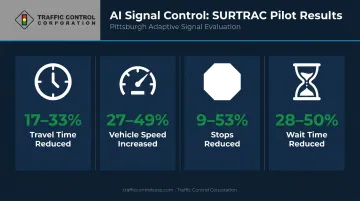
Yes. AI-enabled traffic signal systems are deployed and producing measurable results. The SURTRAC system developed at Carnegie Mellon University used decentralized, schedule-driven AI control across nine intersections in Pittsburgh's East Liberty neighborhood. A 2013 USDOT pilot evaluation found:
- Travel time reduced 17–33%
- Vehicle speed increased 27–49%
- Stops reduced 9–53%
- Wait time reduced 28–50%
These systems use machine learning to analyze detector data, identify traffic pattern shifts, and optimize timing proactively — before congestion builds, not just in response to it. The AI layer builds on flexible progressive foundations by enabling the system to learn from historical patterns: peak-hour behavior, event-day anomalies, weather-related changes.
Vehicle-to-Infrastructure: Making Coordination Visible to Drivers
The TUM project included a "green carpet" component: signal timing data transmitted via mobile network to a TRANSVER application, displaying a recommended travel speed on the driver's smartphone so they could hit successive green phases.
This concept has since formalized into V2I standards. Key components of the current framework include:
- SPaT messages (Signal Phase and Timing) — communicate signal state and countdown data to equipped vehicles using the IEEE 1609 standards stack
- FHWA's V2X Hub — converts controller data into SAE J2735 SPaT messages broadcast by roadside units
- AASHTO SPaT Challenge — launched in 2016, with 26 states participating by early 2020
V2I doesn't change how the signal system works — it makes the coordination visible and actionable to individual drivers, extending the benefits of flexible progressive operation into the vehicle itself.
What Agencies Should Know About Implementation
Infrastructure Requirements
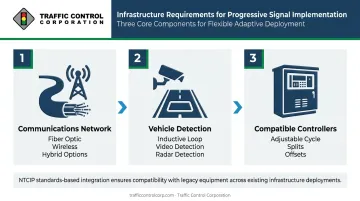
Implementing a flexible progressive system requires three things:
- A communications network linking all intersections to a central or master controller — fiber, wireless, or hybrid
- Vehicle detection at each intersection — loop, video, or radar — feeding live demand data to the coordination system
- Controllers capable of running coordinated timing plans with adjustable cycle lengths, splits, and offsets
The TUM project offers a useful precedent: the team integrated 20-year-old controllers from multiple manufacturers into a unified system combining fixed timing, demand-responsive control, central processing, and mobile data exchange. Legacy equipment doesn't require wholesale replacement. Standards-based integration — via NTCIP protocols, which enable equipment from different manufacturers to operate within one system — can often bring older controllers into a coordinated network.
TCC supports this kind of integration with a complete product lineup: Econolite's 2070 Series and Cobalt controllers (both ATC-compliant and highly configurable), the Centracs ATMS platform for network-wide coordination management, and Centracs Signal Performance Measures (SPM) for continuous performance monitoring and re-timing decisions.
Timing Plan Development and Maintenance
There's no universal optimal cycle length or offset. Agencies must evaluate their specific intersection spacing, traffic volumes, posted speeds, and pedestrian crossing demands to develop coordination plans that perform.
The TUM results — and the gap between their optimized system and fixed-time control — underscore how much performance depends on plan quality.
FHWA recommends reviewing signal timing every 3–5 years, with earlier review triggered by significant traffic or land-use changes (a 5–10% volume change is cited as a possible threshold). Annual reviews are not the FHWA standard, but agencies operating in rapidly growing corridors or after major development should not wait for the full 5-year window.
TCC's Role as a Regional Resource
For Midwest transportation agencies evaluating flexible progressive or adaptive signal upgrades, TCC has supported this space since 1946. With 75+ years in traffic signal distribution and representation of 40+ manufacturers across eleven Midwest states, TCC provides product selection guidance, application assistance, controller and detection equipment, and training programs covering signal timing and coordination.
Factory-trained technical staff are available for product selection, system configuration, and field support throughout the implementation process.
TCC's training catalog includes dedicated courses on signal timing concepts, Cobalt and ASC/3 controller programming for coordinated arterial networks, and the Centracs ATMS platform — the tools agencies actually need when configuring and managing flexible progressive deployments. TCC's service territory spans Illinois, Indiana, Iowa, Minnesota, Missouri, Wisconsin, Michigan, Kansas, Nebraska, North Dakota, and South Dakota.
Frequently Asked Questions
What is the most efficient traffic signal system?
The flexible progressive system is widely regarded as the most capable of the four major signal coordination types. By automatically varying cycle lengths, splits, and offsets via central computer, it adapts to real-time traffic demand across an entire network — something rigid, predetermined timing plans cannot do.
Do AI traffic lights exist?
Yes. AI-enabled traffic signal systems are real and deployed. Systems like SURTRAC use machine learning to analyze detector data and optimize timing proactively, building on flexible progressive principles. The key difference: AI systems learn from historical patterns and act before congestion develops, not just in response to it.
What is the difference between a simple progressive and a flexible progressive signal system?
A simple progressive system runs on a fixed cycle with a locked green wave that doesn't respond to actual demand. A flexible progressive system uses a central computer to dynamically adjust cycle length, phase splits, and offsets at each intersection based on real-time detected conditions.
How does a flexible progressive system respond to changing traffic conditions throughout the day?
Detection data feeds a central controller that activates pre-optimized timing plans by time of day: morning peak, midday, evening peak, overnight. Within each plan, the controller makes real-time adjustments — extending green phases when queues are heavy, shortening them when cross-street demand drops.
What does "offset" mean in a coordinated traffic signal system?
Offset is the time relationship between the coordination reference point at one signalized intersection and that of the next intersection in the coordinated system. It's the parameter that determines whether a vehicle platoon released from one signal arrives at the next signal during its green phase — the mechanism that creates the green wave.
What infrastructure is needed to implement a flexible progressive signal system?
Three essentials are required: a communications network linking all signals to a central controller, vehicle detection at each intersection (loop, video, or radar), and controllers capable of running coordinated timing plans with adjustable cycle lengths, splits, and offsets. In many cases, existing infrastructure can be integrated without full replacement using standards-based protocols like NTCIP.