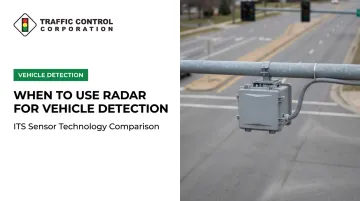
Choosing radar for the wrong scenario, though, creates real problems. Missed detections, poorly configured signal timing, and dilemma-zone crash risk all trace back to mismatched technology selection. A sensor that works beautifully on a rural four-lane highway may struggle at a dense urban intersection with stop-and-go queuing.
This article breaks down exactly when radar is the right call, how the ideal use case shifts with traffic and environmental conditions, and which deployment mistakes agencies should avoid.
Key Takeaways
- Radar performs best on weather-exposed, high-speed approaches where loops and video struggle
- It's best suited for advance detection, dilemma-zone protection, and speed/direction data
- Dense, bumper-to-bumper stop-bar counting often needs video or loop detection instead
- Pairing radar with a second sensor type adds redundancy at high-risk intersections
- A regional ITS distributor can match sensor type to site conditions before installation
Why Timing Matters for Radar-Based Vehicle Detection
"Timing" in radar deployment means two things: picking the right scenario for radar in the first place, and configuring detection zones to match actual approach speeds. Get either one wrong, and the consequences show up fast.
Mistimed or poorly placed detection zones cause missed calls. That translates into extended red times, unnecessary stops, and frustrated drivers who start treating the signal as unreliable. It also creates cost problems agencies don't budget for.
Correcting a bad technology choice after the fact is expensive. Swapping detection types often means:
- Re-installation and new mounting hardware
- Pavement cuts if switching back to loops
- Added maintenance visits to recalibrate or replace equipment
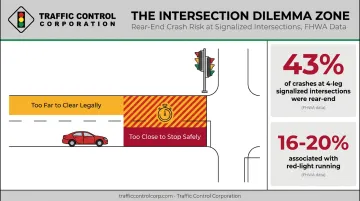
Beyond cost, there's a safety dimension. According to FHWA's Signalized Intersections Informational Guide, rear-end crashes made up 43% of reported crashes at four-leg signalized intersections, using 2009 data. Red-light running was associated with another 16% to 20% of signalized-intersection crashes.
Many of those rear-end collisions trace back to drivers braking hard when they enter a high-speed approach right at yellow onset — precisely the scenario advance detection is designed to prevent.
Poor detection timing on high-speed approaches raises dilemma-zone risk directly. A vehicle that isn't detected early enough gets caught in the gap between "too close to stop safely" and "too far to clear the intersection legally." That's the exact failure mode advance radar detection is built to solve, provided it's deployed and calibrated correctly.
Best Time to Use Radar for Vehicle Detection Based on Different Scenarios
There's no single "best" moment to deploy radar. It depends on traffic volume, roadway geometry, environmental exposure, and what the ITS application actually needs to accomplish. Here's how those factors break down.
Based on Traffic Volume and Approach Type
Radar's strongest use case is high-speed, rural, or multi-lane approaches that need wide advance-detection zones without cutting pavement. FHWA's Traffic Detector Handbook notes that FMCW radar detects both stopped and moving vehicles, unlike simpler CW Doppler radar, which only catches vehicles in motion.
Radar also performs reliably where vehicles are spaced out. Because it tracks distinct moving targets rather than reading a fixed zone, it handles free-flowing traffic on highway approaches well.
Products like Econolite's EPIQ RADAR extend that further, covering up to 900 feet (275 m) with a 110-degree field of view. That range catches vehicles well before the stop bar, which matters for dilemma-zone protection at higher speeds.
Based on Environmental and Weather Conditions
Midwest agencies deal with snow, fog, freeze-thaw cycles, and temperature swings that can degrade loop and camera performance. FHWA's summary of vehicle detection technologies describes microwave radar as largely insensitive to snow, rain, and fog, while video-based systems depend on visibility conditions that fog, glare, and lens contamination can compromise.
That immunity to lighting and weather makes radar a strong candidate for day/night, all-season reliability in exposed locations. Think rural interchanges, bridge approaches, or open highway stretches with no tree cover to soften wind and precipitation exposure.
Based on Site or Infrastructure Constraints
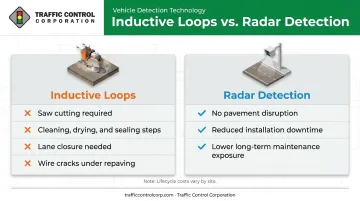
Some sites simply can't accommodate pavement cutting. New construction, bridge decks, and frequently repaved roads all favor overhead or side-mounted radar over embedded loops. Loop installation requires saw cutting, cleaning, drying, wire placement, and sealing, plus the traffic control needed to safely close a lane during the work.
Radar sidesteps that entirely:
- No saw cuts or pavement disruption
- Reduced installation downtime compared to loop crews working lane-by-lane
- Lower long-term maintenance exposure since there's no embedded wire to crack or fail under repaving
That said, a 2016 Western District ITE lifecycle cost study found loops came out cheapest in its specific 10-year modeled scenario: a reminder that agencies should price the full lifecycle, not assume radar automatically wins on cost everywhere.
Based on ITS Application Type
Radar earns its keep in applications that need more than a binary presence signal. Signal actuation and dilemma-zone protection require speed and distance data to make good phase-extension decisions, something loops alone can't provide.
On the freeway side, radar supports:
- Queue detection and incident monitoring
- Corridor-level speed and volume data collection
- Ramp metering and HOT lane management
Sensys Networks' RTMS Echo, for example, is built for exactly this: side-fire FMCW radar covering up to 12 lanes per device, positioned for highway monitoring rather than intersection stop-bar work.
Signs It's the Right Time to Use Radar — and When to Avoid It
Knowing the technical strengths is one thing. Recognizing them at your own site is another. Here's a practical checklist.
Signs Radar Is the Right Choice
- Wide or multi-lane approaches needing consistent, uniform zone coverage from a single sensor
- Frequent loop failures or pavement damage signaling it's time to move to non-intrusive detection
- Harsh-climate exposure where weather-resilient, low-maintenance sensing matters more than initial unit cost
- A need for speed and direction data, not just a yes/no presence call, which is critical for dilemma-zone logic
When You Should Avoid Radar for Vehicle Detection
Radar isn't the right answer everywhere. A few scenarios call for a different tool, or at least a companion sensor.
Dense, bumper-to-bumper, stop-and-go traffic can make it difficult for any sensor to cleanly separate closely spaced vehicles, radar included. FHWA's Traffic Detector Handbook notes that occlusion (tall vehicles in a near lane blocking the view of vehicles in a farther lane) affects side-fired, multilane setups in particular.
Mounting height, setback distance, and calibration all influence how well a given radar unit handles that.
Other situations that warrant a second look:
- Highly precise, per-lane stop-bar counts may be better served by video or loop detection depending on the product and site geometry
- Budget-limited projects where simple presence detection via loops remains the more cost-effective option
- Multiple radar units in close proximity can cause signal interference, requiring careful frequency channel assignment and placement planning during design
Best Practices for Timing and Deploying Radar Correctly
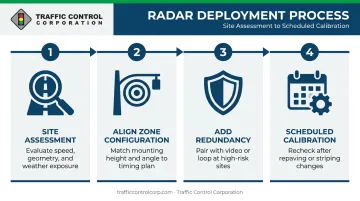
Getting radar right starts before the sensor ever ships. A proper deployment follows a few consistent steps:
- Run a site assessment first. Evaluate approach speed, roadway geometry, and weather exposure before finalizing sensor selection, not after equipment is already ordered.
- Align zone configuration with the signal timing plan. Detection zones, mounting height, and mounting angle all need to match the intersection's actual approach speeds and phasing logic.
- Add redundancy at high-risk locations. Pairing radar with video or loop detection gives high-volume or complex intersections a validation layer if one sensor drifts out of tolerance.
- Calibrate on a schedule, not just at install. Lane striping changes, repaving, and shifting traffic patterns all affect zone accuracy over time.
Incorrect placement or an uncalibrated zone doesn't always announce itself. It degrades performance gradually: missed calls, false triggers, extended reds, long before anyone notices a visible outage. That kind of silent failure is exactly why inspections need to run on a set schedule, not wait for a complaint to trigger one.
This is where working with an experienced regional distributor pays off. Traffic Control Corporation offers site-specific product selection guidance, onsite troubleshooting, and factory-trained field support across its 11-state Midwest territory.
TCC's Detection Systems Turn On service handles zone configuration and sensor alignment at commissioning. Its Detection Systems Audit & Health Checks catch misaligned radar and drifting zones before they compromise safety or efficiency. For agencies deploying Econolite's EPIQ RADAR or EVO RADAR, or Sensys Networks' RTMS Echo, that hands-on support during and after installation matters as much as the hardware itself.
Conclusion
There's no universal "best" vehicle detection technology. The right choice always comes down to traffic conditions, site constraints, and what the specific ITS application requires.
Radar performs best in weather-exposed, wide-approach, low-maintenance scenarios — high-speed rural highways, freeway corridors, and sites where pavement cutting isn't practical. Dense, stop-and-go urban intersections often call for a complementary sensor, or a different technology altogether.
Consulting an experienced Midwest ITS supplier like TCC helps agencies and contractors select, install, and calibrate radar detection correctly the first time. This avoids discovering a mismatch after the equipment is already mounted on the pole.
Frequently Asked Questions
What is radar vehicle detection?
It's a non-intrusive sensing technology that uses electromagnetic (radio) waves to detect the presence, speed, and direction of vehicles. Agencies use it for signal actuation, dilemma-zone protection, and traffic monitoring.
How does radar vehicle detection differ from inductive loop detectors?
Radar mounts above or beside the roadway with no pavement cutting required. Loops are embedded in the pavement and can be damaged by resurfacing, heavy truck traffic, or freeze-thaw cycles.
Can radar detect vehicle speed and direction, not just presence?
Yes. FMCW radar sensors measure speed, distance, and direction simultaneously. This makes them well suited for advance detection and dilemma-zone protection, where timing decisions depend on more than a simple presence call.
Does weather affect radar-based vehicle detection?
Radar is largely immune to rain, fog, snow, and lighting conditions. That makes it reliable across harsh Midwest climates in ways optical sensors like standard video cameras sometimes aren't.
Can radar be used together with video or loop detection systems?
Yes, and it's common practice. Combining radar with a second sensor type adds redundancy at complex or high-risk intersections, giving agencies a validation layer if one system drifts out of calibration.
How much does a radar vehicle detection system cost to install and maintain?
Costs vary by site complexity and sensor type. Radar generally carries lower long-term maintenance costs since there's no pavement wear to repair. Contact Traffic Control Corporation for a site-specific quote tailored to your Midwest location.