Introduction
Transportation agencies need vehicle detection that holds up through Midwest winters, doesn't require constant pavement repair, and won't miss a car sitting at a red light.
Traditional inductive loops have handled that job for decades, but sawcut installations and wire failures create ongoing maintenance headaches for signal, ramp, and rail crossing applications.
Wireless magnetometer technology has become a leading alternative.
Sensys Networks, founded in 2003, was documented by the Federal Highway Administration as early as 2007 for its wireless magnetic sensor approach. By 2014, the company had built a direct interface between its VDS240 sensors and Econolite's Centracs ATMS platform.
This article breaks down what the Sensys system actually is, how it functions in the field, what independent testing shows about its accuracy, and how Midwest agencies can source and install it through Traffic Control Corporation (TCC).
Key Takeaways
- Magnetometer sensors detect vehicles without cutting inductive loops into pavement
- Wireless means two-way radio communication, not battery-free operation
- Independent Illinois testing confirmed sub-10% missed-call rates and near-zero stuck-on calls after a year
- Weather has no effect on magnetic detection, unlike camera-based systems
- TCC supports Midwest agencies with product selection, installation, and Sensys distribution across 11 states
What Is the Sensys Wireless Vehicle Detection System?
The Sensys system is an in-pavement wireless sensor network built around magnetometer technology. Each sensor detects vehicle presence, counts, and classification by measuring changes in the earth's local magnetic field, without the sawcutting, loop wire, and lead-in conduit that inductive loops require.
The product line has expanded well past its original in-road sensor:
| Product | What It Does |
|---|---|
| VDS240 / FlexMag | Flush-mount, in-pavement magnetic sensors for presence and movement detection |
| RTMS Echo | Side-fire FMCW radar covering up to 12 lanes per unit for highway-scale monitoring |
| MultiSens Intersection | Combines video AI with wireless in-road sensing for vehicle, pedestrian, and bicycle detection |
"Wireless" describes the communication method, not the power source. Sensys sensors run on a single lithium-thionyl-chloride battery cell with a manufacturer-stated expected life of around 10 years, communicating over the 2.4-GHz band using the IEEE 802.15.4 protocol. There's no wire trenched back to the cabinet, but the sensor still needs power to operate.
Agencies typically deploy these sensors at:
- Signalized intersection stop bar and advance detection zones
- Railroad grade crossings, as backup detection near the tracks
- Highway and arterial corridors for ongoing data collection
Econolite and Sensys Networks completed an interface between VDS240 sensors and the Centracs ATMS platform in 2014, giving agencies a single interface for detection data and signal management.
How Does the Sensys Wireless Detection System Work?
Hardware Components and Detection Principle
The system relies on a simple architecture:
- In-pavement magnetometer sensor — the field-installed unit that senses vehicles overhead
- Wireless access point — the gateway (branded FlexAP) that bridges sensor data to the controller cabinet
- Repeaters — optional units that relay signals when a sensor sits out of direct line-of-sight to the access point
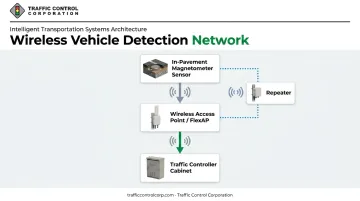
Together, these three components form the detection network's backbone. Each sensor establishes a baseline reading of the local magnetic field. A vehicle's metal mass disrupts that field as it passes or stops overhead, and the sensor interprets the disruption as a detection call sent to the controller.
Installation and Controller Integration
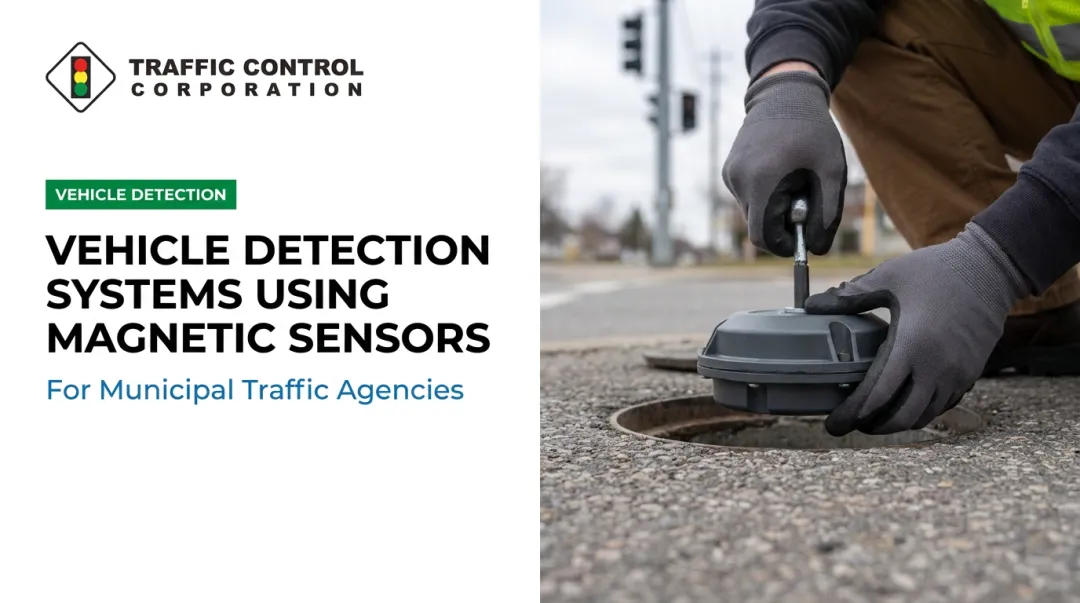
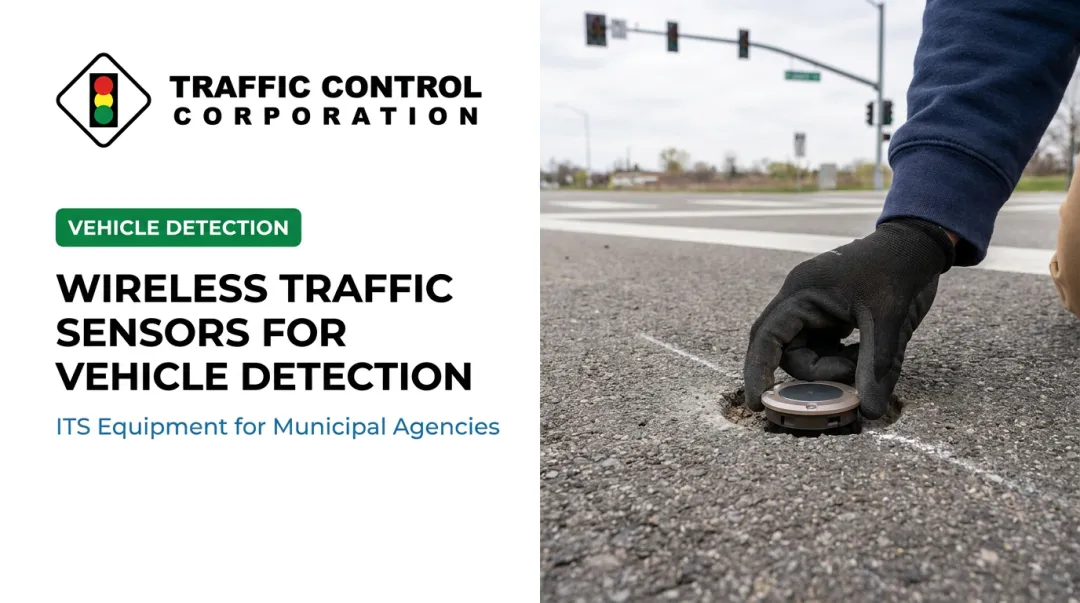
That reliance on magnetic disruption rather than physical contact keeps installation fast compared to loop cutting. A technician drills a core roughly 4 inches in diameter and about 2 to 2.25 inches deep, sets the sensor in place, and seals it flush with epoxy that cures in around five minutes.
Detection calls travel wirelessly to a contact closure card mounted in the cabinet's standard detector rack. Sensys's FlexConnect interface delivers this data via SDLC, conforming to NEMA TS2-2003 standards so it works with the controllers agencies already have.
From there, data feeds into software such as SensTraffic for real-time and historical reporting on counts, speeds, occupancy, and travel times.
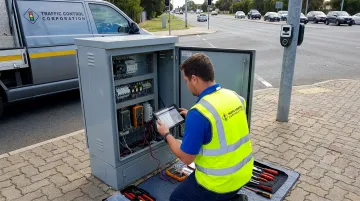
Agencies deploying this system don't have to manage installation alone. TCC's factory-trained technicians provide installation and detection commissioning support across the Midwest.
Key Features, Benefits & Real-World Performance Data
The biggest advantage over inductive loops is disruption, or the lack of it. A small drilled core replaces the sawcut loop pattern used in traditional installations, delivering:
- Faster installs with minimal pavement cutting
- No wire to replace as pavement shifts or cracks
- Less roadway disruption during construction
Independent field data confirms strong detection performance, too. The Illinois Center for Transportation ran a year-after evaluation of a Sensys installation at a signalized intersection. Results showed:
- No missed, stuck-on, or dropped calls at the stop bar after a full year of operation
- Adjacent-lane false calls dropped from a 5.6%–7.6% range down to 0.8%–2.4% after sensor recalibration
- Advance detection zones held missed-call rates between 0.6% and 6.1%, with false calls under 2%
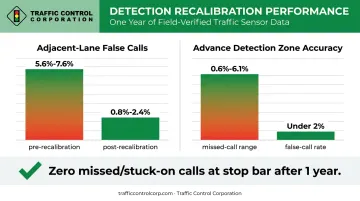
That recalibration result matters. It shows the system can be tuned for site-specific accuracy rather than left at default settings and hoped for the best.
Weather resilience is another differentiator. The FHWA has documented that magnetic sensors are insensitive to rain, snow, and fog, conditions that routinely degrade video-based detection. For agencies managing intersections through Midwest winters, that's not a minor detail.
Looking ahead, MultiSens Intersection lets agencies layer video AI on top of existing wireless sensor investments, adding pedestrian and bicycle detection without ripping out in-ground hardware that's already working.
Common Applications for Wireless Vehicle Detection
Signalized intersections. Stop bar and advance detection zones actuate signal phases and reduce the risk of red-light-runner incidents caused by missed calls. This is the most common deployment scenario.
Railroad grade crossings. Sensors positioned near tracks have been evaluated as potential backup detection for quad-gate operation, monitoring both through and turn lanes close to the crossing.
Field testing in Illinois found missed-call rates below 1% in this application. However, opposite-direction traffic can still generate elevated false calls—a known limitation agencies should plan around.
Highway and arterial data collection. For corridor-level monitoring, radar units like the RTMS Echo cover up to 12 lanes per device from a single side-fire installation. This feeds counts, speeds, and classification data into planning and signal timing decisions.
TCC positions the RTMS Echo specifically for this use case, including ramp metering and HOT lane management, rather than intersection stop-bar duty.
Sensys Wireless Sensors vs. Other Detection Technologies
Choosing between detection technologies comes down to site conditions and what an agency already has installed. TCC's technicians weigh these trade-offs daily, matching sensor technology to each agency's intersection layout.
| Factor | Wireless Magnetometer | Video Detection | Radar (RTMS Echo) |
|---|---|---|---|
| Installation | Small pavement core, short lane closure | Overhead mounting, possible closure | Side-fire, no pavement cutting |
| Weather/lighting impact | None, magnetic detection unaffected | Fog, glare, and shadows can degrade accuracy | Minimal impact at typical ranges |
| Best use case | Intersection stop bar/advance precision | Wide-area intersection monitoring | Highway/corridor-scale coverage (up to 12 lanes) |
| Maintenance | Battery-based, ~10-year expected life | Periodic lens cleaning, alignment checks | Non-invasive, browser-based reconfiguration |
Video detection has closed some of the weather gap through AI-assisted processing, but it still depends on a clear line of sight.
Radar units like the RTMS Echo trade intersection-level precision for lane coverage, making them better suited to highway monitoring than stop-bar actuation. For stop-bar and advance detection, FlexMag-style sensors remain the standard recommendation.
Choosing and Installing a Wireless Detection System with TCC
Picking the right detection technology isn't a one-size-fits-all decision. Intersection geometry, weather exposure, existing cabinet standards, and budget all factor in, and getting it wrong means costly rework down the line.
That's where local expertise matters. Traffic Control Corporation has served the Midwest since 1946, bringing over 75 years of field experience to the table. Its territory spans 11 states: Illinois, Indiana, Iowa, Kansas, Michigan, Minnesota, Missouri, Nebraska, North Dakota, South Dakota, and Wisconsin.
As an authorized Sensys Networks distributor, TCC's factory-trained technicians support agencies with:
- Product selection and application assistance, matching detection equipment to specific intersection geometry and cabinet constraints
- Detection systems turn-on service, including zone calibration and sensor alignment
- Detection systems audits and health checks to catch drifting sensors before performance suffers
- Product and systems training for agency staff maintaining equipment long-term
Agencies evaluating wireless or hybrid detection for their jurisdiction can reach TCC's Woodridge, IL team at 630-543-1300 or through trafficcontrolcorp.com/contact for application-specific guidance.
Frequently Asked Questions
What does the Sensys wireless vehicle detection system do?
It detects vehicle presence, counts, and classifies traffic using in-pavement wireless magnetometer sensors, supporting signal actuation and traffic data collection without cutting inductive loops.
How does the Sensys wireless vehicle detection system work?
Sensors detect disruptions in the local magnetic field caused by passing vehicles, then transmit detection calls wirelessly to an access point that feeds the traffic controller.
How accurate is the Sensys system compared to inductive loops?
Independent Illinois testing found missed-call rates well under 10% and near-zero stuck-on or dropped calls after a year of operation, with false calls dropping sharply after site recalibration.
Does weather affect the performance of wireless vehicle detection sensors?
No. Magnetic detection is unaffected by rain, snow, or fog, since it doesn't rely on optical sensing the way camera-based systems do.
How long do Sensys wireless sensors typically last once installed?
Sensors run on a single battery cell with a manufacturer-stated expected life of around 10 years, and field testing shows stable performance even after a full year of continuous use.
Can wireless vehicle detection sensors be integrated with existing traffic signal controllers?
Yes. Detection calls pass through contact closure cards using SDLC interfaces compatible with standard NEMA TS2 controllers and ATMS platforms like Centracs.