Introduction
Every day, drivers approach signalized intersections at 40, 50, even 60 miles per hour, expecting to see a red, yellow, or green light in time to react. Many don't.
Distracted drivers, aging eyes, and color vision deficiencies all make it harder to spot a signal change until it's too late.
The Federal Highway Administration has flagged this problem directly. Backplates with retroreflective borders now sit on FHWA's list of Proven Safety Countermeasures, giving agencies a low-cost tool with documented crash-reduction results.
This guide breaks down what these backplates actually are, the crash data behind them, how much they cost to install, and what agencies need to know before rolling them out at scale.
Key Takeaways
- Retroreflective backplates cut intersection crashes by 15%, per FHWA's CMF Clearinghouse data
- MUTCD Section 4D.06 requires a 1- to 3-inch yellow retroreflective border
- Installation costs range $35–$110 per head, from tape retrofit to factory-applied backplates
- Material and method choice depends on signal inventory, budget, and safety goals
What Are Retroreflective Traffic Signal Backplates?
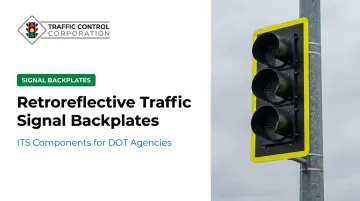
A standard signal backplate is simply the panel mounted behind a traffic signal head. Its job is basic but important: create a solid, contrasting background so the illuminated signal face stands out against sky, foliage, or building clutter during the day.
A retroreflective backplate does something more. It adds a fluorescent yellow reflective border, 1 to 3 inches wide per MUTCD guidance, around the plate's perimeter. That border doesn't just improve daytime contrast. It projects a bright rectangular outline at night by bouncing headlight beams straight back toward the driver.
The difference matters most in three scenarios:
- Power outages that leave the signal head unlit, while the reflective frame still marks its exact location
- Low-light conditions that make it hard for adjusting eyes to pick out signal color against a dark sky
- Aging or color vision-deficient drivers who struggle to distinguish red from green under certain lighting
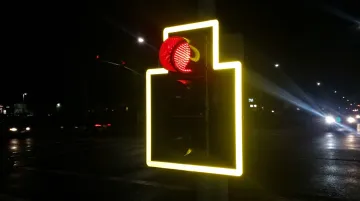
This isn't a cosmetic upgrade. FHWA specifically designed the treatment as a human-factors fix for older drivers and color vision-deficient drivers, groups who often need extra visual cues to react in time.
Why Agencies Are Adopting This Countermeasure Nationwide
State DOTs aren't treating this as optional anymore. Caltrans has installed reflective borders at more than 5,500 signalized intersections across California as part of a systematic statewide safety push. Connecticut DOT goes further, mandating retroreflective backplates on all new signal spans and applying them as standard practice on every upgraded intersection.
The agencies seeing the best results aren't cherry-picking a handful of dangerous intersections. They're making retroreflective borders the default across every intersection they upgrade.
The Safety Case: Crash Reduction Data Behind Retroreflective Backplates
The baseline number comes from the CMF Clearinghouse. Its evaluation of 17 treated sites, using an Empirical Bayes before-after method, found a Crash Modification Factor of 0.85, equivalent to a 15% reduction in total crashes at signalized intersections after backplate installation. That's a four-star-rated finding, meaning the methodology holds up.
Individual case studies show even sharper results at specific locations:
| Location | Total Crash Reduction | Injury Crash Reduction | Other Findings |
|---|---|---|---|
| Columbia, SC (3 intersections) | 28.6% | 36.7% | 49.6% drop in late-night/early-morning crashes |
| Kentucky (30 intersections) | 19.6% | — | Angle crashes down 44.4%; rear-end crashes down 10% |
Why Nighttime Crashes Drop the Most (and Who Benefits)
The pattern across both case studies holds steady: nighttime and low-visibility crash reductions consistently outpace daytime numbers. That tracks with how the technology actually works. Retroreflective sheeting depends on headlight beams hitting the border and bouncing back to the driver's eyes.
In daylight, the yellow border helps with contrast, but it's competing with ambient light. At night, it's the dominant visual signal, which explains why angle crashes (the kind that happen when a driver misjudges signal timing at a cross street) drop so sharply.
Who benefits most from increased signal conspicuity? Three driver groups gain the most from this treatment:
- Older drivers, who often experience reduced contrast sensitivity and slower visual processing at night
- Color vision-deficient drivers, who may struggle to distinguish red and green under certain ambient lighting
- Motorists on rural highways who encounter an unexpected signalized intersection after miles of open road with no warning
Installation Methods & Cost Considerations
Agencies generally choose from three installation approaches, and the right one depends on budget, existing equipment, and how many intersections need treatment.
Tape applied to existing backplates. This is the lowest-cost option, running around $35 per signal head, and works well for older signal inventory or agencies treating a handful of intersections rather than a full program. The tradeoff is durability: field-applied tape on an existing panel may not hold up as long as factory-integrated material.
New backplates with pre-applied retroreflective tape. More durable and better suited to new signal installations or full replacements. Before ordering, agencies need to inventory existing signal head brands and sizes to make sure the new backplates fit without modification.
New backplates without pre-applied tape (field-applied). Offers similar durability benefits to Method 2, but adds labor cost since the reflective sheeting has to be applied on-site. The same inventory groundwork applies here too.
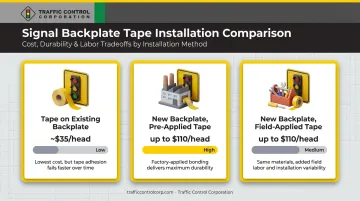
FHWA benchmarks put total costs between $35 and $110 per signal head, depending on the method:
| Installation Method | Cost per Signal Head |
|---|---|
| Tape applied to existing backplates | ~$35 |
| New backplates (pre-applied or field-applied tape) | Up to $110 |
On the labor side, FHWA field data shows installation can take as little as 10 to 15 minutes per backplate when crews are simply swapping backplates and leaving the existing signal head in place.
Where this gets complicated is procurement. Matching backplate dimensions, mounting hardware, and sheeting grade to an agency's existing signal fleet isn't always straightforward, especially across a mixed inventory built up over decades.
TCC works with agencies across its 11-state Midwest territory to match backplate style, size, and mounting hardware to existing signal inventory, whichever installation method fits the project. That matching reduces the guesswork before a purchase order goes out.
Selecting the Right Retroreflective Sheeting & Backplate Material
Not all reflective sheeting performs the same, and the choice affects both safety outcomes and how often an agency has to replace materials down the road.
Conspicuity is the top factor. Full-cube reflective sheeting is generally recognized at greater distances than standard prismatic sheeting, giving drivers more time to react.
However, FHWA's review of state practices found prismatic sheeting, particularly ASTM Type XI, used most often for signal-backplate borders, though Types I, III, and IV also show up depending on the state. The 2023 MUTCD sets a performance floor: border sheeting should be at least as bright as Type IV, without mandating full-cube Type XI specifically.
Durability matters just as much as brightness. Signal backplates sit outdoors for years, facing:
- UV exposure that degrades reflective film over time
- Temperature swings between summer heat and winter freeze-thaw cycles
- Wind, hail, and other severe weather
Material choice, whether that's an aluminum composite backplate or a weather-resistant reflective tape, directly affects how many replacement cycles an agency budgets for over a signal's service life.
Viewing angle is the piece agencies sometimes overlook. Signal heads mount well above typical headlight height, so the sheeting needs to reflect effectively even when headlights hit it from a disadvantageous angle. Sheeting engineered for a wide reflective cone performs better here than material designed primarily for flat, head-on visibility.
Implementation Considerations for Agencies
Before rolling out retroreflective backplates at scale, a few practical issues deserve attention.
Wind load is the big structural question. Adding a full backplate increases the surface area exposed to wind on a mast arm or pole. NCHRP Report 412 found that backplate-equipped signal attachments exposed to rear wind were the most susceptible configuration to galloping in tested scenarios. That said, the risk isn't uniform:
- Tape applied to an already-supported existing backplate adds negligible load, according to New Hampshire DOT's engineering review
- Adding an entirely new rigid backplate where none existed before changes the wind-exposed profile and warrants a structure-specific check
- Locations with sustained high wind speeds deserve priority review regardless of backplate type, per NCHRP's galloping susceptibility findings
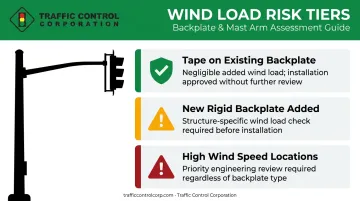
Agencies should verify existing mast arms and poles can handle the added load before installation rather than assuming every structure is fine.
Jurisdiction-wide adoption produces the best safety return. State DOTs that make retroreflective backplates a standard treatment across all signalized intersections, rather than isolated high-crash locations, see the strongest aggregate results. Piecemeal installation limits the benefit.
Installation errors are avoidable with the right support. Retrofitting existing signal heads introduces plenty of ways to get it wrong: mismatched mounting hardware, sheeting that doesn't meet MUTCD brightness requirements, or louver openings accidentally covered (which defeats their wind-dispersing function).
Partnering with an experienced regional distributor that offers factory-trained field service staff, onsite troubleshooting, and product training helps agencies avoid these costly mistakes and keeps warranty coverage intact.
Frequently Asked Questions
What are traffic signal backplates?
A backplate is a panel installed behind a traffic signal head to create a contrasting background. This improves visibility of the illuminated signal face against sky, buildings, or foliage.
What is a reflective backplate traffic light?
This refers to a signal backplate framed with a yellow retroreflective border. The border reflects headlights back to drivers, making the signal outline visible at night and during power outages.
How much does it cost to install retroreflective backplates?
FHWA cites a range of roughly $35 per head for tape applied to existing backplates, up to $110 per head for new backplates with integrated retroreflective material.
Are retroreflective borders required by the MUTCD?
MUTCD Section 4D.06 (previously 4D.12 in the 2009 edition) provides design guidance for agencies that choose to implement this treatment, recommending a 1- to 3-inch yellow border. Many states now adopt it as standard practice even where it isn't mandated.
How long does it take to install a retroreflective backplate?
Agencies like the City of Nashua, NH report installation times of roughly 10 to 15 minutes per backplate when the signal head stays in place.
Do retroreflective backplates still work during a power outage?
Yes. The reflective border stays visible through headlight reflection even when the signal itself loses power, giving drivers a clear visual cue to stop or proceed with caution.