Introduction
A driver rounds a bend on a rural two-lane road doing 55 mph. The curve tightens faster than expected.
There's no sign, no chevron, nothing to cue the brake pedal three seconds earlier. That split-second gap between seeing a hazard and reacting to it is where crashes happen.
It's not a rare scenario. Horizontal curves account for more than 25% of fatal crashes nationwide, with an average crash rate roughly three times higher than straight roadway segments, according to FHWA's horizontal curve safety data.
Advance warning signs exist to close that gap. This article breaks down what these signs are, how the MUTCD governs their design and placement, and where agencies deploy them most. It also covers how technology like RRFBs is changing how effective they can be.
Key Takeaways
- Advance warning signs give drivers time to perceive, decide, and react before reaching a hazard
- MUTCD placement requires engineering judgment, not guesswork or fixed formulas
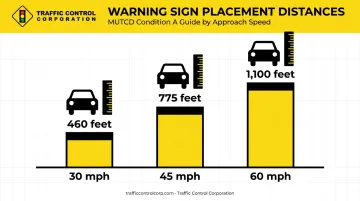
- Distance scales with speed: roughly 460 feet at 30 mph up to 1,100 feet at 60 mph
- School zone signs must use fluorescent yellow-green backgrounds by MUTCD standard
- RRFBs can push driver yielding rates as high as 98% when paired correctly with a warning sign
What Is an Advance Warning Sign?
An advance warning sign is a non-regulatory, diamond-shaped device that alerts drivers to a condition ahead that might not be obvious until it's too late to react safely. MUTCD Chapter 2C governs these signs, and the rules are specific about where they go and why.
The Diamond Shape and Color Code
Per current MUTCD Section 2C.02, warning signs must use a black legend and border on a yellow background, formatted as a diamond unless otherwise specified. Fluorescent yellow-green (FYG) is required for school-condition signs and optional for pedestrian, bicycle, and playground signs, boosting conspicuity where vulnerable road users are involved.
Common examples include:
- W1-2 (Curve Ahead): warns of an approaching horizontal alignment change
- W3-1 (Stop Ahead): flags a downstream traffic control device that isn't yet visible
- W11-2 (Pedestrian Crossing Ahead): alerts drivers to an upcoming crosswalk
These differ from regulatory signs (red/white, legally enforceable, like STOP or speed limit signs) and guide signs (green, purely informational). Warning signs advise; they don't command.
Why Placement Comes Before the Hazard, Not At It
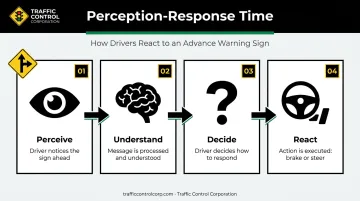
The entire concept hinges on Perception-Response Time (PRT): the time a driver needs to notice the sign, understand the message, decide on an action, and physically execute it. Placing the sign at the hazard defeats the purpose entirely. By then, there's no time left to act.
MUTCD Section 2C.01 is direct on this point: warning sign use shall be based on an engineering study or engineering judgment. Placement isn't arbitrary, and it isn't something a contractor should eyeball on-site.
The Three Types of Warning Signs (and How They're Categorized)
A common search question is "what are the three types of warning signs?" The honest answer: MUTCD's Table 2C-1 organizes warning signs by subject matter rather than three rigid buckets, but three broad functional groupings do help make sense of the system.
Roadway Alignment and Surface Conditions
These signs address physical characteristics of the road itself:
- Horizontal and vertical alignment (Curve Ahead, Hill Ahead)
- Cross-section changes (Road Narrows, Narrow Bridge)
- Surface or weather conditions (Bump, Slippery When Wet, Fog Area)
Traffic Control and Flow Warnings
This group flags upcoming traffic control devices or flow changes drivers might not anticipate:
- Advance traffic control (Stop Ahead, Signal Ahead)
- Merge and lane-ending conditions
- Intersection warnings (Cross Road, Side Road, T-Intersection)
Pedestrians, Bicyclists, and Other Road Users
This category covers non-vehicular conditions — pedestrians, bicyclists, animals, farm equipment, and shared-use path crossings. These signs frequently pair with supplemental plaques like AHEAD or XX FEET, which add distance or directional context without changing the sign's core category.
These Chapter 2C subcategories aren't the only lens for viewing warning signs. Some industry sources treat "warning, regulatory, guide" as the three overarching sign families across the entire MUTCD — a distinct, equally valid framing from the subcategories described above.
MUTCD Standards for Placement and Design
Getting placement right means understanding two variables: how fast traffic is moving, and what the driver needs to do in response.
Perception-Response Time Drives Distance
The faster the approach speed, the more distance a driver needs to perceive a warning sign, process it, and react. MUTCD Table 2C-3 provides guide distances for two conditions:
- Condition A: speed reduction and lane changes in heavy traffic
- Condition B: deceleration to a specific advisory speed
| Approach Speed | Condition A Distance |
|---|---|
| 30 mph | 460 ft |
| 45 mph | 775 ft |
| 60 mph | 1,100 ft |
These are guidelines, not blanket mandates — engineering judgment still applies to every installation.
Sizing and Placement Rules
MUTCD Section 2C.03 sets a minimum 36 x 36 inch size for diamond warning signs facing traffic on multilane conventional roads with speed limits above 35 mph, with larger oversized options standard on freeways and expressways.
Placement has a sweet spot:
- Too far in advance, and drivers forget the warning before reaching the hazard
- Too close, and there's not enough reaction time
Because visibility and driver behavior shift with lighting and traffic patterns, agencies should periodically re-evaluate placement in both day and night conditions. These distance and size rules cover geometry, but one sign category carries its own color mandate: school-zone signs require FYG (fluorescent yellow-green) backgrounds as a required design element, unlike the discretionary FYG option available for general pedestrian or bicycle signs.
Common Real-World Applications
Theory matters, but these signs earn their keep in specific field conditions:
- Pedestrian crossings: A W11-2 sign combined with an AHEAD or XX FEET plaque warns drivers of an upcoming crosswalk, particularly valuable where sight lines are limited by curves, hills, or roadside obstructions.
- School zones: Agencies must install school advance warning signs before the first school crosswalk sign in each direction of travel, using the mandatory FYG sheeting to maximize visibility during pickup and drop-off windows.
- Work zones and incident response: Temporary advance warning setups protect both workers and responders. According to FHWA's Traffic Incident Management research, secondary crash likelihood increases by 2.8% for every minute a primary incident remains a hazard in the roadway.
That statistic alone justifies rapid, correctly-placed temporary signage instead of delayed, ad hoc setups.
Enhancing Sign Visibility with Beacons and Technology
Static signs work well in most conditions, but some sites need additional reinforcement to achieve reliable driver compliance.
RRFBs Add Measurable Compliance Gains
Rectangular Rapid-Flashing Beacons (RRFBs) mounted with an advance warning sign can produce dramatic improvements in driver behavior. FHWA reports yielding rates as high as 98% at marked crosswalks using RRFBs, with pedestrian crash reductions of up to 47%, according to FHWA's proven safety countermeasures data on RRFBs.
An important distinction: an advance RRFB supplements the beacon at the crosswalk rather than replacing it. The two should be interconnected so drivers see a consistent, synchronized warning as they approach.
Wireless and Solar Systems Reduce Infrastructure Costs
Beyond RRFB placement, the power and communication infrastructure behind a beacon system also affects site feasibility. Agencies increasingly deploy solar-powered, wirelessly connected beacon systems to avoid trenching for electrical service. TCC works with JSF Technologies, whose AB Series beacons use a WP6 wireless controller with over 2,000 meters of range and system-to-system flash synchronization. This makes them well-suited for school zones, curve warnings, and pedestrian crossings where running conduit isn't practical.
As a Midwest distributor working with beacon, sign, and ITS manufacturers across an 11-state territory, TCC helps agencies match the right technology to site-specific conditions rather than defaulting to a one-size-fits-all beacon package.
Getting Advance Warning Signage Right: Working with a Regional Expert
Correct sign selection, sizing, and placement take more than a spec sheet. It takes engineering judgment paired with real product knowledge — knowing which beacon controller integrates with existing cabinet hardware, or which sheeting grade meets FYG requirements for a school zone install.
Traffic Control Corporation has served Midwest transportation agencies since 1946, building a multi-million-dollar inventory and a factory-trained field service team that supports:
- Selects products suited to site-specific warning and beacon applications
- Troubleshoots existing sign and beacon installations onsite
- Trains agency teams on the specific equipment they're deploying
That support spans DOTs, municipalities, and contractors across Illinois, Indiana, Iowa, Kansas, Michigan, Minnesota, Missouri, Nebraska, North Dakota, South Dakota, and Wisconsin. If your agency is planning an advance warning sign or beacon project, reach out to TCC for application-specific guidance before you finalize a spec.
Frequently Asked Questions
What is an advance warning sign?
It's a non-regulatory, diamond-shaped device placed ahead of a hazard to alert drivers to conditions requiring caution or a speed adjustment, per MUTCD Chapter 2C.
What are the three types of warning signs?
MUTCD generally groups warning signs into roadway-related, traffic-related, and non-vehicular condition categories. Other references classify warning, regulatory, and guide as the three broader sign families instead.
How far in advance should a warning sign be placed before a hazard?
It depends on posted speed and the required driver response. MUTCD guide distances range from roughly 460 feet at 30 mph to 1,100 feet at 60 mph, adjusted by engineering judgment.
What is the difference between a warning sign and a regulatory sign?
Warning signs are yellow, advisory, and not legally enforceable. Regulatory signs are white or red, mandatory, and carry legal weight if ignored.
Are advance warning signs required by law?
The MUTCD is federally adopted and legally binding for public roads. However, specific warning sign use typically relies on engineering judgment rather than blanket mandates, except for cases like school zone signs, which are explicitly required.
Who is responsible for installing and maintaining traffic control signs?
State and local transportation agencies and their contractors typically handle installation and maintenance, relying on distributors like Traffic Control Corporation and manufacturers for compliant products and technical support.