Introduction
Picture this: it's raining hard, visibility is low, and you're approaching an intersection you've driven through a hundred times. Instead of its usual green-yellow-red cycle, the signal is just flashing red. Do you stop and wait? Stop and go? Treat it like it's broken?
This confusion is common, and it matters. In 2022, intersections accounted for 12,036 traffic fatalities nationwide, split between unsignalized and signalized locations, according to the Federal Highway Administration's intersection safety data. Not knowing how to handle a flashing signal adds unnecessary risk to already dangerous locations.
This guide breaks down exactly what a flashing red light means and the steps to take when you see one. You'll also learn how it differs from other signal types, where you'll typically encounter it, and how the rules apply across Michigan and the broader Midwest.
Key Takeaways
- A flashing red light carries the same legal weight as a stop sign, requiring a full stop.
- You don't wait for green; proceed once the intersection is clear and safe.
- Flash mode often signals a power outage, malfunction, or scheduled off-peak operation.
- Right-of-way follows first-arrival order, then yields to the vehicle on the right.
- Railroad crossing flashers require you to stop completely until the lights and gates clear.
What Does a Flashing Red Light Mean?
A flashing red light carries the exact same legal authority as a stop sign: drivers must bring the vehicle to a complete stop before proceeding through the intersection.
Here's the part that trips people up: unlike a solid red light, you don't sit and wait for the signal to change. There's no "green" coming. Once you've stopped, checked for cross traffic and pedestrians, and confirmed it's safe, you're clear to go.
Why Signals Flash Red in the First Place
Flash mode is a built-in fallback in modern traffic controllers. Signals typically drop into this state for one of a few reasons:
- Power outages: the signal loses primary electrical service
- Equipment malfunctions: a fault is detected in the controller or monitoring hardware
- Scheduled off-peak operation: some agencies run intersections in flash mode overnight when traffic volume is low
- Active maintenance: technicians place the signal in flash while servicing it
Many intersections pair a flashing red on one street with a flashing yellow on the cross street. The flashing red side must stop; the flashing yellow side can proceed with caution but doesn't need to stop completely. Understanding both halves of that pairing matters, because assuming everyone faces the same signal can lead to a dangerous misread of the intersection.
Flashing red is also used independently at railroad crossings and certain pedestrian crossings, which have their own rules covered later in this article. The core principle to remember everywhere else: stop like a stop sign, then proceed only when clear.
Step-by-Step: What to Do When You Encounter a Flashing Red Light
Knowing the rule is one thing. Applying it correctly at a real intersection, especially with other confused drivers around you, is another.
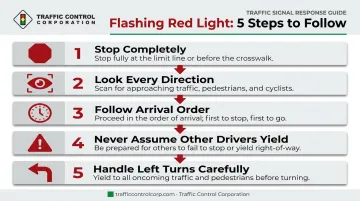
- Stop completely at the marked stop line. If there's no line, stop before the crosswalk. No crosswalk either? Stop at the point where you can see approaching traffic.
- Look every direction — cross traffic, pedestrians, and cyclists — before you move an inch further.
- Follow arrival order. The first vehicle to reach the intersection generally proceeds first. If two vehicles arrive at roughly the same moment, the driver on the right typically has priority.
- Never assume the other driver will yield, even if you technically have the right-of-way. Watch for eye contact, brake lights, or deceleration that confirms they're actually stopping.
- Handle left turns carefully. If you're turning left and a vehicle is coming straight through from the opposite direction, that straight-moving traffic generally has priority over your turn.
If every direction of an intersection is flashing red, treat it exactly like a standard four-way stop. No street has priority over another; it's simply first-come, first-served, with the right-hand rule breaking ties.
Flashing Red vs. Other Traffic Signals
Drivers often lump flashing red in with other signal types, but each one requires a distinct response.
| Signal Type | Required Action | When You May Proceed |
|---|---|---|
| Solid red | Stop and remain stopped | Only when the light turns green |
| Flashing yellow | Slow down, proceed with caution | Immediately, once safe — no full stop required |
| Red arrow | Stop; the arrow's turn is not permitted | Only when the arrow changes or another signal permits it |
| Flashing red | Stop completely | Once the intersection is clear and it's your turn |
The MUTCD's guidance on flashing signal operation confirms that a flashing red requires drivers to follow the same rules that apply after a stop sign.
Flashing red on your street often pairs with flashing yellow on the cross street. Misreading which one applies to your lane is one of the more common intersection mistakes, so take a beat to confirm before assuming.
Common Places You'll Encounter Flashing Red Lights
Malfunctioning or Power-Outage Signals
Flash mode exists as a safety fallback. When a controller detects a conflict, loses power, or suffers a component failure, it defaults to flashing red rather than displaying a potentially unsafe combination of indications.
This fail-safe design is intentional. It keeps an intersection usable, just under stricter rules, rather than leaving it dark.
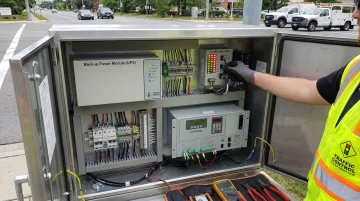
Reliable flash-mode behavior depends heavily on the equipment inside the cabinet. Traffic Control Corporation (TCC) supports municipalities and DOTs across the Midwest with signal products, field service, and troubleshooting aimed at minimizing malfunction-related flash events.
Key cabinet components affecting flash-mode reliability include:
- Conflict monitors that determine when a fault should force flash mode
- Backup power components that keep signals cycling normally during a brownout or outage
- Field service support to diagnose and resolve malfunction-related flash events
Railroad Crossings
Railroad crossing signals run on a separate control system triggered directly by an approaching train, unlike the cabinet-controlled signals above. Flashing red lights at railroad crossings work independently of nearby traffic signals.
Per NHTSA's railroad crossing safety guidance, drivers should stop at least 15 feet from the lights, gate, or flagger, and stay stopped until the lights stop flashing and gates fully rise.
This applies even if no train is visible. Trains can be closer and faster than they appear.
Pedestrian Crossings and Off-Peak Operation
Flashing red is used at certain pedestrian crossings, including hybrid beacons, to force a stop during high foot-traffic periods. Once stopped, drivers may proceed when the crosswalk is clear.
Some agencies also program regular signals to flash overnight when traffic volume drops. This improves flow at quiet hours while still requiring drivers to stop and check for cross traffic before proceeding in either scenario.
Flashing Red Light Rules in Michigan and Across the Midwest
Under Michigan's vehicle code, a flashing red signal is treated identically to a stop sign. Drivers must come to a complete stop before the crosswalk or limit line, then proceed only under the same rules that govern a standard stop-sign intersection.
That stop-then-yield principle holds steady across the broader Midwest, even though statutory wording varies slightly state to state:
- Illinois — stop at the line or nearest point with visibility, then proceed under stop-sign rules
- Indiana — same stop-then-yield structure
- Iowa — stop, then yield to any vehicle in the intersection or close enough to present a hazard
- Minnesota — stop at the line or nearest visibility point before proceeding
- Wisconsin — stop before the nearest crosswalk or limit line, then yield as at a stop sign
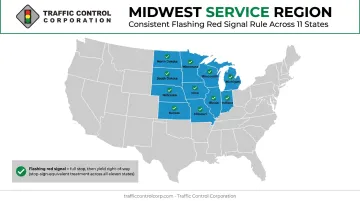
These rules only work as intended when the underlying signal equipment performs reliably. TCC supplies and services the controllers, conflict monitors, and cabinets that keep flashing-signal operations running safely for transportation agencies across Illinois, Indiana, Iowa, Kansas, Michigan, Minnesota, Missouri, Nebraska, North Dakota, South Dakota, and Wisconsin.
Legal and Safety Consequences of Ignoring a Flashing Red Light
Rolling through a flashing red without stopping isn't a minor slip. It's generally treated as a moving violation, similar to running a stop sign, and it can carry real consequences:
- Fines and license points: specifics vary by state, and courts weigh the exact charge, but a citation is a realistic outcome
- Higher insurance premiums: insurers treat a signal violation as evidence of risky driving, and that shows up directly in what you pay
- Civil liability: a driver who fails to stop and causes a crash can be held responsible for resulting damages, injuries, or worse
None of these outcomes require anything unusual to happen. They follow from a simple failure to treat a flashing red the way the law requires: like a stop sign, every single time.
Frequently Asked Questions
What should you do when approaching a flashing red traffic light?
Come to a complete stop, check for cross traffic and pedestrians in every direction, and proceed only when it's safe and you have the right-of-way.
What is a flashing red light in Michigan?
Michigan law treats a flashing red signal exactly like a stop sign. Drivers must stop completely before proceeding when the intersection is clear.
What is the difference between a flashing red light and a flashing yellow light?
Flashing red requires a full stop before proceeding. Flashing yellow only requires slowing down and proceeding with caution. No stop is needed.
Who has the right-of-way if two cars arrive at a flashing red light at the same time?
The vehicle on the right generally proceeds first when both cars arrive simultaneously. If arrival times differ, the first vehicle to stop typically goes first.
Is a flashing red light the same as a stop sign?
Functionally, yes. Both require a complete stop before proceeding. A flashing red is typically part of an active signal system, but the driver's required action is identical.
Why would a traffic light flash red instead of operating normally?
Common causes include power outages, equipment malfunctions, scheduled maintenance, or programmed off-peak flash operation during low-traffic overnight hours.