Introduction
A marked crosswalk with no signal often does little to slow traffic down. Drivers roll through, pedestrians hesitate at the curb, and near-misses become routine at the same intersections year after year.
The numbers back this up. The Governors Highway Safety Association projects 6,732 pedestrian deaths in the U.S. in 2025 — a preliminary estimate that's down 7% from 2024 but still 5% above 2019 levels, according to GHSA's 2025 preliminary data.
That gap between "marked" and "safe" is what Rectangular Rapid Flashing Beacons (RRFBs) close. The Federal Highway Administration recognizes RRFBs as a proven, low-cost countermeasure that boosts driver yielding without the expense of a full traffic signal.
This guide covers how RRFBs work, what the safety research shows, current MUTCD compliance rules, typical costs, and how to choose the right system for your project.
Key Takeaways
- RRFBs add two rapid-flashing yellow LEDs to standard pedestrian crossing signs
- FHWA data shows up to 98% motorist yielding and 47% fewer pedestrian crashes
- RRFBs are now formally codified under MUTCD 11th Edition, Chapter 4L, effective January 2024
- Installed cost depends heavily on power source, site access, and equipment tier
- Working with a regional distributor like TCC simplifies specification, sourcing, and field support
What Is a Rectangular Rapid Flashing Beacon?
An RRFB is a pedestrian- or bicyclist-activated warning device built around two rectangular, high-intensity yellow LED indications mounted directly below a pedestrian, school, or trail warning sign. When triggered, the beacons fire in an irregular, rapid "wig-wag" pattern, nothing like the slow, steady pulse of older circular flashing beacons.
That distinction matters. The erratic, high-frequency flash pulls a driver's peripheral vision toward the sign far more effectively than a predictable blink ever could. It's the same principle behind why strobing hazard lights catch your eye faster than a steady brake light.
Two activation methods are typical:
- Push-button activation — a pedestrian presses a button to trigger the flash cycle for a set duration
- Passive detection — video or infrared sensors detect a waiting pedestrian and activate the beacon automatically, no button press required
Regardless of activation method, one distinction stays constant: an RRFB is a warning enhancement, not a traffic control signal. Unlike a red light or a Pedestrian Hybrid Beacon, it creates no legal obligation for drivers to stop — it simply makes the crossing sign harder to ignore.
Standard placement calls for beacon assemblies on both sides of the roadway. Where a median or pedestrian refuge island exists, agencies should also install a beacon there rather than skipping the center placement.
RRFB vs. Other Crosswalk Safety Devices
RRFBs aren't the only tool in the toolbox, and they aren't always the right one. Here's how they stack up against other common devices:
| Device | Reported Performance | Key Limitation |
|---|---|---|
| RRFB | Yielding up to 98% (FHWA) | Ceiling varies by speed, lanes, crossing distance |
| Circular flashing beacon | One Seattle site saw yielding rise from 46% to just 52% after installation | Steady flash draws less driver attention |
| In-roadway warning lights | Historical multi-site average of 28%–53% by day, 13%–65% at night | Performance drops sharply after dark without RRFB pairing |
| Pedestrian Hybrid Beacon (PHB) | 55% reduction in pedestrian crashes (FHWA) | Requires a full stop; higher cost than RRFB |
These figures come from different study designs and shouldn't be read as one ranked list. But the pattern is consistent: rapid, irregular flash patterns outperform steady ones, and only a PHB legally compels a stop.
How Effective Are RRFBs at Improving Pedestrian Safety?
FHWA includes RRFBs in its Proven Safety Countermeasures collection — a designation reserved for treatments backed by solid crash data. That's a meaningful distinction from anecdotal traffic-calming ideas that lack peer-reviewed support.
The headline numbers:
- Up to 98% motorist yielding at RRFB-equipped crossings
- Up to 47% reduction in pedestrian crashes
- A Crash Modification Factor of 0.526, drawn from a nine-state study spanning 1,928 site-years between 2004 and 2013
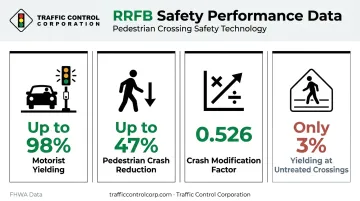
Compare that to a plain, unenhanced marked crosswalk. In one documented case in St. Petersburg, Florida, driver yielding at an untreated crossing sat at just 3%, a stark illustration of how little a paint stripe alone accomplishes.
But the 98% figure is a ceiling, not a guarantee. FHWA is explicit that yielding rates swing based on:
- Posted speed limit
- Number of travel lanes
- Total crossing distance
- Time of day
FHWA also flags a real risk: installing RRFBs everywhere dilutes their impact. Drivers who see the same device at every other block start tuning it out, the same way overused warning signs lose their punch.
The agency's guidance is to reserve RRFBs for locations with documented pedestrian safety issues, particularly multilane crossings posted below 40 mph, where the treatment performs best.
RRFB Regulations: MUTCD Compliance and Placement Rules
For years, RRFBs operated under FHWA Interim Approval status (first IA-11, then IA-21) while the agency gathered enough field data to justify permanent rulemaking. That waiting period ended with the MUTCD 11th Edition, effective January 18, 2024, which folded RRFB provisions into Chapter 4L as a standard, permanently recognized device.
Required sign pairings. An RRFB can't stand alone. It must accompany one of these warning signs:
- W11-2 (Pedestrian warning sign)
- S1-1 (School warning sign)
- W11-15 (Trail crossing warning sign)
Every installation also requires a W16-7P downward diagonal arrow plaque.
Where RRFBs are off-limits. Chapter 4L prohibits RRFB use at crossings already governed by a STOP sign, YIELD sign, traffic signal, or Pedestrian Hybrid Beacon, since these controls carry legal force already. The one exception: roundabout approaches and egresses, where an RRFB can still supplement existing controls.
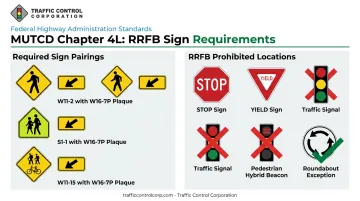
Placement. Beacon assemblies belong on both sides of the roadway. If a median refuge island exists, install a third assembly there rather than treating the median as optional.
One more thing worth doing before you finalize a spec: check your state DOT's currently adopted MUTCD edition and any state supplements. Not every state moves to a new federal edition on the same timeline, and a spec written against outdated guidance can create compliance headaches during review.
RRFB Cost, Funding, and Installation Options
Pricing for a complete RRFB system varies with site conditions, but there are useful benchmarks to start from. A U.S. DOT cost record puts a typical furnish-and-install cost around $10,000 per crosswalk, covering materials, equipment, and labor. For solar-powered special provisions specifically, a 2014–2019 average landed closer to $7,767.70.
Solar vs. hardwired power is usually the biggest cost swing factor:
- Solar-powered systems skip grid connection entirely, avoiding trenching and conduit work altogether. That makes them the practical choice at rural or remote crossings far from existing power infrastructure.
- Hardwired (AC) systems tie into the grid instead, bringing trenching and permitting costs that climb fast at sites without nearby power access.
There isn't a single reliable national figure for AC-powered installs, since site-specific labor and permitting costs vary too much to generalize. Get a site-specific quote rather than assuming a hardwired system costs a flat amount more.
These installation costs push many agencies to offset expenses through outside funding rather than absorbing them locally. Funding sources agencies commonly tap include:
- Highway Safety Improvement Program (HSIP): federal-aid funding tied to a data-driven safety case
- Safe Streets and Roads for All (SS4A): implementation grants requiring an eligible Action Plan
- State-level programs, such as Illinois's Transportation Enhancement Program, which covers crossing warning lights and pedestrian signal modifications
Documentation showing RRFBs as an FHWA-recognized proven countermeasure strengthens most funding applications, since reviewers are looking for treatments with a track record, not experimental ideas.
Choosing the Right RRFB System and Installation Partner
Not every RRFB on the market is built the same way, and the hardware is only part of the equation. Before finalizing a spec, ask any vendor:
- Does this system meet MUTCD 11th Edition, Chapter 4L requirements, confirmed in writing rather than just implied?
- What are the full product specifications, including wireless range, flash customization, intensity adjustment, and power options?
- What warranty terms apply, and do they cover full replacement or defects only?
- What's the installed cost, not just the hardware line item, including mounting, wiring, and commissioning?
TCC has worked through these questions with agencies across the Midwest for decades. Founded in 1946, Traffic Control Corporation has spent over 75 years as a regional distributor of traffic signal equipment and ITS solutions, representing more than 40 manufacturers across an 11-state Midwest territory.
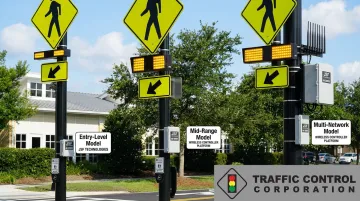
For RRFB systems specifically, TCC's core manufacturer partner is JSF Technologies. Its AB Series spans eight models, from the entry-level AB-1400 to the multi-network AB-9407, all built on a shared wireless controller platform with flash duration customization and remote firmware updates.
Two additional partners round out a fully compliant crossing:
- Applied Information adds cellular monitoring and remote scheduling
- PedSafety supplies accessible push buttons and APS stations
Beyond the initial purchase, TCC's factory-trained field service team provides:
- Product selection assistance matched to intersection geometry and existing cabinet infrastructure
- Onsite troubleshooting when a system malfunctions after installation
- Product and systems training so agency staff can maintain equipment long after the installation crew leaves
That kind of local support tends to matter more once a system has been in the field for a year or two than it does on install day.
Frequently Asked Questions
What is a rectangular rapid flashing beacon?
An RRFB is a pedestrian-activated warning device featuring two rectangular yellow LED beacons that flash in a rapid, irregular pattern below a crosswalk warning sign. It supplements the sign rather than replacing it.
How effective are rectangular rapid flashing beacons at improving pedestrian safety?
FHWA reports motorist yielding rates up to 98% and pedestrian crash reductions up to 47% at RRFB-equipped crossings. Actual results vary based on speed limit, lane count, and crossing distance.
How much does a rectangular rapid flashing beacon cost?
A federal cost benchmark puts typical furnish-and-install costs around $10,000 per crosswalk, with solar-powered special provisions averaging closer to $7,767. Power source and site access are the biggest cost drivers.
Are RRFBs required to be MUTCD compliant?
Yes. RRFBs are now a standard device under MUTCD 11th Edition, Chapter 4L, effective January 2024, and installations must meet its sign pairing and placement requirements.
Where should RRFBs be installed?
They work best at uncontrolled multilane crossings posted below 40 mph, school zones, and trail crossings with moderate traffic speeds. FHWA advises against installing them at every crossing, since overuse reduces driver responsiveness.
What is the difference between an RRFB and a Pedestrian Hybrid Beacon (PHB)?
A PHB displays a red signal that legally requires drivers to stop. An RRFB only enhances driver awareness of a warning sign and carries no legal stop requirement on its own.