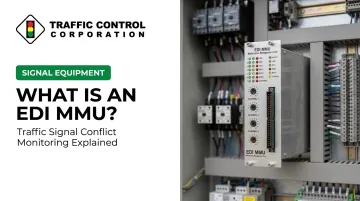
Search "EDI MMU," though, and you'll land on results from two completely different industries. In traffic engineering, MMU means one thing. In computing and embedded systems, it means something else entirely. That overlap trips up a lot of searches, whether you're a signal technician looking up a part number or someone just curious what's inside that cabinet.
This guide sticks to the traffic-control meaning. We'll cover what EDI and MMU stand for, how the unit functions inside a signal cabinet, what's new in current models, and how agencies choose and source the right one.
Key Takeaways
- MMU (Malfunction Management Unit) forces an intersection into flash mode when it detects a signal conflict
- EDI (Eberle Design Inc.), now part of Synapse ITS, has built these monitors for 45 years
- NEMA TS2 standardizes MMU function so units interoperate across cabinet types and manufacturers
- Newer models add remote app access, guided diagnostics, and stronger cybersecurity
- Cabinet compatibility and a properly trained sourcing partner matter as much as the unit itself
What Does "EDI MMU" Actually Mean?
What Is EDI?
EDI, short for Eberle Design Inc., has manufactured traffic monitoring hardware since 1980. Its 2025 product launch cites 45 years of experience building intersection-monitoring and detection equipment for the traffic, rail, and access control industries. EDI now operates as part of the Synapse ITS family of brands, and its monitors show up in signal cabinets across a large share of North American intersections.
What Does MMU Stand For in Traffic Control?
MMU stands for Malfunction Management Unit — a cabinet-mounted device that continuously checks the traffic signal's outputs for unsafe or conflicting conditions. If it finds one, it takes the intersection out of normal operation before anyone gets hurt.
You'll also hear these called "conflict monitors." That's the older, more common industry term, and NEMA TS2 explicitly pairs both names under one standard. This standardization matters: it means an MMU from EDI has to meet the same fault-detection requirements as one from any other manufacturer, so cities aren't locked into a single vendor. TCC's certified technicians test and certify MMUs from EDI, Reno A&E, and other NEMA-compliant manufacturers, giving Midwest agencies the same flexibility for service and support.
Why the Acronym Gets Confusing
Outside transportation, MMU almost always refers to a Memory Management Unit, computer hardware that translates the virtual memory addresses software uses into physical addresses the processor can act on. It's a completely unrelated piece of technology that happens to share three letters. This article is strictly about the traffic-signal-safety device.
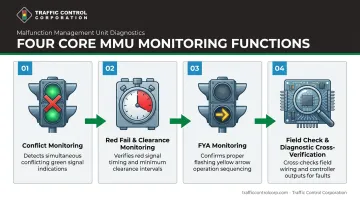
How Does an EDI MMU Work? Core Monitoring Functions
An MMU sits between the traffic controller and the field wiring or load switches. Instead, it watches continuously, comparing what the controller commands against the actual voltages showing up in the field. Any mismatch triggers a response, since even a brief conflict could put drivers in danger.
Conflict Monitoring
This is the function most people picture: catching two conflicting green (or Walk) indications on the same intersection at once. If the MMU sees a combination that isn't marked permissive on its program card, it immediately forces the cabinet into flashing operation. No waiting, no second check.
Red Fail & Clearance Monitoring
The unit also watches for red failures: a channel showing no voltage at all on its Green, Yellow, or Red field inputs. Just as important, it verifies timing: the minimum yellow change interval must be met before a phase ends, and the yellow-plus-red clearance time must meet the programmed threshold before a conflicting phase can display. Skip either check, and a driver could enter the intersection just as cross traffic gets the green.
Flashing Yellow Arrow (FYA) Monitoring
MUTCD's 2009 guidance on traffic control signal features requires flashing yellow arrow displays to use a four-section signal face in most configurations. NEMA's Amendment 4 built the monitoring architecture to match: two paired MMU channels track the four outputs of a single FYA signal group, covering the permissive channel's red, yellow, and green/FYA inputs alongside the protected turn's green arrow.
EDI states it deployed its first FYA-capable monitor in 2005, ahead of the eventual NEMA TS2-2016 standard that formally incorporated these provisions.
Field Check & Diagnostic Cross-Verification
Advanced units, like EDI's SmartMonitor line, go a step further. In Type 16 operation, Field Check Monitoring compares what the controller commanded over SDLC communications against what the MMU is actually sensing in the field. That cross-reference helps a technician quickly pinpoint whether a fault sits in the controller, the load switch, or the wiring itself, rather than guessing.
Key Features of Modern EDI MMUs
Today's MMUs do more than watch for conflicts. A few features now show up across most current-generation units:
- Diagnostic/Setup Wizard: Walks technicians through configuration and flags the exact faulty channel, so setup doesn't depend on memorizing every program card rule
- Remote Access & Mobile App: EDI's next-generation MMU, launched in 2025, delivers real-time intersection alerts, remote configuration, and citywide device visibility from mobile or desktop
- Enhanced Cybersecurity: End-to-end protections, including user verification and device auditability, aligned with current data-protection expectations for public infrastructure
- Cabinet Mode Flexibility: One unit family supports Type 12, Type 16, and SDLC configurations, adapting to different controller setups without separate hardware per cabinet type
- Cost and Labor Efficiency: Remote diagnostics cut down on unnecessary truck rolls, letting technicians check status and pull logs before deciding whether a field visit is needed
That last point matters for agencies managing hundreds of intersections with a limited maintenance crew. Fewer wasted trips to a cabinet that turns out to be fine means more hours available for the intersections that actually need attention.
Why MMUs Matter for Traffic Safety and Compliance
The MMU is the fail-safe of last resort. If a controller malfunctions, a load switch fails, or wiring degrades in a way that creates a conflicting green, the MMU is what stands between that fault and a crash.
According to FHWA's Traffic Signal Program Handbook, an MMU fault sends the intersection to a fail-safe mode — usually flashing red for all approaches — until a technician resets it.
This isn't optional equipment for most public agencies:
- NEMA TS2 places MMU requirements directly inside its cabinet assembly standard
- MUTCD requires an independent flasher mechanism and a conflict-monitor circuit capable of initiating flash mode
- Flashing operation must continue even if the controller or MMU is removed or powered off
Running an outdated or non-compliant monitor doesn't just risk a malfunction going undetected. It creates a liability gap for the agency if an incident happens and the equipment can't be shown to meet current standards.
Choosing and Sourcing the Right EDI MMU for Your Agency
Picking the right unit comes down to matching hardware to your cabinet, not simply choosing the newest model on the shelf. Consider:
- Cabinet compatibility: Confirm whether your cabinets run NEMA TS-1, NEMA TS-2, ATC, CALTRANS 33x, or ITS Cabinet standards before specifying a unit.
- Channel and phase requirements: A standard monitor like EDI's MMU-1600D covers straightforward operations, while the programmable eight-phase, dual-ring MMU2-1600GE fits more complex intersection geometry.
- Connectivity needs: Decide whether your agency's network and staffing justify remote app access and enhanced security features, or whether a standard unit suffices.
This is where a regional distributor earns its keep. Traffic Control Corporation (TCC) has served Midwest transportation agencies since 1946, representing EDI and 40-plus other manufacturers across an eleven-state territory. Beyond product sales, TCC's factory-trained technical staff provide:
- Product Selection and Application Assistance: Pre-purchase consulting that matches MMU models to existing cabinet types, particularly useful for legacy installations with tight integration constraints.
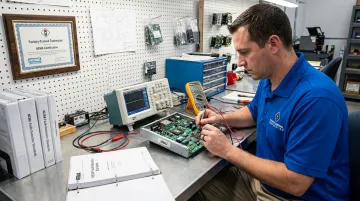
- Conflict Monitor Testing & Certification: Bench testing against NEMA fault-detection standards, with a documented certification record agencies keep for liability purposes.
- Onsite troubleshooting and signal turn-on support across Illinois, Indiana, Iowa, Kansas, Michigan, Minnesota, Missouri, Nebraska, North Dakota, South Dakota, and Wisconsin.
Before you commit to a purchase, talk with a knowledgeable distributor to confirm NEMA and MUTCD compliance up front. It's a lot cheaper than discovering a mismatch after the equipment is already installed.
Frequently Asked Questions
What does MMU stand for in traffic control?
MMU stands for Malfunction Management Unit, a cabinet-mounted device that monitors traffic signal outputs for unsafe or conflicting conditions. When it detects a fault, it forces the intersection into a safe flashing mode.
Is an EDI MMU the same as a conflict monitor?
Yes. "Conflict monitor" is the older, common term for the same category of device, now standardized as an MMU under NEMA TS2. NEMA's own documentation lists both names together.
What happens when an MMU detects a fault?
The unit de-energizes its output relay and transfers the intersection to flashing operation, typically flashing red on all approaches. It logs the fault, and the condition stays latched until a technician resets it.
Do all traffic signal cabinets require an MMU?
Most modern NEMA TS2-compliant cabinets require an MMU as a mandatory safety component. Whether a specific agency's procurement rules require TS2 compliance depends on local specifications.
What's new in EDI's latest MMU model?
EDI's 2025 next-generation unit adds mobile and desktop app access, real-time intersection alerts, and remote configuration, along with enhanced cybersecurity like user verification and device auditability. The goal: fewer unnecessary truck rolls.
What does MMU stand for in embedded systems security?
In computing, MMU refers to a Memory Management Unit — hardware that translates virtual memory addresses into physical ones. It has no connection to the traffic-signal Malfunction Management Unit covered in this article.