Picking the wrong one isn't a minor misstep. It can leave a safety gap on a high-speed arterial, burn through a limited capital budget, or fail to satisfy MUTCD warrant requirements during a design review.
The stakes are real: FHWA reports that RRFBs cut pedestrian crashes by 47%, while Pedestrian Hybrid Beacons reduce pedestrian crashes by 55%, along with a 29% drop in total crashes. This guide breaks down when each device makes sense, backed by MUTCD chapter references and field data.
Key Takeaways
- RRFB: Rapid-flashing LEDs request yielding on roads posted 35-40 mph, at lower cost.
- HAWK/PHB: Full stop-and-go sequence legally compels drivers to stop, suited to higher-speed, higher-volume arterials.
- Choice hinges on posted speed, AADT, lane count, and MUTCD warrant analysis, not a default answer
- TCC supplies and supports both product lines across its 11-state Midwest territory
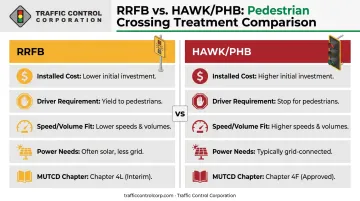
RRFB vs HAWK: Quick Comparison
| Factor | RRFB | HAWK / PHB |
|---|---|---|
| Cost (installed) | Historically $4,500-$52,000, averaging around $22,250; some solar bids run closer to $10,000 | Historically $21,000-$128,000, averaging near $57,680 per unit |
| Driver requirement | Yellow flashing display; drivers must yield, but there's no red stop indication | Full sequence ending in steady red (must stop) and flashing red (stop, then proceed if clear) |
| Speed/volume fit | Most effective under roughly 40 mph | FHWA guidance points toward speeds near 35 mph or higher and AADT above 9,000 |
| Power needs | Solar or hard-wired; two beacon units minimum, plus median unit if applicable | Overhead or pole-mounted beacon faces on each approach, stop lines, detection, associated cabinet |
| MUTCD chapter | Chapter 4L | Chapter 4J |
Cost figures come from FHWA's 2018 program benchmarks and a 2024 ITS deployment evaluation. They're historical reference points, not current Midwest bid guarantees, since mounting, trenching, and power source all swing the final number.
What Is an RRFB?
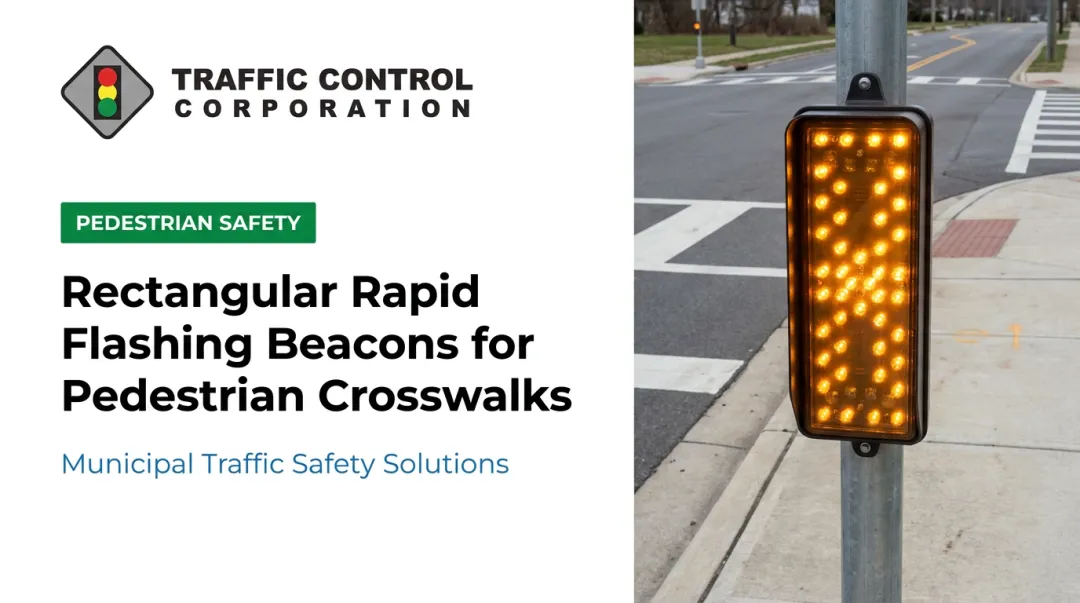
A Rectangular Rapid Flashing Beacon is a supplemental warning device, not a traffic signal. It mounts near existing crosswalk warning signs and fires a high-intensity, wig-wag LED flash pattern the moment a pedestrian or cyclist activates it.
MUTCD Chapter 4L classifies it as a Warning Beacon, meaning drivers still carry the underlying duty to yield. Nothing forces them to stop the way a red light would.
Why Agencies Choose RRFBs
The appeal comes down to speed of deployment and low overhead:
- Solar compatibility removes trenching costs at sites far from grid power
- Quick retrofit onto existing sign posts, often without new poles
- Configurable activation — push-button, passive video, or infrared detection
- Single or dual-beacon setups, depending on crossing width and lane count
Within this configurable lineup, TCC's primary RRFB line comes from JSF Technologies' AB Series, spanning eight models from the compact AB-1400 up to the multi-network AB-9407. Each unit runs on a wireless controller platform that supports remote monitoring through Applied Information's Glance platform.
Where RRFBs Perform Best
School zones, trail crossings, and residential or collector roads with low-to-moderate speeds are the sweet spot. Pairing an RRFB with a raised crossing, curb extension, or median refuge island adds a physical layer of protection the beacon alone can't provide.
This effect shows up clearly in the data. FHWA's before/after study across 22 multilane uncontrolled crossings found motorist yielding jumped from roughly 4% before installation to 78% within a week. That figure settled around 83% after a year, a dramatic result for a device that costs a fraction of a full signal.
What Is a HAWK Beacon (Pedestrian Hybrid Beacon)?
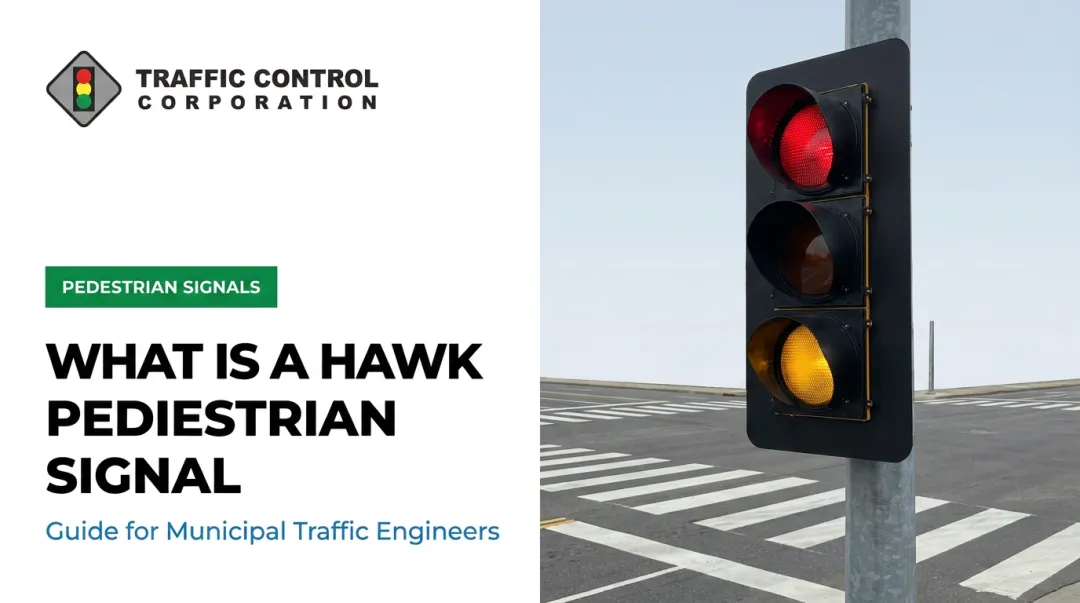
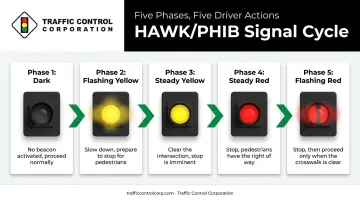
The HAWK, formally the Pedestrian Hybrid Beacon under MUTCD Chapter 4J, looks different from any other signal on the road: two red lenses stacked above a single yellow lens. It stays dark until a pedestrian activates it, then runs through flashing yellow, steady yellow, steady red, and alternating flashing red before returning to dark.
That steady red phase is the key distinction from an RRFB. Drivers must come to a complete stop and remain stopped. During the later flashing red phase, they may proceed cautiously, but only after stopping and confirming the crosswalk is clear.
That legal stop requirement translates into measurable behavior change. FHWA field research at 20 PHB sites in Austin and Tucson recorded average motorist yielding of 96%, with individual sites ranging from 87% to 100%.
Where HAWK Signals Fit
HAWK installations make sense on:
- Multi-lane arterials with posted speeds at or above 35 mph
- Corridors with AADT above roughly 9,000 vehicles
- Crossings near hospitals, schools, or transit stops with heavy pedestrian demand
State DOTs typically deploy HAWK signals where a full traffic signal isn't warranted by conventional volume thresholds, but an uncontrolled crossing isn't safe enough either. TCC sources HAWK/PHB units through PedSafety, a division of Campbell Company, with NEMA TS-1, TS-2, and ATC cabinet compatibility built in.
RRFB vs HAWK: Which One Should You Choose?
There's no universal winner here. The right device depends on a handful of engineering factors reviewed together, not in isolation:
- Posted speed: under 40 mph tends to favor RRFB; 35 mph and above shifts the calculus toward HAWK
- AADT: higher volumes strengthen the case for a legally binding stop
- Number of lanes: multi-lane crossings without a refuge island raise the risk profile HAWK is built to address
- Budget constraints: RRFB's lower installed cost matters when a corridor has multiple crossings needing treatment
- MUTCD warrant analysis: Chapter 4J requires an engineering study comparing vehicle and pedestrian volumes against Figure 4J-1 or 4J-2 curves; Chapter 4L has no numerical warrant, so engineering judgment carries more weight
These treatments aren't mutually exclusive across a corridor, either. Many agencies layer RRFBs with curb extensions, raised crossings, or refuge islands per FHWA's STEP guidance, reserving HAWK signals for the specific intersections where speed and volume justify the added cost.
The right fit comes from warrant data and engineering judgment, not a default preference. TCC works alongside Midwest agencies to walk through both product lines, match equipment to existing cabinet infrastructure, and provide hands-on application assistance before a bid ever goes out.
Real-World Case Study: Grandview Parkway, Traverse City, Michigan
A four-lane section of Grandview Parkway carrying roughly 30,000 vehicles per day had no signalized crosswalks at Elmwood Avenue or Hall Street, despite five crashes recorded over the preceding two years. Local input pushed MDOT's North Region and the Traverse City Transportation Service Center to act.
| Case detail | Outcome |
|---|---|
| Roadway | Four-lane arterial, ~30,000 AADT |
| Prior crash history | 5 crashes over 2 years |
| Treatment installed | Two Pedestrian Hybrid Beacons (June 2019) |
| Result (through March 2020) | Zero pedestrian or bicycle crashes recorded |
The nine-month observation window is short, so this isn't a long-term percentage reduction claim. Still, the zero-crash result on a high-volume arterial shows exactly where PHB investment outperforms a lower-cost alternative like RRFBs.
Agencies facing a similar crossing decision don't have to work through the trade-offs alone. TCC's engineers help agencies across its 11-state Midwest service area—including Michigan—select the right beacon, troubleshoot onsite, and train staff on both RRFB and HAWK/PHB systems.
Frequently Asked Questions
What is the difference between the HAWK (PHB) signal and an RRFB?
A HAWK legally stops traffic with a red signal phase, while an RRFB only asks drivers to yield through flashing warning lights. That legal distinction is why HAWK systems cost more and suit higher-speed, higher-volume roads.
What are the four types of crossings?
Common descriptive categories include marked uncontrolled crosswalks, RRFB-enhanced crossings, PHB/HAWK-controlled crossings, and fully signalized intersections. MUTCD doesn't formally define these as a fixed four-tier system, but the labels are widely used in practice.
Can RRFB and HAWK be used at the same crosswalk?
Generally, no. Each device serves a different function, and MUTCD language treats RRFBs as inapplicable where a PHB or signal already controls the approach. RRFBs are more commonly paired with physical treatments like refuge islands instead.
Are drivers legally required to stop for a HAWK beacon?
Yes, during the steady red phase, drivers must stop and remain stopped. After that, drivers may proceed cautiously through the alternating flashing red phase, but only once the crosswalk is clear.
How much does it cost to install an RRFB vs. a HAWK signal?
Historical FHWA figures put RRFB installations around $4,500-$52,000, averaging near $22,250, while HAWK/PHB installations run $21,000-$128,000, averaging around $57,680. Actual costs vary by mounting, power source, and region.
Which MUTCD warrants determine whether I need a HAWK or an RRFB?
HAWK/PHB installations fall under Chapter 4J, which uses engineering-study curves comparing vehicle and pedestrian volumes. RRFBs fall under Chapter 4L, which has no numerical warrant, leaving speed, volume, and engineering judgment to guide the decision.