Introduction
Picture a signal engineer who needs vehicle counts at a busy arterial intersection by next month. The old approach means saw-cutting pavement, closing a lane, and waiting for a crew with specialized tools. There's a faster way.
Wireless traffic sensors skip the trenching entirely. They mount on poles, sit on the shoulder, or embed with minimal pavement disturbance, then send data to a controller or cloud platform over radio, cellular, or similar links.
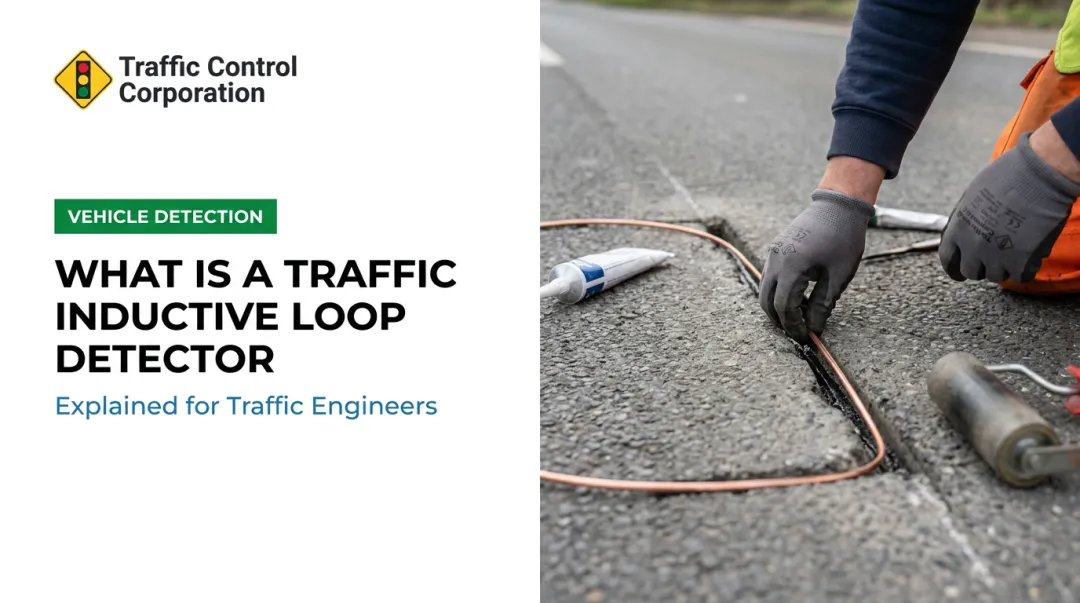
Reliability drives this shift as much as convenience does. According to the FHWA Traffic Detector Handbook, 25% of roughly 15,000 inductive loops in a New York study were inoperative at any given time. Above-ground and low-impact alternatives close that reliability gap.
This guide covers how these sensors work, the main technology types, real advantages over loops, common applications, and what to evaluate before you specify a system.
Key Takeaways
- Wireless sensors detect vehicles without pavement-embedded hardware, cutting installation time and lane closures
- Radar, magnetometers, video/AI, Bluetooth/WiFi, and acoustic/infrared each suit different needs, not one universal solution
- These systems support permanent installations and short-term studies like work zones or special events
- A multi-manufacturer distributor helps match sensor type to actual site conditions, not guesswork
What Is a Wireless Traffic Sensor and How Does It Work?
A wireless traffic sensor detects a vehicle's presence, passage, speed, or classification, then transmits that data without a hardwired connection back to a controller or central system. The industry splits detection into two categories.
In-roadway detectors sit embedded in the pavement or subgrade, such as loops and magnetometers. Over-roadway detectors mount above or beside the road, including radar, video, and Bluetooth readers. Wireless technology shows up in both categories, so "wireless" describes the communication method, not the physical placement.
The Basic Detection Pipeline
Here's how a typical event moves through the system:
- Sensing — A vehicle triggers a change in the sensor's field, whether magnetic, radar reflection, or video frame
- Conversion — The sensor turns that change into a digital signal
- Transmission — Data travels wirelessly via RF, cellular, or a similar protocol to a receiver, controller, or cloud platform
- Application — Agencies use the resulting data for signal timing, vehicle counts, or reporting dashboards
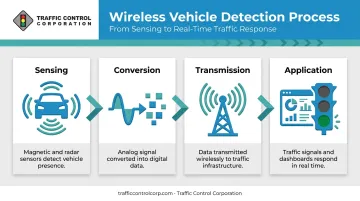
Beyond sensing and transmission, most wireless sensors run on battery or solar power with long-life designs, letting them operate for years with minimal site visits. Agencies apply this data to actuated signal control, ramp metering, variable speed limits, and queue warning systems.
Performance still hinges on matching the sensor to the site: a wireless magnetometer from a manufacturer like Sensys Networks suits a single-lane approach, while an Intuicom radio link fits a corridor spanning several intersections.
Types of Wireless Traffic Sensor Technologies
No single sensor fits every application. The right pick depends on lane configuration, speed environment, data requirements, and budget.
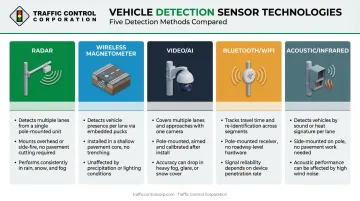
Radar-Based Sensors
Above-ground radar units mounted on poles or mast arms detect presence, speed, and count across multiple lanes at once. Frequency-modulated continuous wave (FMCW) models can even detect stopped vehicles, which continuous-wave Doppler units cannot.
Side-fire configurations, like Sensys Networks' RTMS Echo distributed through TCC, cover up to 12 lanes from a single roadside pole and configure through a browser interface rather than specialized field tools. This makes radar a strong fit for highway approaches and multi-lane arterials.
Wireless Magnetometers
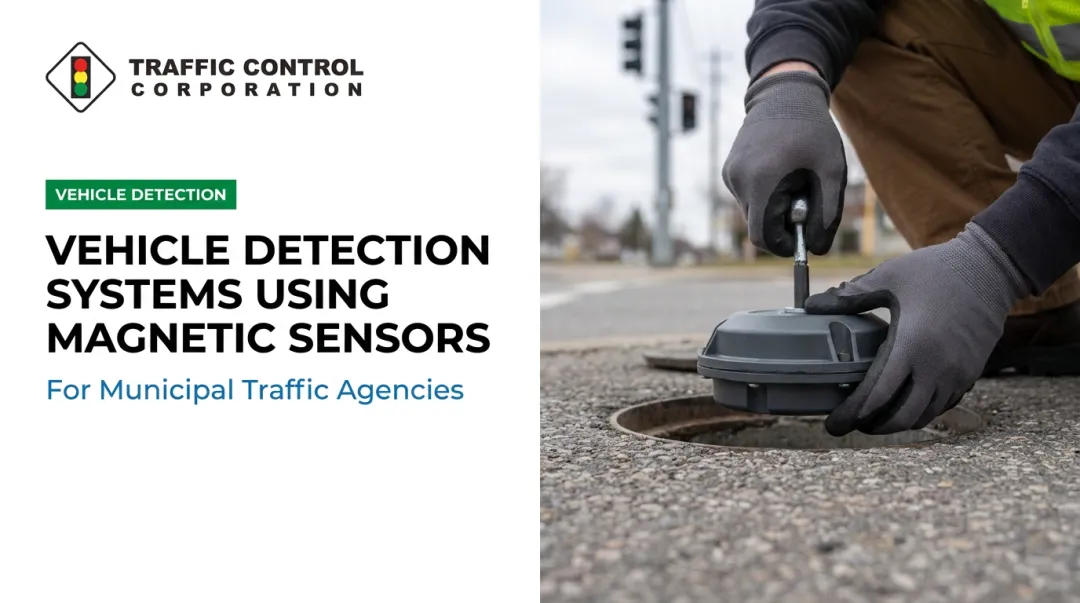
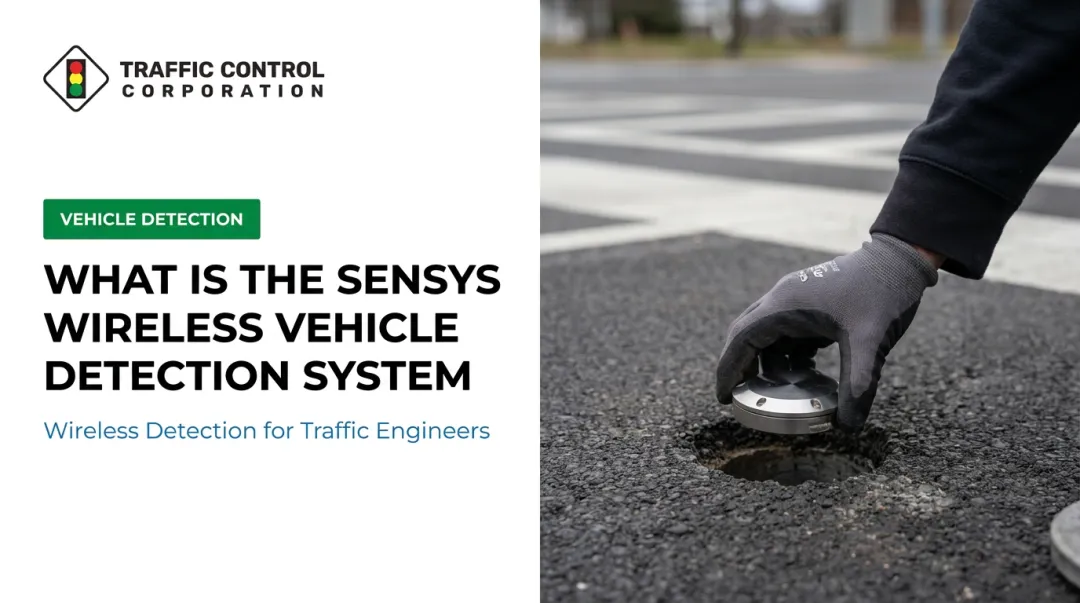
Compact magnetometers install with far less pavement disturbance than a full loop cut, though they still require some in-ground work. They detect vehicles through changes in the Earth's magnetic field and transmit results wirelessly to a roadside receiver, with typical sensor-to-radio ranges around 100 to 200 feet.
One unit commonly emulates a standard loop's detection zone, but small fixed zones may need multiple sensors for full lane coverage.
Video and AI-Based Detection
Camera systems paired with AI analytics can classify vehicles, pedestrians, and bicycles while monitoring several lanes from a single unit. Products like Econolite's Autoscope OptiVu and EPIQ RADAR (which pairs FMCW radar with a 1080p camera) increasingly transmit over wireless links or power line communications instead of dedicated cable runs.
Occlusion, glare, and heavy precipitation remain known limitations for camera-based systems.
Bluetooth and WiFi Detectors
These systems detect MAC addresses from Bluetooth and WiFi-enabled devices in passing vehicles, matching the same identifier at two points to calculate travel time and origin-destination patterns. FHWA recommends truncating, randomizing, or deleting MAC identifiers after matching to protect driver privacy.
This method samples a portion of traffic, not every vehicle, since it depends on devices being discoverable.
Acoustic and Infrared Sensors
Microphone arrays detect vehicles by sound signature, while infrared sensors sense heat or motion changes. Both are often paired with other technologies or used for stopped-vehicle detection.
FHWA notes that acoustic arrays generally handle precipitation well but can be affected by cold-temperature shifts in sound generation, while infrared sensitivity can drop during heavy rain, snow, or dense fog.
Benefits of Wireless Sensors Over Traditional Inductive Loops
Eliminating saw-cutting changes the installation math. Wireless detection simplifies both setup and ongoing operations in ways traditional loops can't match:
- Cuts installation time by eliminating trenching, resulting in shorter lane closures, fewer crews on-site, and less worker exposure to live traffic.
- Simplifies maintenance since pole-mounted radar or camera units are typically accessible from the shoulder, unlike a failed loop that requires digging up pavement again.
- Enables software-based reconfiguration, letting many wireless systems relocate or adjust without new construction when lane layouts change or a temporary deployment needs to shift.
The reliability case is backed by data, not just convenience. Beyond the New York loop study cited earlier, FHWA documented annual loop failure rates of 24% in one Minnesota district and 29% in Cincinnati. Cracked sealant, water intrusion, and freeze-thaw damage to embedded wiring drove most of these failures.
That said, wireless isn't automatically superior in every case. MnDOT's evaluation of non-intrusive detection technologies found that accuracy varies by technology, installation quality, traffic conditions, and weather, meaning results can approach loop-level accuracy but aren't guaranteed by default (MnDOT Non-Intrusive Detection Evaluation). Proper mounting, aiming, and calibration still determine whether a sensor performs as advertised.
Common Applications for Wireless Vehicle Detection
Wireless detection shows up across a range of scenarios, each with different priorities:
- Signalized intersection actuation — Detectors call and extend green phases based on actual traffic presence instead of fixed timing plans, reducing unnecessary delay
- Work zone monitoring — Portable radar and Bluetooth units feed queue-warning systems, triggering changeable message signs when traffic slows unexpectedly
- Temporary traffic studies — Short-term counts and classification studies deploy quickly without cabling, useful for before/after comparisons or special event planning
- Corridor travel-time monitoring — Bluetooth or WiFi readers placed at multiple points along a route calculate segment travel times, as seen in TxDOT's Houston-area deployment along 225 miles of I-45
- Congestion mapping and queue-warning — Networked sensors along a corridor detect slowdowns and alert drivers or operators before backups worsen
These deployments share a common thread: speed and flexibility where fixed infrastructure isn't practical. Michigan DOT put that to use with portable sensors to power dynamic lane-merge systems in work zones, adjusting merge messages as real-time conditions change. That's the practical value of wireless detection: quick setup where cabling isn't feasible or worth the cost.
How to Choose the Right Wireless Traffic Sensor System
Start with the operational goal, not the hardware. Signal actuation, count and classification data, speed monitoring, and travel-time analysis each point toward a different sensor category.
Key evaluation factors:
- Detection accuracy for your specific lane configuration and approach geometry
- Weather and environmental durability, especially under Midwest snow, glare, and freeze-thaw cycles
- Power source and battery life, including whether solar or mains power is available
- Data transmission range and reliability between sensor and receiver or controller
- Integration compatibility with existing controllers, NEMA TS2 or ATC protocols, and ATMS software like Centracs
Mismatched hardware and site conditions cause more underperformance than any single product flaw. A radar unit aimed wrong, or a magnetometer placed where a fixed zone can't accommodate future restriping, will disappoint regardless of the manufacturer's specs.
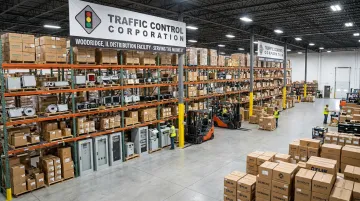
Traffic Control Corporation (TCC) has served as the Midwest's regional distributor for over 75 years. TCC represents 40+ manufacturers, including Econolite, Sensys Networks, Image Sensing Systems, GE Current, Reno A&E, and Intuicom, backed by a multi-million-dollar inventory at its Woodridge, Illinois facility.
Agencies across TCC's 11-state service area get support that goes beyond the sale:
- Product selection guidance matched to site conditions and lane geometry
- Onsite troubleshooting when a detection zone underperforms
- Factory-trained calibration and configuration, from EPIQ RADAR units to a 12-lane RTMS Echo deployment
- Integration support connecting sensor data into Centracs +Detect
Frequently Asked Questions
How does a traffic sensor work?
A sensor detects a vehicle's presence, passage, or speed through methods like magnetic field changes, radar reflection, or video analysis. That detection converts into a signal sent to a controller or data system.
What devices can be used to monitor the flow of traffic?
Common devices include inductive loops, magnetometers, radar units, video/AI cameras, Bluetooth/Wi-Fi detectors, and acoustic or infrared sensors. Each suits different lane configurations, budgets, and data needs.
What is the difference between wireless and wired traffic sensors?
Wired sensors like loops require embedded cabling and physical construction to install or repair. Wireless sensors transmit data via radio, cellular, or similar protocols, simplifying both installation and relocation.
How accurate are wireless traffic sensors compared to inductive loops?
Accuracy depends on the technology and installation quality, not a fixed industry number. Properly specified and mounted wireless sensors can match or exceed loop accuracy while offering far easier maintenance access.
Do wireless traffic sensors work in all weather conditions?
Most are rated for outdoor use, but performance varies by technology. Short-range radar generally handles inclement weather well, while video and infrared sensors can be affected by fog, heavy rain, or snow (FHWA Over-Roadway Sensors Summary).
How long do wireless traffic sensor batteries typically last?
Battery life varies by device and usage pattern, though manufacturer estimates for some wireless magnetometers range from 8.5 to 13 years. Solar-powered options can extend service life further, but batteries remain finite components requiring eventual replacement.