That's the real-world stake behind Accessible Pedestrian Signal (APS) failures, and it's why "APS Guardian" keeps coming up in traffic engineering circles. The acronym itself causes confusion, since APS also stands for Adult Protective Services in social work and gets used loosely as shorthand in various businesses. This article sticks to one lane: APS in the traffic engineering and ADA compliance world, and what APS Guardian-style monitoring means for agencies responsible for keeping these devices working.
Key Takeaways
- APS Guardian is Accessible Pedestrian Signal monitoring technology, not a legal or social-services term.
- Remote monitoring catches stuck buttons, silent audio, and lost connectivity before they trigger ADA compliance risks.
- Centralized dashboards cut manual field inspections and speed up repair timelines.
- TCC supports Midwest agencies with APS Guardian selection, installation, and technical service.
What Does APS Stand For in Traffic Management?
In transportation and public infrastructure, APS stands for Accessible Pedestrian Signal. According to the Manual on Uniform Traffic Control Devices (MUTCD), 11th Edition, an APS is defined as a device that communicates pedestrian signal phase information in non-visual formats, including audible tones, speech messages, and vibrotactile surfaces.
This isn't optional street furniture. Multiple federal and legal mandates make APS installation and maintenance a requirement, not a courtesy:
- MUTCD requires an APS whenever a new pedestrian signal head goes in or an existing one gets replaced.
- ADA Title II requires public entities to maintain accessible features in operable working condition, with only isolated or temporary interruptions permitted for repairs.
- PROWAG (Public Right-of-Way Accessibility Guidelines) spells out the technical requirements, covering pushbutton placement, tactile arrows, locator tones, and audible WALK indications.
So when someone searches "APS" in this context, they're not looking for Adult Protective Services or a generic business acronym. They're looking at a compliance-driven piece of infrastructure with legal teeth behind it.
What Is APS Guardian?
APS Guardian describes the category of remote monitoring and diagnostic technology built specifically for Accessible Pedestrian Signal installations. Public agencies use these systems to keep tabs on the health of every APS unit across their intersection network, without physically visiting each one.
The Problem It Solves
Without remote monitoring, agencies typically find out about a broken APS in one of two ways: a citizen complaint, or an infrequent manual inspection. Both are slow. Both leave a gap during which a person who is blind or has low vision might not get accurate crossing information.
That gap carries real legal weight. A federal judge held the City of Chicago liable under the ADA in 2023. The ruling followed findings that, of nearly 2,800 intersections with visual pedestrian signals, fewer than 1% had APS installed when the Department of Justice intervened.
New York City faced a similar reckoning, with a federal order requiring more than 9,000 new APS installations over ten years. Malfunctioning units that go undetected for months can create the same kind of exposure as never installing APS at all.
How Monitoring-Capable APS Systems Work
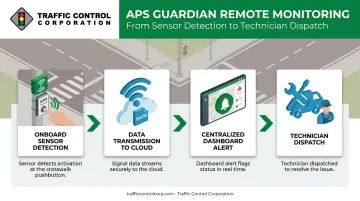
Remote monitoring closes exactly this gap. APS units built for this purpose use onboard sensors and firmware to track status data, then report it back to a centralized dashboard that maintenance staff can access from a desk instead of a bucket truck.
Typical status data includes:
- Activation counts per pushbutton press
- Audio output levels
- Network connectivity status
These systems are designed to slot into the broader Intelligent Transportation Systems (ITS) ecosystem rather than operate as an island. That means integration with existing traffic signal controllers and cabinet setups, not a rip-and-replace approach. TCC works with APS products, including PedSafety's Guardian APS line and networked APS variants, that are built to fit into agencies' existing signal infrastructure.
Here's how this plays out in practice: a county receives an alert that a pushbutton at a school crossing has stopped registering activations. Instead of waiting for a resident to call in weeks later, the maintenance team dispatches a technician within hours, working from the alert data instead of guessing which intersection needs a visit first.
Key Features That Make APS Guardian Essential
The value of APS Guardian monitoring comes down to a handful of core capabilities that shift agencies from reactive to proactive maintenance.
Real-time fault detection and alerts. The system flags issues as they happen, not weeks later. Common triggers include:
- Non-functioning pushbuttons
- Low or absent audio tone output
- Lost network connectivity between the unit and central system
Centralized cloud dashboard. Traffic engineers and maintenance teams get one screen showing the APS health status of every monitored intersection, instead of piecing together information from scattered service tickets or memory.
Documentation and Diagnostics
Historical data logging. Every alert, repair, and status change gets recorded automatically. This creates a maintenance trail that's useful during compliance audits or when applying for state and federal infrastructure grants, since agencies can point to documented monitoring practices rather than saying "we check periodically."
Remote diagnostics. Checking a unit's status remotely cuts down on "truck rolls" — crew visits that exist only to confirm a problem is real.
The Federal Highway Administration notes that remote monitoring and automated performance measures help agencies catch problems before complaints arrive, enabling targeted maintenance instead of blanket routine checks.
Compatibility. APS Guardian units are built to work across multiple APS hardware types and existing signal cabinets, which matters for agencies managing a mixed inventory built up over years of different procurement cycles.
Benefits of APS Guardian for Municipalities and DOTs
The features above translate into concrete operational and legal advantages for agencies managing pedestrian infrastructure at scale.
- Reduced ADA/PROWAG compliance risk. Proactively catching a dead speaker or stuck button before a complaint gets filed keeps agencies ahead of the kind of exposure Chicago and New York faced in court.
- Improved safety outcomes. AFB estimates 49.5 million U.S. adults report at least some trouble seeing, all of whom depend on functioning APS devices for safe crossings.
- Lower long-term maintenance costs. Alert-driven repairs replace reactive fixes discovered only after something breaks or someone complains.
- Faster response times. Shrinking the detection-to-repair window directly reduces how long a non-functioning signal puts a pedestrian at risk.
- Stronger data for budgeting and grants. Documented monitoring and maintenance records give agencies a much stronger case when applying for capital funding or state and federal accessibility grants.
Implementing APS Guardian: What to Expect
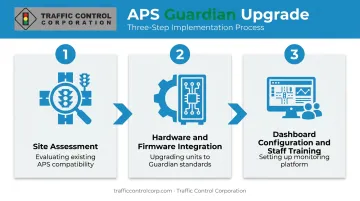
Rolling out APS Guardian-style monitoring takes real coordination, but it's far less involved than rebuilding an intersection network from scratch. The typical path looks like this:
- Site assessment — Evaluate existing APS units at each intersection to determine what's already compatible and what needs upgrading.
- Hardware and firmware integration — Bring units up to Guardian-compatible standards, which may mean firmware updates rather than full hardware swaps.
- Dashboard configuration and staff training — Set up the central monitoring platform and get maintenance staff comfortable navigating alerts and reports.
Here's the part agencies sometimes underestimate: this isn't a one-time install and walk away. Long-term success depends on having local technical support and spare-parts access on hand, because a monitoring system is only as good as the team that can act on its alerts.
This is where TCC fits in. As a regional distributor serving eleven Midwest states out of its Woodridge, Illinois headquarters, TCC provides factory-trained technicians who support APS Guardian rollouts directly.
Their services include:
- Product selection guidance based on existing APS inventory
- Installation support during hardware and firmware upgrades
- Onsite troubleshooting when alerts need a human response
- System training for maintenance and traffic engineering staff
Agencies working with TCC get a local point of contact rather than relying solely on remote manufacturer support when something needs attention in the field.
Frequently Asked Questions
What does APS stand for in business?
"APS" is used differently across industries, from Adult Protective Services to various company-specific acronyms. In transportation and public works, it specifically means Accessible Pedestrian Signal, which is the context relevant to APS Guardian.
What is the difference between a standard pedestrian signal and an APS?
A standard pedestrian signal relies only on visual WALK/DON'T WALK indications. An APS adds audible tones, vibrotactile arrows, and locator tone features so pedestrians who are blind or have low vision can cross safely.
Is Accessible Pedestrian Signal technology required by law?
Yes, in specific circumstances. ADA Title II requires accessible features to be maintained in working order, and PROWAG establishes technical requirements agencies must follow for new construction and alterations.
Can APS Guardian work with the traffic signal equipment an agency already has installed?
Generally, yes. These monitoring systems are built to integrate with existing signal controllers and multiple APS hardware types, and distributors like Traffic Control Corporation provide field support for integration rather than requiring a full system replacement.
Who typically uses APS Guardian-style monitoring systems?
State and local transportation agencies, DOTs, municipalities, and their contractors use these systems to manage pedestrian signal networks across their intersections.
How does APS Guardian help with accessibility compliance audits?
Historical data logging and reporting create a documented maintenance record. Agencies can reference this trail during compliance reviews, audits, or grant applications to demonstrate active maintenance practices.