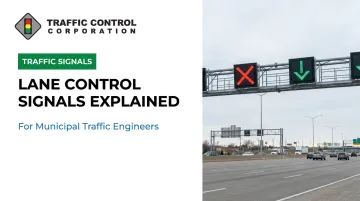
That confusion is common, and it's exactly what lane control signals are designed to eliminate. Officially called lane-use control signals, these overhead devices are a standardized traffic control device defined in the Manual on Uniform Traffic Control Devices (MUTCD). Agencies use them to manage reversible lanes, control freeway merges, and mark temporary lane closures.
This guide breaks down what each indication means, where you'll encounter these signals, and the engineering standards agencies and contractors must follow to install them correctly.
Key Takeaways
- Lane control signals use overhead arrows and X symbols instead of standard traffic lights
- MUTCD Chapter 4T defines five steady indications, including arrows and X symbols
- Reversible-lane corridors, freeway merges, toll plazas, tunnels, and bridges are the primary applications
- Placement, mounting height, and visibility distance all follow strict engineering requirements before installation
What Are Lane Control Signals?
Per MUTCD Chapter 4T, lane-use control signals are special overhead signals with distinctive shapes and symbols placed over individual lanes. Their job is to permit lane use, prohibit it outright, or warn drivers that a change is coming.
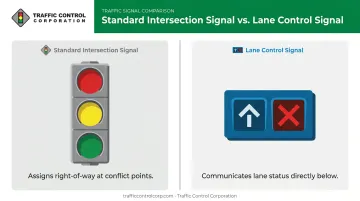
They look and function nothing like a standard intersection signal:
| Signal Type | Shape | Symbols | Purpose |
|---|---|---|---|
| Standard intersection signal | Circular | Red, yellow, green lights | Assigns right-of-way at conflict points |
| Lane control signal | Rectangular, opaque background | Arrow or X | Communicates lane status directly below |
The meaning comes from the symbol, not the position of a light within a housing.
Static signs sometimes accompany these signals to reinforce the message, particularly at reversible-lane entry points where drivers need extra context.
Two core engineering purposes drive their use:
- Controlling reversible-lane operations, where a corridor flips direction based on time of day
- Managing non-reversible lane status, such as opening or closing a freeway lane during an incident or work zone
Before an agency installs dynamic signals, an engineering study should determine whether static signs alone can control the reversible operation satisfactorily, or whether dynamic lane-use control signals are actually warranted. That threshold matters. Dynamic systems carry more installation and maintenance overhead than fixed signage, so the decision isn't automatic.
What Do Lane Control Signal Indications Mean?
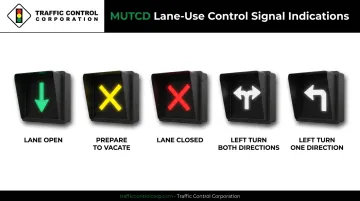
The MUTCD standardizes five signal indications so drivers interpret them the same way whether they're in Chicago or Charlotte. That consistency is what makes reversible-lane and work zone environments safe to navigate at highway speed.
Downward Green Arrow
A steady green arrow means you're permitted to travel in the lane directly below it. Nothing more complicated than that. Just remember the lane's direction can change later in the same day.
Steady Yellow X
This tells you to prepare to leave the lane safely before it changes to a red X. Treat it the same way you'd treat a yellow traffic light: a warning, not an invitation to linger.
Some states use a flashing version instead. Washington State, for example, allows a flashing yellow X to permit continued use of the lane for a left turn, provided the driver uses proper caution, under RCW 46.61.072. That's a state-level variation, not a nationwide standard, so check local guidance if you're unsure.
Steady Red X
A red X prohibits any use of that lane in the displayed direction. Never enter a lane marked with a steady red X, even if it looks clear ahead. The lane may already be carrying opposing traffic.
White Two-Way Left-Turn Arrow
This permits left turns from either direction in that lane but prohibits through travel. Oncoming traffic shares the same lane for turns, which is why through-driving under this indication is never allowed.
White One-Way Left-Turn Arrow
This permits a left turn in one direction only. Unlike the two-way version, there's no opposing left-turn traffic sharing the lane, which simplifies the movement.
According to current MUTCD Chapter 4T guidance, these five indications make up the complete federal list. Older editions included a flashing yellow X for shared left-turn lanes, which explains why some states, including New York, still reference it in driver materials even though it's absent from the current federal table.
Where Are Lane Control Signals Used?
The most common application is reversible-lane commuter corridors, where a lane's direction flips between morning and evening rush hours to improve peak-period flow. Interstate 5 north of Seattle is a well-documented example, with WSDOT operating express lanes on a directional schedule.
Freeway and expressway applications are just as common:
- Merging traffic from on-ramps into mainline lanes
- Lanes that end near a freeway terminus, requiring drivers to merge before the drop
- Temporary blockages from crashes, breakdowns, or active construction zones
Beyond freeways, agencies also deploy these signals at toll plazas, tunnels, and bridges, where lane status can change throughout the day based on traffic volume or maintenance needs.
Maryland's Bay Bridge is one of the better-documented examples. Its Automated Lane Closure System includes 100 lane-use control signals across the span, working alongside gantries and remotely operated swing gates to manage two-way traffic patterns during peak crossings, according to the Maryland Transportation Authority.
Virginia's Monitor-Merrimac Memorial Bridge-Tunnel uses a similar approach, communicating whether a lane is open, closing, or closed.
Design, Placement & MUTCD Compliance Standards
Getting a lane control signal installation right isn't just about picking the correct symbol. MUTCD Chapter 4T sets specific dimensional, placement, and operational requirements.
| Requirement | Standard |
|---|---|
| Arrow/X face size | Minimum 18 x 18 in. (12 x 12 in. allowed below 40 mph with minimal visual clutter) |
| Left-turn arrow face size | Minimum 30 x 30 in. (18 x 18 in. allowed at lower speeds) |
| Mounting height | 15–19 ft above pavement |
| Visibility distance | At least 2,300 ft under normal conditions |
Placement rules require signals to be centered over the controlled lane and aligned in a straight line perpendicular to traffic flow. On sections longer than 2,300 feet, or where the roadway curves, agencies must add intermediate signal faces so drivers can always see at least one, ideally two.
Beyond placement, operational behavior carries equal weight for MUTCD compliance. Safety-critical rules include:
- Never displaying conflicting indications, such as a green arrow shown to both directions of the same lane
- Requiring a manual override whenever the system runs on automated control
For agencies and contractors sourcing this equipment, working with a regional distributor that understands both the hardware and the compliance side simplifies the process considerably. Traffic Control Corporation (TCC) has represented manufacturers including Econolite and GE Current for over 75 years across the Midwest, pairing product supply with installation guidance and technical training for teams deploying MUTCD-compliant lane-use control equipment.
Types of Lane Control Signal Technology
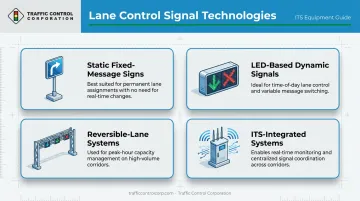
Lane control signal technology falls into a few main categories, each suited to different deployment needs.
- Static, fixed-message signals: Still useful where an engineering study confirms conditions don't warrant dynamic control
- LED-based dynamic signals: Integrate with detectors and Traffic Management Centers for real-time status updates, now standard in most modern deployments
- Reversible-lane systems: Rely on overhead gantry installations, especially on highways, bridges, and multi-lane arterials where dozens of signal faces must stay coordinated across a long span
- ITS-integrated systems: Pair lane control signals with broader Intelligent Transportation Systems (ITS) platforms for centralized, automated lane management
This integration work gets complex fast. Signal timing, detection data, and central software all need to talk to each other reliably.
TCC supports this integration through product selection assistance and ATMS deployment services tied to platforms like Econolite's Centracs. This helps agencies match lane control hardware to existing cabinet types and communications infrastructure before a project goes to bid.
Frequently Asked Questions
What are lane control signals used for?
They manage reversible-lane operations, control freeway merges, and indicate temporary lane closures from incidents or construction. The overhead symbol tells drivers whether the lane below is open, closing, or closed.
How do you indicate lane control?
Through standardized MUTCD symbols: a green arrow for open, a yellow X to prepare to vacate, a red X for closed, and white arrows for left-turn-only lanes. Each symbol has one fixed meaning nationwide.
Where are overhead lane control signals typically used?
Most commonly on reversible highways and freeway merge points. You'll also find them at toll plazas, tunnels, and bridges where lane status changes throughout the day.
What is the difference between lane control signals and regular traffic signals?
Lane control signals use rectangular, symbol-based faces to manage individual lanes, not intersections. Regular traffic signals use red/yellow/green lights to assign right-of-way at conflict points.
Are lane control signals legally binding for drivers?
Yes. They carry the same legal authority as other MUTCD-regulated devices, and drivers are required to obey them, including never entering a lane marked with a steady red X.
What does a flashing yellow X mean on a lane control signal?
Some states use a flashing yellow X to reinforce the need to change lanes soon. It's not part of the current federal MUTCD list, so drivers should check their state's specific guidance.