Introduction
Ask any regular bus rider and they'll tell you: waiting at red lights while your bus idles in traffic is one of the most frustrating parts of the commute. It's not just a feeling.
Public transit commutes in the New York metro area take an average of 51 minutes, compared to just 29 minutes by car, according to Census Bureau data referenced by Governing.
A big chunk of that gap comes from stop-and-go delay at signalized intersections.
Transit Signal Priority (TSP) is the traffic engineering tool cities use to close that gap. It's not the same as adding bus lanes or redesigning routes. TSP works directly with signal timing to get buses, streetcars, and light rail vehicles through intersections faster.
This article breaks down what TSP is, how active and passive systems differ, the benefits agencies can expect, and what it takes to plan and deploy a TSP program.
Key Takeaways
- TSP adjusts signal timing, extending green lights or shortening red phases, to cut the time transit vehicles wait at intersections
- Two main types exist: passive TSP (pre-timed, no detection hardware) and active TSP (real-time vehicle detection)
- Successful deployment requires joint planning between transit agencies and traffic signal operators, plus onboard and roadside technology
- This strategy works well with queue jump lanes, dedicated bus lanes, and emergency preemption, though it remains effective standalone
What Is Transit Signal Priority?
TSP is a signal-timing strategy that adjusts a traffic signal's red/green cycle so a transit vehicle is more likely to arrive at a green light. Instead of a bus sitting through a full red phase, the signal either extends the green or cuts the conflicting phase short.
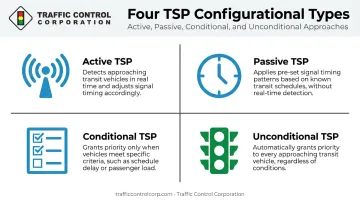
Agencies and vendors use several names depending on how the system is configured, per the NACTO Transit Signal Priority Handbook:
- Active TSP: real-time detection triggers a signal change
- Passive TSP: timing is pre-optimized, no detection needed
- Conditional TSP: priority only granted when specific rules are met
- Unconditional TSP: priority granted every time a vehicle approaches
TSP primarily serves buses, but it applies just as often to streetcars and light rail vehicles operating in mixed traffic or shared travel lanes.
TSP Is Signal Logic, Not Infrastructure
Here's where a lot of confusion happens. "Transit priority" is often used as a catch-all term for bus lanes, queue jumps, and route redesign. TSP is narrower. It's specifically about how the signal controller decides when to change phases. No new lanes, no repaved curbs. Just smarter phase logic.
That distinction matters for planning purposes: TSP is something a signal agency can typically implement faster and at lower cost than physical infrastructure changes. It's also why more transit and traffic agencies now treat TSP as a first step toward improving reliability, rather than waiting for larger capital projects.
Getting there, though, isn't a solo effort. A transit vehicle and a traffic signal typically fall under different jurisdictions. TSP only works when the transit agency and the signal-operating agency agree on shared goals, priority rules, and who's responsible for which equipment.
How TSP Works: Passive vs. Active Priority
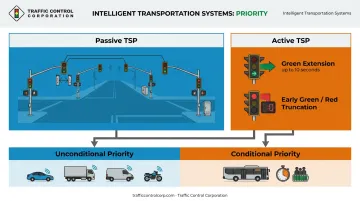
TSP strategies fall into two broad categories. Passive TSP needs no special detection hardware. Active TSP detects an approaching vehicle in real time and adjusts the signal on the spot.
Passive Transit Signal Priority
Passive TSP optimizes area-wide signal timing around the average speed of transit vehicles rather than average car speed. Instead of coordinating a "green wave" for cars, the corridor is timed for buses making frequent stops.
This approach works best in:
- Downtown corridors with short blocks
- Routes with frequent transit service
- Areas where retiming benefits transit and general traffic together
No onboard equipment. No roadside detectors. Just retimed signals.
Active Transit Signal Priority
Active TSP requires detection. An onboard transponder, GPS/AVL unit, or CAD/AVL system tells the signal controller a transit vehicle is approaching, and a TSP-capable controller adjusts the phase in response.
The two most common treatments:
- Green extension: holds the current green phase, typically up to about 10 seconds, so the bus clears the intersection without stopping
- Early green (red truncation): shortens the conflicting phase so the signal returns to the transit phase sooner
Queue jump lanes often pair with active TSP. A short bus-only lane combined with an early green lets the bus bypass queued traffic and merge back in ahead of the pack.
More advanced systems add phase rotation, actuated transit phases, or phase insertion. These techniques reorder or briefly add signal phases to serve an approaching transit vehicle, typically on higher-frequency BRT corridors with sophisticated controllers.
Priority also splits into two triggering models. Unconditional priority grants every approaching transit vehicle the adjustment. Conditional priority only kicks in when specific rules are met, such as the bus running behind schedule, carrying high passenger loads, or arriving during off-peak hours.
Key Benefits of Transit Signal Priority
TSP's core value is straightforward: less time stopped at red lights means faster, more predictable transit trips.
The data backs this up. King County, Washington documented a 40% reduction in transit signal delay after deploying TSP, according to the FHWA Traffic Signal Timing Manual. Results vary by corridor, but high-frequency routes with more intersections tend to see larger cumulative gains than low-frequency routes with fewer stops.
Beyond travel time, TSP delivers:
- Improved reliability: buses hit scheduled timepoints more consistently, which matters more to riders than raw speed
- Higher rider satisfaction: predictable service reduces the psychological cost of waiting
- Support for ridership goals: reliable transit is one of the strongest levers agencies have for attracting new riders
There's also a citywide angle. Agencies pursuing congestion reduction and lower single-occupancy vehicle trips often cite TSP as a low-infrastructure way to make transit more competitive with driving, supporting broader sustainability targets without the cost of new lanes or rail.
TSP vs. Related Traffic Priority Strategies
TSP gets grouped with several other signal and lane treatments. They're related, but not interchangeable.
| Strategy | What It Does | Right-of-Way Level |
|---|---|---|
| TSP | Adjusts signal timing for transit vehicles | Conditional, partial (limited green extension) |
| Emergency Vehicle Preemption | Detects emergency vehicles and interrupts normal signal operation | Full, immediate |
| Queue Jump Lanes | Short dedicated lane lets transit bypass queued traffic | Physical, not signal-based |
| Dedicated Bus Lanes | Full-length lane reserved for transit | Physical infrastructure |
The biggest mix-up is TSP versus preemption. Both rely on vehicle detection, but preemption interrupts signal coordination entirely to clear a path for fire trucks or ambulances. TSP works within existing coordination, offering a smaller, conditional nudge rather than full control of the intersection.
Queue jumps and dedicated lanes solve a different problem: they address physical congestion, not signal phase timing. Most cities running mature transit priority programs combine several of these tools on the same corridor rather than picking just one.
Implementing TSP: Planning, Equipment & Key Considerations
Getting TSP running well starts long before any equipment goes in the ground.
Planning comes first. The transit agency and the signal operating agency need to agree on shared goals, priority rules (conditional vs. unconditional), and who owns which piece of the system. Skipping this step is the most common reason TSP deployments underdeliver.
Equipment You'll Need
Onboard (transit vehicle side):
- GPS/AVL systems for vehicle location and schedule status
- Automated passenger counters (APCs) for occupancy-based conditional rules
Roadside (intersection side):
- Vehicle detection receivers
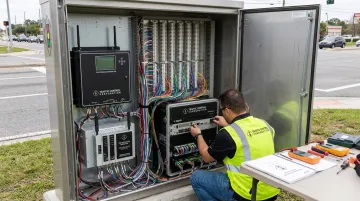
- TSP-capable signal controllers
- Priority-processing software
This is typically where agencies lean on an experienced regional distributor. Traffic Control Corporation (TCC) represents more than 40 manufacturers of traffic signal equipment and ITS solutions.
Two examples show the range available: Econolite's Centracs Priority platform combines TSP and emergency preemption on one system, while Applied Information's Glance system uses GPS and cellular communication for vehicle detection. TCC's factory-trained field staff across the Midwest help agencies select TSP-compatible controllers and detection equipment that fit their existing cabinet setup.
Cost-Sharing and Trade-offs
There's no single national standard for splitting costs, but the common pattern splits funding by function. The signal agency typically funds intersection-side equipment like controllers and detectors, while the transit agency covers onboard equipment such as AVL and APCs.
Once that split is set, the bigger picture puts TSP spending in perspective: compared to building new lanes or rail infrastructure, TSP costs are relatively moderate.
One trade-off agencies must manage carefully: frequent or poorly-tuned TSP activations can add delay to cross-street traffic and take one to two signal cycles to return to normal coordination. This is why most agencies set conditional rules rather than granting unconditional priority everywhere.
Best practice for getting started: run a corridor traffic study first. Prioritize routes with the highest existing transit delay and ridership before scaling TSP citywide.
Frequently Asked Questions
What is transit signal priority (TSP)?
TSP is a signal-timing strategy that gives transit vehicles priority at intersections by holding green lights longer or shortening red phases. The goal is reducing delay without granting full right-of-way like emergency preemption does.
What's the difference between active and passive transit signal priority?
Passive TSP optimizes signal timing for average transit speed and needs no special hardware. Active TSP detects approaching vehicles in real time using GPS/AVL or transponders and adjusts signals dynamically for each vehicle.
How much delay can TSP reduce for transit vehicles?
Documented results vary by corridor, but King County, Washington saw a 40% reduction in transit signal delay after deployment. High-frequency bus corridors with more intersections tend to see larger cumulative benefits than low-frequency routes.
Does transit signal priority cause delays for other traffic?
Yes, if overused. Frequent activations can add modest delay to cross-street traffic and take one to two signal cycles to recover normal coordination, which is why agencies use conditional rules and monitor activation frequency closely.
Is transit signal priority the same as emergency vehicle preemption?
No. Both use vehicle detection, but preemption grants full, immediate right-of-way for emergency vehicles. TSP offers limited, conditional adjustments like green extension, working within existing signal coordination rather than overriding it.
What equipment do agencies need to install TSP?
Agencies need onboard equipment (GPS/AVL, automated passenger counters) and roadside equipment (detection receivers, TSP-capable controllers, priority software). A regional distributor can help match compatible components and verify proper integration before installation.