Introduction
Picture this: you're backing out of a parking space at a busy shopping center. An SUV on your left and a pickup truck on your right completely block your sightlines. Your backup camera shows the space directly behind you — but nothing approaching from either side along the parking aisle. Without cross path detection, that's a collision waiting to happen.
NHTSA estimates 292 annual backover fatalities and 18,000 injuries, with an additional 171 fatalities and 30,000 injuries in other backing crashes. Routine reversing maneuvers carry real risk — and the numbers reflect it.
Blind spot monitoring (BSM) and cross path detection are two distinct driver assistance technologies built to address different parts of this problem. BSM watches for vehicles alongside you during highway driving; cross path detection guards against perpendicular traffic when you're reversing.
They're often paired in the same vehicle and share hardware, but they serve separate functions. For transportation professionals, fleet managers, and agency personnel specifying or evaluating these systems, understanding both is essential.
This guide covers how each system works, where they differ, their real-world limitations, and how vehicle-level detection connects to broader traffic infrastructure.
Key Takeaways
- BSM monitors lateral blind zones while your vehicle moves forward
- Cross path detection monitors perpendicular traffic behind you while reversing
- Both systems use similar radar hardware but activate under different conditions
- Neither system reliably detects pedestrians, cyclists, or small motorcycles
- Both are driver aids — not substitutes for checking mirrors and looking over your shoulder
What Are Blind Spot and Cross Path Detection Systems?
Blind Spot Monitoring (BSM)
BSM uses sensors — typically mounted near the rear bumper or side panels — to watch the zones alongside and slightly behind your vehicle that mirrors can't cover. When another vehicle enters that zone during highway travel or a lane change, the system triggers a warning: usually a light in the side mirror, an audible chime, or both.
The system activates during forward travel above a set minimum speed. That threshold varies by manufacturer — Ford's BLIS activates around 6 mph, while Honda's Blind Spot Information System operates between 20 and 100 mph. No single industry standard governs that range.
Cross Path Detection (Rear Cross Traffic Alert)
Cross path detection — also called Rear Cross Path (RCP) or Rear Cross Traffic Alert (RCTA) — activates only when the transmission is in REVERSE. It monitors perpendicular zones behind the vehicle, scanning for objects approaching from either side as the driver backs out.
Detection target speed ranges vary by manufacturer:
- Toyota RCTA: Detects approaching vehicles at roughly 5–18 mph
- Ford Cross Traffic Alert: Targets vehicles approaching at 4–37 mph
- General activation limit: Most systems won't reliably detect objects outside their designed speed range
How the Two Systems Relate
Despite covering different scenarios, BSM and cross path detection are often built on shared radar hardware within the same vehicle platform. What separates them is activation condition and detection angle:
- BSM: Active during forward travel, scanning adjacent lanes
- Cross path detection: Active in reverse only, scanning perpendicular traffic paths
Both systems work alongside backup cameras but are not replacements for them. Used together, they cover the two most common blind-spot risk scenarios: highway lane changes and low-speed reversing maneuvers.
How Do Blind Spot and Cross Path Detection Systems Work?
Sensor Technology
Most modern BSM and cross path detection systems use millimeter-wave radar mounted near the rear corners of the vehicle. Per IEEE technical documentation, automotive short-range radar typically operates in the 76–77 GHz and 77–81 GHz bands (the latter commonly identified as 79 GHz). Some older or entry-level systems use ultrasonic sensors instead.
Radar works by emitting radio waves and analyzing the reflected signals from nearby objects. The system calculates distance, relative speed, and direction — determining whether an object is approaching, stationary, or moving away.
Detection Zone Geometry
The sensor placement creates distinct coverage shapes:
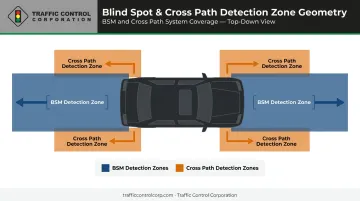
- BSM zones: Extend rearward and laterally from each rear corner, covering the adjacent lane alongside the vehicle. NHTSA's test procedure defines this as a 2.5-meter-wide rectangular region extending from the side-mirror housing rearward.
- Cross path detection zones: Extend perpendicular to the rear of the vehicle — effectively "looking" down the parking aisle to the left and right.
Imagine the BSM zones as two rectangles running alongside your car, and the cross path zones as two additional rectangles extending outward from your rear bumper at 90 degrees. Together, they create overlapping rear-quadrant coverage.
Alert Escalation and Activation Logic
When an object enters the monitored zone, the vehicle responds through:
- A visual warning — typically an illuminated icon in the side mirror
- An audible chime — which often increases in urgency as the detected object gets closer
- Haptic feedback in some vehicles, such as steering wheel vibration
Cross path detection systems typically increase alert urgency based on how fast the approaching vehicle is moving and how close it is. A vehicle crossing at 15 mph triggers a more immediate response than one at 5 mph.
Integration With Broader ADAS
These alert systems don't operate in isolation — the same radar sensors powering BSM also feed data into other vehicle safety functions. In more advanced vehicles, that shared sensor data supports:
- Lane-change assist: flags unsafe merge attempts before the driver commits
- Automatic emergency braking: triggers if a detected object moves into the vehicle's path without driver response
As of 2022, HLDI data shows BSM was standard or optional on roughly 40% of registered vehicles. An estimated 25% of vehicles on the road were actually equipped, reflecting broad availability that has yet to reach full market penetration.
Blind Spot Monitoring vs. Cross Path Detection: Key Differences
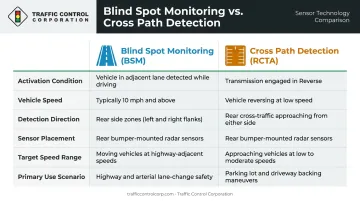
The table below compares the two systems across the attributes that matter most:
| Attribute | Blind Spot Monitoring (BSM) | Cross Path Detection (RCTA) |
|---|---|---|
| Activation condition | Forward travel | Transmission in REVERSE |
| Vehicle speed | Varies by OEM (approx. 6–20 mph minimum) | Host vehicle typically below 5–7 mph |
| Detection direction | Adjacent lanes, rearward approach | Perpendicular zones behind vehicle |
| Typical sensor placement | Rear bumper corners | Same rear corner sensors, extended zone |
| Target speed range | Highway and road speeds | Low parking lot speeds (approx. 4–37 mph depending on OEM) |
| Primary use scenario | Highway lane changes | Backing out of parking spaces |
The Common Point of Confusion
Because these systems often use shared hardware and activate in close sequence during reversing maneuvers, drivers and even some documentation treat them as a single feature. They aren't. Cross path detection is a reversing safety aid; BSM is a forward-travel safety aid. The practical difference matters most when a driver expects one system to cover a scenario it was never designed to handle.
What These Systems Don't Detect
Neither BSM nor cross path detection is designed to reliably identify:
- Pedestrians — even at close range
- Cyclists, including e-bikes
- Small motorcycles
- Shopping carts and similar non-vehicle objects
Toyota's OEM documentation explicitly lists pedestrians, bicycles, small motorcycles, and animals among objects the BSM/RCTA system may not detect. SAE J2802 — the standard governing BSM operating characteristics — focuses on vehicle targets. Fleet managers and transportation professionals need to communicate this clearly to drivers.
Real-World Applications Across Vehicle Types
Passenger Vehicles
BSM and cross path detection are now standard or available as options on most new passenger cars, SUVs, and pickup trucks from major manufacturers. The everyday use case is exactly what the technology was designed for: safer lane changes on the highway and backing out of obstructed parking spaces.
IIHS research found BSM associated with 14% fewer lane-change crashes, while a separate IIHS study found rear cross-traffic alert associated with 22% fewer backing crashes and 32% fewer perpendicular-direction two-vehicle backing crashes — both statistically significant findings.
Commercial and Fleet Vehicles
Large trucks, buses, and delivery vehicles have dramatically larger blind zones than passenger cars. IIHS reports that in 2023, 17% of the 4,354 deaths in large truck crashes involved pedestrians, bicyclists, or motorcyclists — a disproportionate share tied partly to turning and reversing maneuvers where blind zones are most dangerous.
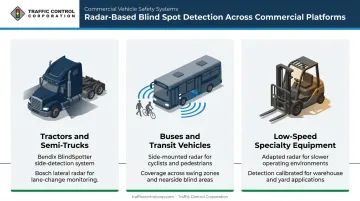
Radar-based blind spot detection for commercial vehicles is available across a range of platforms:
- Tractors and semi-trucks: Bendix (BlindSpotter) and Bosch offer side-detection systems for long-haul and regional fleets
- Buses and transit vehicles: Side-mounted radar alerts drivers to cyclists and pedestrians in wide swing zones
- Low-speed specialty equipment: Forklifts, mining trucks, and campus vehicles use adapted radar tuned for slower operating speeds
Infrastructure and Intersection-Level Detection
Detection technology doesn't stop at the vehicle. The same principles behind vehicle-mounted radar are being applied at fixed infrastructure — intersection conflict warning systems use radar, video, loops, and other sensors to detect vehicles and pedestrians entering conflict zones.
State DOTs and transportation agencies across the Midwest are deploying these systems to add an independent, infrastructure-level layer of protection at high-risk intersections. TCC (Traffic Control Corporation) distributes detection and ITS solutions to agencies across eleven Midwest states, including Econolite's EPIQ RADAR™ and EVO RADAR systems, which support pedestrian detection, dilemma zone monitoring, and intersection conflict warning.
Beyond product supply, TCC provides field commissioning, radar calibration, and the Traffic Detection 101 training course to help agencies get systems deployed and operating correctly.
Limitations of Blind Spot and Cross Path Detection Systems
These systems have real operational limits — and knowing them helps drivers and fleet operators avoid over-relying on technology that was never designed to replace active observation.
Three Critical Operational Limitations
1. Sensor obstruction Adjacent vehicles, walls, or structures can block the sensor's line of sight entirely. Ice, mud, heavy snow, or road spray can also degrade or eliminate detection capability — a real concern in Midwest winters.
2. Angled parking Cross path detection is optimized for perpendicular parking configurations. In angled parking lots, the detection zones may not align with actual traffic paths, reducing the system's effectiveness precisely when drivers assume it's working.
3. Detection speed envelope Objects moving too slowly or too quickly for the system's designed envelope may not trigger an alert. A vehicle crawling at 2 mph or a car moving through the lot at 40 mph could both fall outside the detection parameters.
Vulnerable Road User Gaps
As noted above, most BSM and cross path systems are not designed for pedestrian or cyclist detection. Drivers should not assume that silence from the system means the path is clear of all road users. That gap — combined with the sensor limitations above — is why active observation can't be delegated to the system entirely.
Best Practice Guidance for Drivers and Fleet Operators
These systems are driver aids, not replacements for active observation. Best practices include:
- Always check mirrors and physically look over your shoulder before and while reversing
- Reverse slowly — lower speed gives sensors more time to detect approaching cross traffic
- Be especially cautious when sensors may be obstructed (after precipitation or in enclosed structures)
- In angled parking lots, treat the system as less reliable and rely more heavily on direct observation
- Train drivers explicitly on what the system does and doesn't detect — don't assume the technology is self-explanatory
The Role of Detection Technology in Modern Traffic Infrastructure
A Layered Safety Approach
Vehicle-level BSM and cross path detection represent one layer of a broader safety strategy. Transportation agencies are increasingly deploying fixed detection infrastructure as an independent second layer — particularly at signalized intersections and pedestrian crossings where vehicle-mounted systems provide no coverage at all.
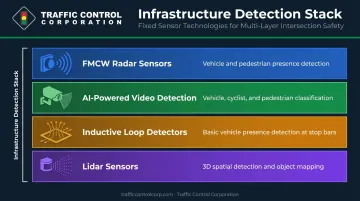
The detection technologies used in fixed infrastructure include:
- FMCW radar sensors (such as Econolite's EPIQ RADAR™) for vehicle and pedestrian presence detection
- AI-powered video detection (such as Econolite's Autoscope® OptiVu) for classifying vehicles, cyclists, and pedestrians
- Inductive loop detectors for basic vehicle presence at stop bars
- Lidar sensors for 3D spatial detection in complex environments
FHWA research on intersection conflict warning systems has documented before-after crash reductions ranging from 3.5% to more than 19%, though human factors and message design significantly influence outcomes.
The Connected Vehicle Horizon
The longer-term shift is toward Vehicle-to-Infrastructure (V2I) communication (where onboard ADAS and roadside infrastructure exchange data in real time). TCC distributes Applied Information's C-V2X roadside units and Econolite/Savari StreetWAVE RSUs, both of which support connected vehicle applications including red-light violation warnings and intersection safety alerts.
These products connect directly to the broader question transportation professionals face: how does current BSM and cross path detection technology fit into this emerging V2I ecosystem? The radar sensors, video detection systems, and communication nodes being deployed today form the foundation for connected and automated vehicle networks. Agencies that get detection right at the intersection level now won't need to retrofit their infrastructure later.
Frequently Asked Questions
What is cross path detection?
Cross path detection (also called Rear Cross Path or Rear Cross Traffic Alert) is a vehicle safety feature that activates when the car is in reverse. It monitors the zones perpendicular to the rear of the vehicle and warns the driver when another vehicle approaches from either side, most commonly in parking lot situations.
What is the difference between blind spot monitoring and cross path detection?
Blind spot monitoring is active during forward driving and detects vehicles in the lateral blind zones during lane changes. Cross path detection is active only in reverse and detects vehicles approaching from the sides behind the vehicle. They use similar sensor hardware but serve different driving scenarios.
How does blind spot detection technology work?
Millimeter-wave radar sensors mounted near the rear bumper emit radio waves and detect reflected signals from objects in the blind zone. When a vehicle is detected, the system triggers visual and/or audible alerts to warn the driver.
Can blind spot and cross path detection systems detect pedestrians and cyclists?
Most systems are not designed to reliably detect pedestrians, bicyclists, or small motorcycles. They are primarily optimized for vehicle detection. Drivers should not rely on these alerts to identify all types of road users in or around the vehicle's path.
At what speeds does cross path detection operate?
Cross path detection is designed to detect objects moving at low speeds typical of parking lot traffic. Target speed ranges vary by manufacturer — Toyota's RCTA targets approximately 5–18 mph, while Ford's system extends to 37 mph. Objects moving outside the system's designed range may not trigger a reliable alert.
What causes blind spot and cross path detection to stop working properly?
Three common causes account for most failures:
- Sensor obstruction — ice, mud, snow, or nearby structures blocking the sensor
- Angled parking layouts that misalign detection zones with actual traffic paths
- Objects moving outside the system's designed speed range, which may not trigger a reliable alert