Introduction
Most network intrusions don't announce themselves. A compromised device sitting quietly on your network might be checking in with an attacker's server every few minutes — sending small, unremarkable packets that look identical to normal traffic. That's beaconing, and it's one of the more difficult threats to catch precisely because it's designed to be invisible.
For organizations managing networked infrastructure (traffic signal controllers, wireless backhaul radios, PTZ cameras, connected sensors) the stakes are higher than most IT environments. These devices communicate outbound continuously by design, which means malicious beaconing can hide effortlessly behind legitimate operational traffic.
That exposure window is substantial. According to Mandiant's M-Trends 2026 report, the global median dwell time for undetected attackers in 2025 was 14 days — and in some espionage cases, adversaries stayed active for over a year. Understanding what beaconing is, how to detect it, and how to stop it is the first practical step toward closing that gap.
Key Takeaways
- Beaconing traffic is a post-exploitation behavior where malware regularly "checks in" with an attacker's command-and-control (C2) server.
- Attackers use HTTP/S, DNS, and SSH protocols specifically because they blend with legitimate network traffic.
- Warning signs include regular-interval outbound connections, unknown domain contacts, and suspicious HTTP user agents.
- Effective defense combines network monitoring, endpoint security, firewall segmentation, and behavioral detection.
- Undetected beaconing enables data theft, lateral movement, ransomware deployment, and botnet recruitment.
What Is Beaconing Traffic and How Does It Work?
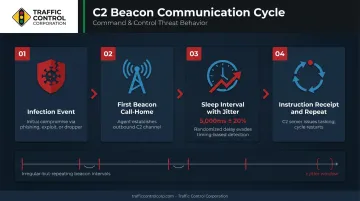
Beaconing traffic describes a pattern where malware installed on a device periodically sends outbound signals (often called "call home" communications) to a remote server controlled by an attacker. Each signal confirms the infection is still active, checks for new instructions, or transmits stolen data back to the attacker.
The critical distinction: beaconing is a post-exploitation behavior. The infection event (phishing email, drive-by download, supply chain compromise) happens first. Beaconing begins afterward, as the mechanism that keeps the attacker connected. Most organizations focus heavily on preventing initial infection but underinvest in detecting what happens once something gets through.
CISA's analysis of Cobalt Strike Beacon — one of the most widely used attacker tools — shows how configurable this is. Operators set a SleepTime value (how often the implant calls back) and a Jitter percentage (random variation added to the interval). One documented sample used a 5,000 ms sleep with 20% jitter, making exact-interval detection rules ineffective.
DNS Beaconing
DNS is among the most evasive C2 channels because DNS traffic is rarely inspected at depth. An infected host makes routine DNS queries to an attacker-controlled domain. Commands or data are encoded inside the query and response fields — subdomains, TXT records, and similar structures — making the communication functionally invisible to perimeter tools that only check whether a domain resolves.
Detection indicators for DNS beaconing include:
- Unusually long or encoded subdomain strings
- High query frequency from a single host
- Repeated failed lookups (common with domain generation algorithms)
- DNS requests from processes that don't normally generate them
HTTP/HTTPS Beaconing
Malware disguises C2 traffic as ordinary web browsing over port 80 or 443, sometimes including crafted browser-like headers and user agents to pass casual inspection.
HTTPS beaconing is especially problematic. Most security tools cannot decrypt it without dedicated SSL inspection. If the attacker routes traffic through a trusted cloud service or CDN as the C2 relay (a technique called domain fronting), the traffic appears to originate from a completely legitimate destination.
SSH Beaconing
Rather than creating a new protocol, attackers tunnel C2 traffic inside SSH connections. CISA documented a recurring scheduled task that launched ssh.exe, established a reverse tunnel to a C2 server, and dynamically forwarded attacker traffic into the victim network. In environments that rely heavily on encrypted remote access (common in ITS and OT deployments) SSH-based tunneling can persist for extended periods unnoticed.
Behavioral indicators to watch for include:
- Scheduled tasks or cron jobs invoking
ssh.exeor similar binaries unexpectedly - Outbound SSH connections to non-standard or external hosts
- Persistent reverse tunnels that survive system reboots
- Unusual port-forwarding activity originating from workstations
What Happens If Beaconing Traffic Goes Undetected?
Undetected beaconing gives attackers time — and time is what transforms a contained infection into a catastrophic breach.
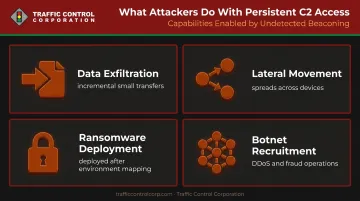
With persistent C2 access, attackers can:
- Exfiltrate data incrementally, in small transfers designed to avoid triggering volume thresholds
- Move laterally across the network, compromising additional devices from an initial foothold
- Deploy ransomware once they've mapped the environment and maximized their position
- Recruit devices into botnets for DDoS attacks or further fraud operations
IBM's 2024 Cost of a Data Breach Report found that breaches with lifecycles over 200 days averaged $5.46 million in total cost (the highest lifecycle cost category in the study). For industrial organizations, that window is not hypothetical: the average time to identify a breach is 199 days, with another 73 days to contain it.
For organizations managing networked transportation infrastructure, this isn't abstract risk. In 2018, the Colorado Department of Transportation suffered two SamSam ransomware attacks affecting approximately 150 servers and 2,000 workstations — a direct consequence of undetected attacker presence in an agency network.
Warning Signs You're Experiencing Beaconing Activity
Beaconing is designed to be quiet, but it does leave traces. Security teams who know what to look for can catch it:
- Regular outbound intervals — consistent or semi-regular connections to the same external IP or domain, especially outside business hours when no user activity should be occurring
- Repeated small transfers to unknown domains — especially newly registered domains with no DNS history. Unit 42 research found over 70% of sampled newly registered domains were malicious, suspicious, or otherwise unsafe
- Suspicious user agents or self-signed certificates — HTTP logs showing browser-like user agents with no matching installed application, or outbound TLS connections using certificates that don't match known software
How to Prevent Beaconing Traffic
No single control stops beaconing. Effective prevention layers proactive architecture decisions with detection-oriented monitoring, with each layer addressing what the others miss.
Implement Continuous Network Traffic Monitoring
Deploy tools that log all outbound connections and flag statistical anomalies: unusual destinations, abnormal connection frequencies, low variation in packet sizes, or data volumes inconsistent with the device type.
Beaconing relies on repetition. A device that connects to the same external IP every 300 seconds (with 20% variation) will stand out against a clean baseline — but only if someone is looking. Continuous monitoring creates that visibility.
For agencies running Econolite Centracs® ATMS or similar platforms, this means supplementing operational traffic analytics with dedicated network security monitoring, since ATMS tools are designed to track signal performance, not detect malicious outbound patterns.
Deploy Endpoint Security and Anti-Malware Controls
Endpoint detection and response (EDR) tools monitor process behavior at the host level, catching unauthorized executables and flagging suspicious outbound communication attempts before a C2 channel fully establishes.
A compromised traffic controller, wireless radio, or video detection sensor initiates the first call-home from its own process space. Endpoint protection intercepts at that layer before the C2 channel solidifies. Deploy EDR before expanding any networked infrastructure, including IoT devices and field equipment.
Apply Firewall Rules and Network Segmentation
Configure egress filtering to block or flag outbound traffic to unrecognized IP addresses. Segment the network so compromised devices cannot communicate freely with external destinations or move laterally to adjacent systems.
Key configuration principles:
- Restrict outbound rules as stringently as inbound rules (most organizations over-focus on inbound)
- Create DMZ segments at enforcement boundaries between IT and OT networks
- Allow communications only between explicitly authorized device pairs
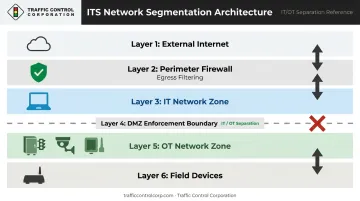
For organizations operating connected ITS infrastructure (traffic signal networks, wireless backhaul systems, roadside units), network segmentation is especially critical. Ruggedcom, a Siemens business distributed through TCC, provides ruggedized industrial networking equipment designed for these environments, where standard enterprise hardware isn't suited to the physical or operational demands of field deployment.
Proper segmentation means that even if a cellular modem or field radio is compromised, it cannot reach a C2 server or pivot to the intersection controller behind it.
Use Behavioral Detection and Machine Learning Analysis
Traditional signature-based tools fail against modern beaconing because attackers modify communication profiles: changing domains, adjusting intervals, altering payloads to evade static rules. Behavioral analysis platforms map expected behavior for each device and user, then flag deviations from that pattern.
The behavioral fingerprint of beaconing persists even when the specific payload or destination changes. ML-driven anomaly detection catches it regardless of what the malware author does to surface-level indicators. Key fingerprint characteristics include:
- Timing regularity: consistent intervals between outbound calls, even with introduced jitter
- Packet size consistency: low variation in payload size across connections
- Process-to-destination pairings: the same process repeatedly contacting the same external endpoint
Tips for Long-Term Beaconing Detection and Control
Sustaining effective defenses takes ongoing habits, not one-time fixes:
- Run regular threat-hunting exercises against outbound traffic logs, reviewing for recurring connection patterns at low frequency or high jitter that periodic rules won't catch
- Train security and IT staff to recognize beaconing IoCs and document a clear incident response procedure for suspected C2 activity
- Keep block lists current for known malicious domains and C2 infrastructure, but pair them with behavioral monitoring — block lists only catch threats that have already been identified
- Document and whitelist legitimate beaconing from SaaS tools, update services, and device telemetry; a clean baseline makes anomalous patterns stand out immediately
- Retain sufficient log history to compare traffic distributions over time — CISA has documented C2 sleep intervals as short as 5 seconds with 20% jitter, which means exact-period rules will miss real threats without enough historical data to spot recurring source-destination pairs
Conclusion
Beaconing traffic has identifiable characteristics: regularity, protocol mimicry, and persistent outbound connections to destinations your organization didn't authorize. These patterns make it detectable, but only if monitoring infrastructure exists to surface them.
Prevention requires layered defenses, where each control compensates for the gaps in the others:
- Network monitoring creates visibility into outbound connection patterns
- Endpoint protection catches infections at the host before they escalate
- Firewall segmentation limits how far a compromised system can reach
- Behavioral detection finds patterns that signature-based tools miss
Early detection dramatically reduces cost and impact. Organizations that catch beaconing within 14 days face substantially smaller breach costs than those where dwell time stretches to 200 days. That gap comes down to whether the monitoring infrastructure was in place before the incident began.
Frequently Asked Questions
What is beaconing traffic?
Beaconing traffic is a pattern where malware on a compromised device periodically sends outbound signals to an attacker-controlled command-and-control (C2) server. These signals confirm the infection, deliver stolen data, or receive instructions — all designed to look like normal network activity.
How do you detect beaconing traffic?
Look for outbound connections at consistent intervals to the same unknown destination, especially outside business hours. Behavioral analysis tools that baseline normal activity per device are most effective, since they flag timing regularity and packet-size consistency regardless of whether the destination is a known malicious IP.
What is C&C (command-and-control) beaconing?
C&C beaconing is the mechanism where a compromised host checks in with the attacker's command-and-control server on a schedule. The server can respond with instructions: launching a DDoS attack, exfiltrating files, delivering ransomware, or advancing to the next intrusion stage.
What is a phishing beacon?
A phishing beacon is a tracking element — typically a hidden pixel or script — embedded in a phishing email or page. When the recipient opens the message, the pixel loads and signals back to the attacker, confirming the target is active and sometimes capturing metadata like IP address or device type.
What is the difference between beaconing and normal network traffic?
Legitimate software also makes outbound connections (update checks, telemetry, SaaS sync). Malicious beaconing differs by its strict periodicity, consistent packet sizes, connections to destinations with no business justification, and the absence of any user-initiated action triggering the traffic.
Can a firewall alone stop beaconing traffic?
No. CISA has documented C2 traffic tunneled over ports 80 and 443 through legitimate CDNs, which standard port-based firewalls allowed through as normal web activity. Stopping it requires layering egress filtering with behavioral monitoring and endpoint security.