
Introduction
Urban growth puts relentless pressure on the infrastructure cities built decades ago. The World Bank reports nearly 60 million additional urban residents per year, with close to 7 in 10 people projected to live in cities by 2050. Meanwhile, U.S. drivers already lost an average of 43 hours to congestion in 2024, costing roughly $771 per driver and nearly $88 billion nationally.
The pain points driving municipal urgency are consistent: worsening traffic congestion, aging signal and road infrastructure, inefficient resource allocation, and the need to make real-time decisions across complex city systems — often with shrinking budgets.
IoT architecture is the framework that makes intelligent responses possible. It connects physical sensors in the field to the networks, processing systems, and software applications that turn raw data into action. Without it, connected devices are just hardware on poles.
This guide explains how IoT architecture is structured across four functional layers, how it powers smart city applications — especially traffic and transportation — and what challenges and emerging trends Midwest municipal agencies need to plan around when deploying connected infrastructure.
Key Takeaways
- IoT architecture has four layers: Perception, Network, Data Processing, and Application
- Smart traffic management is the highest-impact application for most municipalities
- Adaptive signal control improves travel time and emissions by 10% or more, per FHWA benchmarks
- Legacy infrastructure, cybersecurity, and vendor interoperability are the primary deployment challenges
- Open-architecture controllers and standards-based platforms allow incremental modernization
What Is IoT Architecture and Why Do Smart Cities Need It?
IoT architecture is the layered framework through which data flows — from physical sensors and devices, through communication networks and processing systems, to software applications that generate operational responses.
A simple example: a video detection camera at an intersection captures real-time vehicle queue lengths. That data travels over a wireless network to a traffic management center, where adaptive signal control software adjusts green-phase timing to clear the backlog. Each step — sensing, transmitting, processing, acting — is a distinct layer of the architecture. Remove any one of them and the system breaks down.
That breakdown happens more often than it should. Many municipalities have deployed connected devices without the supporting architecture to make them useful — sensors generating data no one can access, or networks transmitting information no system can interpret. Neither delivers operational value. Smart city IoT requires connectivity and structured data flows working together.
The global smart cities market was valued at $615.7 billion in 2024 and is projected to reach $1.45 trillion by 2030 — a 15.6% CAGR. For public agencies deciding how to prioritize infrastructure modernization budgets, understanding the architecture determines whether that investment produces results or just adds complexity.
The Four Layers of IoT Architecture in Smart Cities
Perception Layer (Sensing)
The perception layer is where IoT meets the physical world. Sensors, actuators, cameras, and smart devices collect raw data from the urban environment, forming the foundation on which everything else depends.
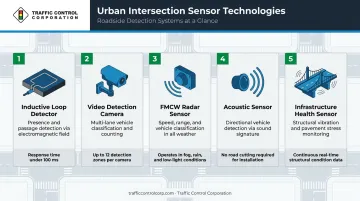
At intersections and along roadways, common sensor types include:
- Inductive loop detectors: wire loops embedded in pavement detect vehicle presence through inductance changes; still among the most widely deployed technologies across the U.S.'s 330,000+ signalized intersections
- Video detection cameras: AI-powered systems like Econolite's Autoscope OptiVu analyze traffic zones for vehicle presence, counts, speed, and occupancy; newer models detect bicycles and pedestrians including vulnerable road users
- FMCW radar sensors: above-road installation with no pavement cuts; Econolite's EPIQ RADAR covers two approaches and up to 900 feet with a 110° field of view, tracking up to 128 objects simultaneously
- Acoustic sensors: passive arrays that recognize vehicle-generated sound to detect presence and flow
- Infrastructure health sensors: wireless sensors measuring strain and vibration for structural assessment of bridges and roads
Midwest agencies sourcing detection equipment across these categories can work with TCC as a single regional point of contact. TCC distributes Econolite's detection line (EPIQ RADAR, EVO RADAR, Autoscope OptiVu, AccuSense wireless in-ground sensors), EDI loop detectors, and Image Sensing Systems' RTMS radar-camera units.
Network Layer (Connectivity and Transport)
Raw sensor data is worthless until it reaches a system capable of acting on it. The network layer handles transmission, with technology selection driven by bandwidth requirements, power constraints, and geographic coverage.
| Technology | Best Fit for Municipal Use |
|---|---|
| LTE | Video backhaul, high-data mobile field devices |
| LTE-M | Mobile or moderate-data transportation assets |
| NB-IoT | Fixed, battery-powered municipal sensors with small payloads |
| LoRaWAN | Lighting, environmental monitoring, low-rate telemetry |
| LPWAN | Distributed sensors where battery life matters more than bandwidth |
| 5G | Emerging V2X and high-rate roadside applications |
Internet gateways and data acquisition systems convert analog sensor outputs to digital format, aggregate data from multiple sources, and route it toward processing.
At the intersection level, TCC's Intuicom wireless radio portfolio — broadband radios, wireless serial radios, and purpose-built traffic signal interconnect radios — handles the "last mile" wireless link. Ruggedcom networking equipment covers the harsh outdoor conditions typical of Midwest deployments.
Data Processing Layer (Middleware)
Not all data needs the same processing speed. Smart city architectures typically run two parallel paths:
- Hot path: near-real-time analytics for time-critical operations — adjusting signal timing based on live congestion, detecting incidents, triggering emergency vehicle preemption
- Cold path: batch analysis for planning — identifying long-term traffic patterns, infrastructure condition trends, seasonal demand shifts
Edge computing sits at the center of hot-path processing. By handling computation close to the sensor — at the intersection cabinet or nearby field device — edge systems reduce the latency that would make real-time signal decisions impractical. NIST defines edge computing specifically around this principle: computation near end devices rather than reliance on remote centralized resources.
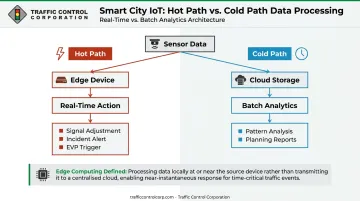
The stakes in transportation are concrete: emergency vehicle preemption systems can't wait for a cloud round-trip. Edge intelligence enables local decisions in milliseconds, not seconds.
Application Layer
Once data is processed — at the edge or in the cloud — it feeds the application layer, where it becomes operational decisions. This includes:
- Adaptive traffic signal control systems: software that adjusts green-phase timing dynamically based on real-time volumes
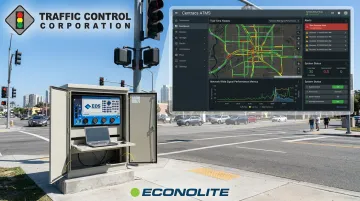
- ATMS dashboards: centralized platforms like Econolite's Centracs that give traffic engineers network-wide visibility, alerts, and performance reporting
- Transit tracking and priority applications: systems that coordinate bus signal priority requests and provide real-time vehicle location to passengers
- Environmental alert systems: air quality and weather condition monitoring that triggers public notifications
TCC supports Centracs ATMS deployments across its 11-state Midwest territory, providing installation, hardware integration, operator training at its Woodridge, Illinois facility, and ongoing system health monitoring. A documented example: DuPage County, Illinois expanded its Centracs-based system from 72 signals to approximately 200 signals with 60 cameras for real-time traffic observation — a scale typical of the projects TCC supports.
Key Smart City Applications Built on IoT Architecture
Transportation and mobility represent the highest-impact application category for municipalities — particularly in vehicle-heavy Midwest cities where signal network age and congestion costs are significant.
Smart Traffic Management
IoT sensors at intersections feed real-time traffic data through the network layer to adaptive signal control systems that adjust timing based on actual vehicle volumes, replacing pre-set schedules that no longer reflect actual demand.
FHWA benchmarks show adaptive signal control commonly improves travel time, control delay, emissions, and fuel consumption by 10% or more, with results varying based on prior timing quality and traffic conditions.
Houston TranStar's 2023 annual report puts the value in concrete terms: $544.6 million in annual benefits against $25.3 million in operating costs — a 21.5:1 benefit-cost ratio from integrated regional traffic and incident management.
TCC's portfolio supports the full physical and systems layer of adaptive signal control:
- Controllers: Econolite Cobalt Series and 2070LX+ running EOS software (10,000+ field installations)
- Detection: EPIQ RADAR, EVO RADAR, Autoscope OptiVu for real-time vehicle, pedestrian, and bicycle data
- ATMS: Centracs cloud platform for network-wide management and signal performance metrics
- Connected vehicle: Applied Information C-V2X roadside and onboard units with guaranteed 5G upgrade path
Smart Public Transit
IoT transforms transit operations through several interconnected systems:
- Transit Signal Priority (TSP) — vehicle-mounted units request green extensions or early greens at approaching intersections; USDOT data shows TSP reduced average bus travel times by 7.5% in Los Angeles and 15% in Chicago in documented deployments
- Automatic vehicle location — GPS-based tracking feeds central operations with real-time fleet position
- Electronic fare collection and passenger Wi-Fi — onboard connectivity improves rider experience and generates ridership data
TCC distributes TSP systems through both Applied Information and Global Traffic Technologies (GTT). GTT's Opticom Multimode Phase Selector — which supports both legacy infrared and modern GPS-based priority simultaneously — is particularly valuable for transit agencies operating across jurisdictions with mixed technology generations.
Environmental and Infrastructure Monitoring
IoT sensors embedded in public infrastructure enable predictive maintenance rather than reactive repair:
- Bridge wireless sensors measure strain and vibration to flag structural concerns before failure
- Road surface sensors detect pavement degradation and freeze-thaw damage
- Air quality monitors track pollution levels in real time for public health alerts
The stakes are substantial: ASCE's 2024 report identifies 42,067 U.S. bridges in poor condition, with replacement costs estimated at $69.7 billion. Shifting from reactive to condition-based maintenance — enabled by continuous sensor monitoring — reduces emergency repair costs and extends infrastructure service life.
Smart Parking and Waste Management
Not every smart city application requires high-bandwidth connectivity. Lower-power IoT protocols handle several city operations efficiently:
- Parking sensors using NB-IoT or LoRaWAN report space occupancy to routing apps, reducing driver search time
- Smart waste bins signal fill levels, allowing collection vehicles to optimize routes and skip unnecessary stops
For public works departments, these applications translate directly to fewer vehicle miles driven and lower fuel costs — measurable savings that are easy to justify in annual budget reviews.
Benefits of IoT Architecture for Municipal Transportation Systems
Operational Efficiency and Cost Reduction
Real-time data lets agencies shift from time-based maintenance schedules to condition-based and predictive approaches. FHWA's traffic signal asset management documentation notes reactive maintenance costs of $399 per signal per year versus $74 for a planned operations check — a 5× cost difference that compounds quickly across networks with hundreds of signals. Over a multi-year horizon, reduced emergency repairs and extended equipment service life add up to substantial budget savings.
Improved Safety and Emergency Response
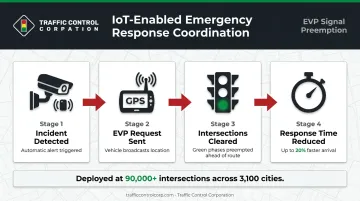
Interconnected IoT systems compress emergency response times through automatic coordination:
- Camera and sensor networks detect incidents and trigger alerts automatically
- Applied Information's Glance EVP system uses GPS and cellular technology to preemptively clear intersections for approaching emergency vehicles, reducing response times by as much as 20%
- Signal preemption systems like GTT's Opticom are deployed at more than 90,000 intersections across 3,100 cities
Sustainability and Emissions Reduction
A 2025 peer-reviewed study found that big-data adaptive signal control produced a net 16% CO₂ reduction in urban areas studied. Reduced vehicle idling at optimized intersections is the primary mechanism, alongside smart street lighting energy savings.
San Diego's combined LED upgrade and smart streetlight project projected savings of approximately 30 million kWh and $2.8 million annually — though the project combined networked controls with LED conversion, so savings reflect both components.
Data-Driven Planning and Governance
The long-term value of IoT architecture is the historical dataset it builds. Transportation planners and DOTs gain continuous, always-on measurement that replaces periodic manual counts — enabling evidence-based decisions rather than relying on data that may be months out of date. Key inputs this continuous data stream supports include:
- Traffic volume counts and turning movement patterns for signal retiming
- Infrastructure condition trends for proactive maintenance planning
- Origin-destination data to guide transit routing and capacity investments
Common Challenges in Deploying Smart City IoT Architecture
Legacy Infrastructure Integration
Most Midwest municipalities operate signal infrastructure not originally designed for digital connectivity. Bridging legacy NEMA and 2070-series controllers with modern IoT systems is the most common deployment challenge.
TCC's approach supports a phased upgrade path:
- Deploy serial-to-fiber converters or Intuicom wireless serial radios to connect legacy controllers to IP networks — no hardware replacement required
- Upgrade to Econolite 2070LX+ (maintains cabinet compatibility) or Cobalt Series for full next-generation capability
- Transition to ATCC or modernized NEMA cabinets with smart city-ready I/O
- Add Applied Information C-V2X roadside units and Centracs ATMS integration for full IoT/V2X overlay
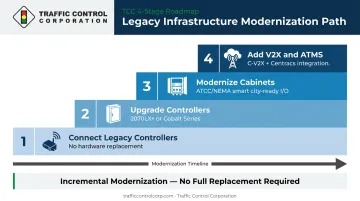
This staged approach lets agencies modernize incrementally rather than requiring full system replacement.
Cybersecurity and Data Privacy
Expanding connected infrastructure also widens the attack surface. CISA's advisory on Econolite EOS versions prior to 3.2.23 identified vulnerabilities with a CVSS score of 9.8 — meaning an unauthenticated remote attacker could potentially gain control of traffic lights. Connected transportation infrastructure requires transportation-specific security controls, not general IT security frameworks.
Effective smart city cybersecurity requires:
- End-to-end encryption across data transmission
- Device authentication for all field hardware
- Regular firmware updates and patch management
- Physical hardware protection at cabinet level
- FHWA and CISA cybersecurity framework compliance
Interoperability and Vendor Fragmentation
Beyond security, multi-vendor environments introduce their own risks. Municipalities sourcing controllers, detection systems, communications hardware, and ATMS software from different vendors face significant integration complexity. NTCIP — developed by AASHTO, ITE, and NEMA — defines the communication protocols and data objects that allow traffic-control equipment from different manufacturers to operate together, but standards compliance alone doesn't eliminate all integration risk.
TCC manages cross-vendor deployments by combining three capabilities:
- Standards-based product selection (NEMA TS1/TS2, ATC, and NTCIP compliance) to minimize compatibility risk from the start
- Centracs ATMS as a unifying management platform across hardware from multiple manufacturers
- Factory-trained field service staff experienced in multi-vendor commissioning and troubleshooting
Emerging Trends Shaping the Future of Smart City IoT
5G and AI-Driven Operations
5G's higher bandwidth and lower latency unlock applications that current cellular networks can't support reliably:
- Real-time video analytics at scale across road networks
- Connected vehicle (V2X) communication between infrastructure and vehicles
- Autonomous vehicle intersection coordination requiring sub-100ms response times
Applied Information's C-V2X roadside and onboard units — distributed by TCC — include a guaranteed upgrade path to 5G, allowing agencies to begin V2X deployment now without stranding current investments.
USDOT's nonbinding V2X deployment plan targets 25% of intersections in the 75 largest metros by 2028, scaling to 85% by 2036. These are goals, not achieved adoption rates — but they signal the infrastructure direction agencies need to plan toward.
AI and machine learning are shifting traffic management from reactive to anticipatory. Key capabilities include:
- Predictive congestion management that adjusts signal timing before bottlenecks form
- Automated incident detection without requiring manual camera monitoring
- Dynamic signal coordination across entire corridors rather than individual intersections
Digital Twins and Edge Intelligence
Digital twin models let city operators simulate infrastructure changes virtually before physical deployment — testing signal timing plans, modeling new road configurations, or evaluating maintenance scenarios without disrupting live operations. FHWA documents UDOT's use of digital-twin concepts to combine asset history and current condition data for infrastructure decisions.
Edge intelligence complements digital twin simulation by enabling faster local decision-making that doesn't depend on cloud connectivity — critical for transportation systems that must maintain operation during network interruptions. For Midwest agencies that have completed initial IoT deployments, pairing edge processing with digital twin simulation enables proactive infrastructure management rather than reactive troubleshooting.
Frequently Asked Questions
What are the four layers of IoT architecture in a smart city?
The four layers are Perception (sensors collecting physical-world data), Network (transmitting that data via cellular, Wi-Fi, or LPWAN), Data Processing (analyzing data at the edge or in the cloud), and Application (software that turns processed data into decisions and actions). Each layer depends on the one below it.
How does IoT architecture improve traffic management in smart cities?
Sensors at intersections collect real-time vehicle volumes, speeds, and queue lengths. That data flows through the network layer to adaptive signal control software, which adjusts green-phase timing dynamically — reducing delay and emissions compared to fixed-timing plans.
What connectivity technologies are most commonly used in smart city IoT deployments?
Cellular options (LTE, LTE-M, NB-IoT, 5G) handle mobile assets and high-bandwidth applications. LoRaWAN and LPWAN serve fixed, battery-powered sensors where coverage matters more than data rate. Match the technology to the application — bandwidth, power budget, and coverage range each point toward different solutions.
What is the difference between edge computing and cloud computing in smart city IoT?
Edge computing processes data locally near the sensor for low-latency, real-time decisions — essential for signal preemption or incident detection. Cloud computing handles large-scale storage and long-term analytics. Most smart city architectures use both, assigning time-critical decisions to the edge and historical analysis to the cloud.
What are the biggest challenges municipalities face when deploying smart city IoT systems?
Legacy infrastructure integration, cybersecurity exposure, and cross-vendor interoperability top the list. Phased deployment using open-architecture controllers and NTCIP-compliant equipment lets agencies add capability incrementally — without replacing functional systems outright.
How can small and mid-sized Midwest cities begin implementing smart city IoT infrastructure?
Start with high-impact, scalable applications — adaptive traffic signals or connected EVP systems deliver measurable ROI and build the data foundation for broader expansion. TCC supports Midwest agencies through this process with product selection, local field service, and procurement guidance aligned to each state's DOT requirements.