Introduction
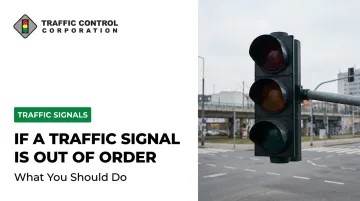
You're approaching a familiar intersection on your commute. The light is usually green at this hour—but today it's completely dark. No red, no green, just a dead signal swaying in the wind.
What do you do?
Most drivers hesitate. Some slow to a crawl and roll through. Others stop awkwardly, unsure who goes next. That split-second confusion is exactly when accidents happen.
Out-of-order traffic signals occur more often than most people expect. Common causes include power grid outages, underground cable faults, severe weather, controller malfunctions, and vehicle collisions striking signal poles. NYC's 311 system recorded nearly 48,000 "Traffic Signal Out" service requests in 2025 alone — a snapshot of how frequently these failures happen in a single major city.
This article covers what to do at each type of signal failure, who has the right of way, the most common mistakes to avoid, and how to report the problem.
Key Takeaways
- A completely dark signal requires a full stop—treat it as a four-way stop
- Flashing red = stop and yield; flashing yellow = slow down and proceed with caution
- First to arrive proceeds first; simultaneous arrivals yield left to right
- Left-turning vehicles must yield to straight-moving traffic, even at out-of-order signals
- Report malfunctioning signals to your local traffic management center or 311 line once you're safely clear
What "Out of Order" Actually Means
Not every signal failure looks the same. Drivers encounter three distinct failure states, and each requires a different response.
The Three Failure States
| Failure State | What You See | What It Means |
|---|---|---|
| Completely dark | No lights at all | Treat as a four-way stop—full stop required |
| Flashing red | All approaches flashing red | Stop sign rules apply on every approach |
| Flashing yellow | Yellow caution flash | Slow down significantly; proceed with caution |
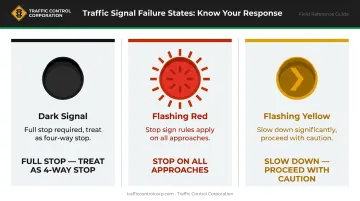
Confusing these states is the first mistake most drivers make. A flashing yellow does not require a full stop—but a dark signal absolutely does.
Common Causes of Signal Failure
Signals go down for many reasons:
- Power outages — grid failures affect entire corridors simultaneously
- Severe weather — storms, flooding, and ice damage electrical components
- Controller unit malfunctions — internal hardware or software failures
- Underground cable faults — damaged wiring that's invisible until the signal dies
- Vehicle collisions — striking a signal pole is a leading cause of localized outages
- Detection system failures — damaged loop detectors or sensors that disrupt controller function
As Oregon DOT notes, winter storms and traffic crashes are among the most frequent triggers for power failures affecting signals.
Why It's Dangerous
Drivers conditioned to signal-guided intersections don't always recognize a failure immediately. That brief moment of confusion leads to real risk at the intersection. The most common contributing factors:
- Hesitation and misjudged right-of-way — drivers unsure who should go first often move at the same time
- Low-visibility conditions — rain, fog, and nighttime driving make a dark signal much harder to spot before you're already in the intersection
How to Navigate an Out-of-Order Traffic Signal Step by Step
Step 1: Identify the Failure Type
Determine which failure state you're dealing with: dark signal, flashing red, or flashing yellow. Each has distinct legal rules. Assuming an intersection is clear without confirming the failure mode is the single most dangerous mistake drivers make.
Step 2: Reduce Speed and Approach with Caution
Begin slowing at least 100 feet before the intersection. Reduced speed gives you more time to assess other vehicles, cyclists, and pedestrians. This is especially critical at night or in poor weather, when other drivers may not recognize the failure.
Step 3: Come to a Complete Stop
For a dark signal or flashing red light, a full stop is legally required—not a rolling stop. Illinois (625 ILCS 5/11-305), Indiana, and Wisconsin all explicitly require stopping before entering the intersection when the signal is non-operational. For a flashing yellow, a complete stop is not required, but you must slow significantly and verify the path is clear.
Step 4: Apply Right-of-Way Rules
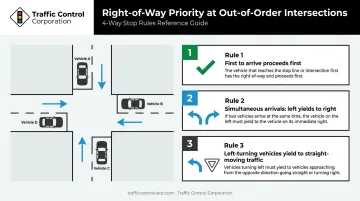
After stopping, the standard four-way stop sequence applies:
- First to arrive at the stop line proceeds first
- Simultaneous arrivals — the driver on the left yields to the driver on the right
- Left-turning vehicles must yield to oncoming vehicles going straight, even if the turning vehicle arrived first
That third rule is the most frequently misunderstood — and a leading cause of crashes at out-of-order intersections. Clear communication in the next step helps prevent exactly that confusion.
Step 5: Communicate and Proceed Safely
Don't assume other drivers know what you're doing. Use eye contact or a brief pause to confirm others are yielding before you enter.
Pedestrians and cyclists retain their right of way even when signals are dark. Check all crosswalks before pulling through the intersection.
Who Has Priority at an Out-of-Order Traffic Signal
When a signal goes out, no single approach automatically wins. Every driver must revert to all-way stop rules, exactly as if stop signs were present on all approaches. This rule holds across traffic codes in Illinois, Indiana, Minnesota, Iowa, Missouri, and Wisconsin.
The First-Arrival Rule
The vehicle that stops first proceeds first. If multiple vehicles arrive simultaneously, the driver on the left yields to the driver on the right.
The Left-Turn Yield Rule
A left-turning driver must yield to all vehicles going straight through the intersection, even if the turning vehicle arrived at the stop line first. This is one of the most frequently violated rules at out-of-order intersections.
Emergency Vehicles
Ambulances, fire trucks, and police vehicles using lights and sirens have absolute priority. Pull over or clear the intersection immediately — regardless of whose turn it is — and wait until the emergency vehicle has passed before proceeding.
When a Police Officer Is on Scene
If an officer or authorized traffic control personnel is directing traffic, follow their instructions. Officer commands override all normal right-of-way rules and any remaining signal indications.
Illinois law (625 ILCS 5/11-305) and Indiana's driver manual both confirm that officer commands supersede signal-based rules.
Common Mistakes Drivers Make at Out-of-Order Intersections
Treating a Dark Signal as a Yield
Many drivers slow down and roll through a dark signal without fully stopping, assuming that if they don't see cross traffic, it's safe. It isn't—and it's illegal. Illinois, Indiana, and Wisconsin statutes all require a complete stop. Failing to stop can result in a traffic citation and, if a crash occurs, exposes the driver to significant legal liability.
Assuming Other Drivers Know the Rules
You cannot count on the driver in the next lane to handle this correctly. Many drivers don't know that a dark signal functions as a four-way stop. Verify that other drivers are actually yielding before you move. Defensive driving matters most when the rules aren't being followed consistently.
Rushing Through Due to Impatience
Out-of-order signals slow things down, and that frustration is understandable. But impatience leads to real consequences: missed pedestrians, skipped direction checks, and unsafe acceleration into an uncontrolled intersection. The extra 60 seconds it takes to proceed correctly isn't worth a collision.
A quick reminder of the three most common errors:
- Rolling through without stopping (always treat a dark signal as a full stop)
- Assuming other drivers know the four-way stop rule (verify before you move)
- Rushing the intersection out of impatience (take your turn, check all directions)
How to Report a Malfunctioning Traffic Signal
When and How to Report
Once you've safely cleared the intersection, report the problem. Early reporting reduces the time other drivers are exposed to the hazard and speeds up repair dispatch. Reporting options by city:
- Chicago: Call 311 or submit via the CHI 311 portal
- Indianapolis: Use the RequestIndy portal for the official faulty-signal workflow
- Minneapolis: No power at all — call 911; powered malfunction — call 311 (612-673-3000) or use the city's online report page
- St. Louis: Call 314-622-4800 or 314-647-3111 during weekday division hours
Most municipalities also accept reports through a 311 service line or non-emergency police dispatch.
What Information to Provide
When you call or submit online, have this ready:
- Exact cross streets of the affected intersection
- Nature of the failure — dark, flashing red, flashing yellow, or stuck on one color
- Approximate time you first observed the issue
- Relevant context — nearby accident, downed power lines, construction activity
Response times vary by city. Salt Lake City targets a 30-minute response during business hours and has averaged just under 20 minutes since 2018. NYC addresses priority outages within 48 hours.
For Transportation Agencies and Municipalities
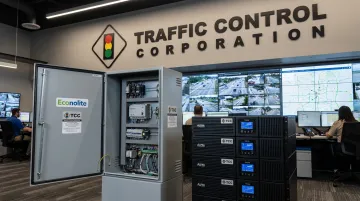
Minimizing outage frequency comes down to proactive maintenance: regular cabinet inspections, annual Malfunction Management Unit (MMU) conflict monitor testing and certification, and reliable backup power systems.
TCC distributes Alpha Technologies UPS systems (FXM series, 350W through 2000W) that activate instantly via automatic transfer switch to keep signals running during outages. These systems back up more than 50,000 traffic intersections, with remote battery monitoring through AlphaGuard and RBMS Plus so agencies can confirm backup readiness before an outage hits.
TCC's product and service portfolio for agencies includes:
- Econolite controllers and cabinets with built-in Battery Backup System (BBS) compatibility
- EDI/Reno A&E MMUs for real-time conflict monitoring and annual certification
- Emergency onsite cabinet troubleshooting and controller repair depot services
- Structured training programs — from NEMA TS2 cabinet wiring to advanced ATMS management — at the Woodridge, Illinois facility or on-site at agency locations
Frequently Asked Questions
What should you do when traffic lights are out of order?
Treat the intersection as a four-way stop. Come to a complete stop before entering, then apply standard right-of-way rules: the first to arrive proceeds first. If two vehicles arrive at the same time, the driver on the left yields to the driver on the right.
Who has priority at an intersection with out-of-order traffic lights?
No vehicle automatically has priority. The first to arrive proceeds first; when arrivals are simultaneous, yield to the driver on your right. Left-turning vehicles must always yield to oncoming straight-moving traffic regardless of arrival order.
Can a police officer overrule traffic signals?
Yes. An officer or authorized traffic control personnel can legally direct traffic in a way that overrides normal signal rules, and all drivers are legally required to follow those directions—this is confirmed in both Illinois and Indiana law.
What does a flashing red light mean at a traffic signal?
A flashing red functions identically to a stop sign. Come to a full stop, check for cross traffic and pedestrians, and proceed only when the way is clear. All approaches face the same requirement.
How do I report a traffic light that is not working?
Once safely past the intersection, contact your local non-emergency police line, city traffic management center, or 311 service. Provide the cross street location and a description of the failure—dark, flashing, or stuck on one color.
What are the legal consequences of ignoring an out-of-order traffic signal?
Failing to stop can result in a traffic citation. Fines vary by state: Iowa sets a scheduled fine of $135, while Wisconsin fines range from $20–$40 for a first offense. If a crash results from the failure to stop, the driver faces potential civil liability as well.