Pedestrian crossing signals exist to remove that guesswork. These are engineered traffic control devices governed by the Manual on Uniform Traffic Control Devices (MUTCD), designed specifically to reduce conflicts between people on foot and vehicles at intersections.
This guide breaks down the signal types, what each indication means, how the underlying technology operates, and what agencies and contractors should look for when sourcing reliable equipment.
Key Takeaways
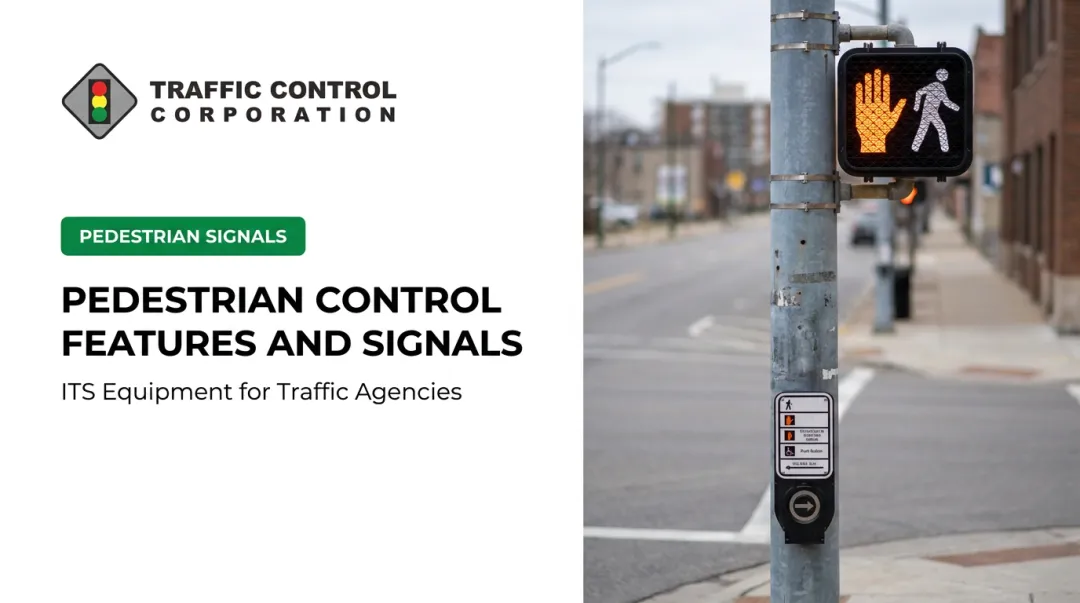
- MUTCD standards define signal colors: a white walking figure for walk, an orange hand for stop.
- Signal types vary by context, including standard ped heads, PHBs (formerly HAWK), RRFBs, and half signals.
- Detection method and timing mode (recall, rest-in-walk, leading pedestrian interval) affect crossing safety.
- Sourcing certified, MUTCD-compliant equipment from an experienced distributor matters as much as engineering design.
What Are Pedestrian Crossing Signals?
Pedestrian signals are dedicated traffic control indications, separate from vehicle signal heads, installed exclusively to guide when a pedestrian may enter and cross a roadway. Under the current 2023 MUTCD 11th Edition, these devices are addressed in Chapter 4I (moved from the 2009 edition's Chapter 4E, where many older engineering references still point).
Why do intersections need a signal dedicated just to pedestrians? A few recurring problems make it necessary:
- Wide intersections where the vehicle clearance interval doesn't leave enough time for someone to cross safely on foot.
- Complex, multi-phase signal operations where vehicle indications don't clearly tell a pedestrian when their path is protected.
- Demand-actuated signals that, without a pedestrian call, may never generate a safe crossing window.
When Are Pedestrian Signals Required?
The MUTCD ties installation to specific warrants and conditions rather than leaving it to guesswork. Per Section 4D.02, pedestrian signal heads are required when:
- A signal is justified under Warrant 4 (Pedestrian Volume) or Warrant 5 (School Crossing).
- An exclusive pedestrian phase or leading pedestrian interval is provided.
- The crossing is an established, signalized school crossing.
- Vehicular indications would be obscured or confusing due to complex geometry.
These warrants determine when a signal goes in, but they don't eliminate the need for caution: a pedestrian signal assigns legal right-of-way, not a safety guarantee. Pedestrians still need to watch for turning vehicles and use judgment, even with a WALK indication showing.
Every installation also requires an independent engineering study. These devices carry real costs in equipment, power, and maintenance, so agencies don't install them reflexively at every corner.
Pedestrian Signal Indications: Colors, Symbols & Meanings
Three distinct messages appear on a pedestrian signal head, and mixing them up leads to real confusion at the curb.
| Indication | What It Means | Color |
|---|---|---|
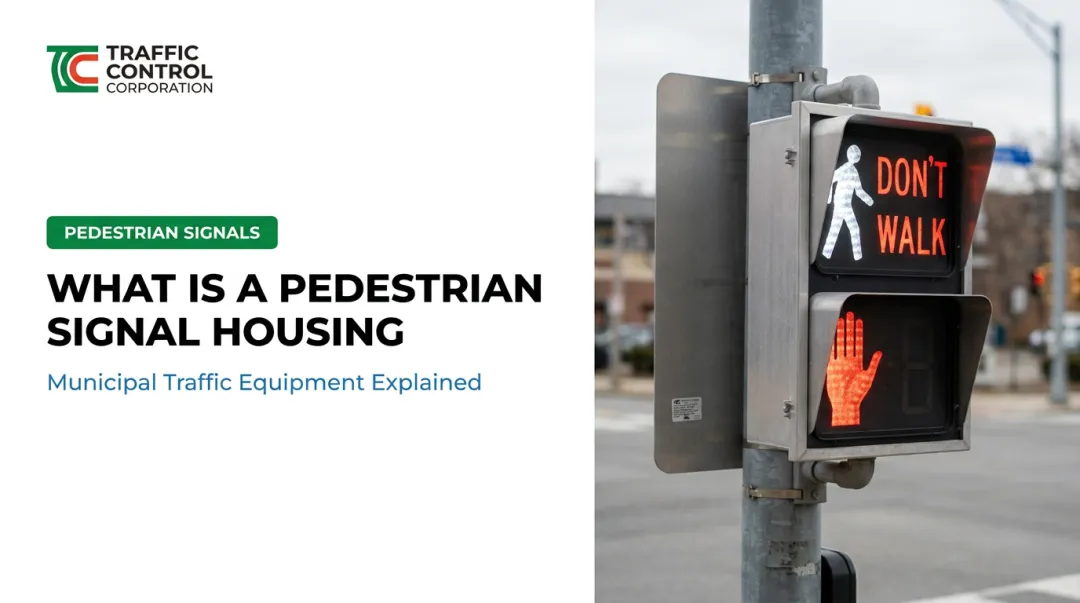
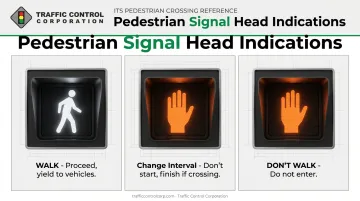
| Steady WALKING PERSON | Pedestrians may begin crossing, but must yield to any vehicles still lawfully in the intersection | Lunar white |
| Flashing UPRAISED HAND | Don't start crossing, but if you're already in the roadway, keep going to the far side or a refuge | Portland orange |
| Steady UPRAISED HAND | Do not enter the roadway | Portland orange |
Each symbol is independently illuminated within its own rectangular background, using the exact colors specified above, with no substitutions.
The Flashing Hand Misconception
A lot of pedestrians assume that once the flashing hand appears, they need to be completely off the roadway. That's not accurate.
The flashing hand marks the pedestrian change interval. This is a period specifically timed so someone who starts crossing right as WALK ends can still reach the far side or a safe refuge before conflicting traffic gets a green light. If you're already in the crosswalk when it starts flashing, you're fine to finish crossing.
Countdown Timers Are Required, Not Optional
Where the pedestrian change interval runs longer than 7 seconds, a countdown display is mandatory. These numeric countdowns give people actual information instead of just a flashing icon.
The safety evidence here is genuinely mixed. FHWA's 2019 Empirical Bayes evaluation estimated countdown displays reduce pedestrian crashes by roughly 9% and total crashes by about 8%.
But a separate peer-reviewed study of 106 Charlotte intersections found the reduction in vehicle-pedestrian crashes specifically wasn't statistically significant, even though total crashes dropped at 68% of studied locations. The takeaway: countdowns are a required information device with promising results, not a guaranteed fix.
Types of Pedestrian Crossing Signal Systems
Not every crossing needs the same hardware. The right system depends on traffic volume, roadway width, posted speed, and whether the location meets full signal warrants.
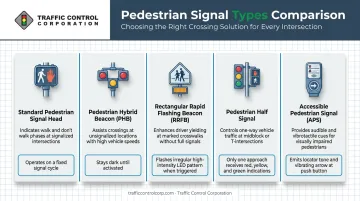
Standard Pedestrian Signal Heads
These pair with a conventional traffic-control signal at intersections meeting both vehicular and pedestrian volume warrants. Every marked crosswalk at a signalized intersection typically gets its own head. TCC supplies these through Econolite in multiple configurations, including 12-inch and 16-inch aluminum and polycarbonate housings. LED units cut energy consumption by up to 90% compared to older incandescent signals.
Pedestrian Hybrid Beacons (PHBs, formerly HAWK)
A PHB sits dark until a pedestrian activates it. Then it runs through a sequence: flashing yellow, steady yellow, steady red, then alternating flashing red. At that point, drivers may proceed after stopping, similar to a stop sign. These are used at uncontrolled midblock crossings that don't meet warrants for a full traffic signal, giving pedestrians a controlled gap without over-signalizing a low-volume location.
Rectangular Rapid Flashing Beacons (RRFBs)
RRFBs supplement crosswalk signage — they don't replace it, and they never display a red stop indication. Instead, pedestrian activation triggers a rapid, irregular yellow flash pattern that's highly visible to drivers.
The yielding data is striking. FHWA's 22-site RRFB study found baseline motorist yielding as low as 0%–26% before installation, jumping to 72%–96% at the two-year follow-up. TCC distributes RRFB systems through JSF Technologies' AB Series (models AB-1400 through AB-9407), available in both solar-powered and hardwired-with-battery-backup configurations, mounted on signal poles, sign structures, or overhead gantries.
Pedestrian Half Signals
A half signal stops traffic in only one direction, commonly at T-intersections where full two-way control isn't warranted. Unlike a PHB, it displays a conventional red-yellow-green sequence on the controlled approach rather than resting dark. It's a legacy configuration term, documented mainly in cities like Portland, and it doesn't appear as a defined category in the current MUTCD Part 4.
Accessible Pedestrian Signals (APS)
APS units add audible tones, vibrotactile surfaces, and pushbutton locator tones so visually impaired pedestrians can tell when WALK is active. Under 2023 PROWAG guidance, covered crosswalks need both audible and vibrotactile WALK indications; audible alone isn't a complete solution anymore.
TCC supplies APS equipment through PedSafety, including:
- Guardian APS — a standalone unit for individual crossings
- WiAAPS — a networked, wireless version for coordinated multi-location operation
- PedSafety SIGNS — Braille and wayfinding signage that complements APS installations
As a Midwest distributor representing manufacturers like PedSafety, Econolite, and JSF Technologies, TCC supplies and supports this full range of signal systems for agencies and contractors across an 11-state territory.
How Pedestrian Signals Operate: Detection, Timing & Safety Best Practices
The hardware only tells half the story. How a signal is timed and triggered shapes whether pedestrians actually get a fair crossing window.
Detection: Push Buttons and Passive Sensors
At actuated signals, a pedestrian typically needs to press a detector to register demand. Skip that step, and the signal may never allocate a WALK phase. The vehicle-side timing simply cycles without ever knowing someone's waiting.
Recall vs. Actuated-Only Operation
- Pedestrian recall automatically serves the WALK phase every cycle, regardless of whether anyone pushed a button. It's generally more pedestrian-friendly since it removes dependence on a working, accessible button.
- Actuated-only operation serves WALK only after a call is registered, which conserves cycle time but leaves pedestrians vulnerable if a button fails or is hard to reach.
Rest-in-Walk and the Leading Pedestrian Interval
Rest-in-walk lets the controller extend the WALK indication while it rests on that phase, rather than cutting it short before the vehicle green ends. This tends to improve compliance since pedestrians aren't rushed.
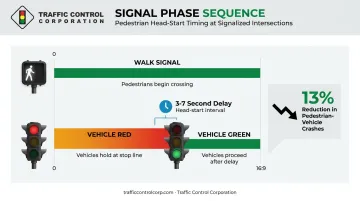
The Leading Pedestrian Interval (LPI) gives pedestrians a 3–7 second head start before the parallel vehicle movement gets a green light, making them more visible to turning drivers before those vehicles start moving. FHWA reports this reduces pedestrian-vehicle crashes by roughly 13% at treated intersections.
Practical Safety Tips
- Always push the detector. Don't assume the signal knows you're there.
- Don't step off the curb once the flashing hand appears near the end of the interval, even if it seems like there's time.
- Stay alert to turning vehicles, even during a WALK indication, since right-of-way isn't the same as guaranteed safety.
These precautions apply at signalized crossings, but not every intersection needs a pedestrian signal or detector in the first place. Engineering studies, based on volume, geometry, and crash history, determine actual need. Installing them everywhere isn't the goal, and it isn't realistic given real infrastructure and power costs.
Partnering with a Trusted Pedestrian Signal Equipment Distributor
Specifying and installing MUTCD-compliant pedestrian signal heads, APS units, PHBs, and RRFBs takes more than a catalog order. Municipalities, DOTs, and contractors need a supply partner who understands procurement, field support, and long-term maintenance, not simply a vendor that ships boxes.
Traffic Control Corporation has worked in this space since 1946, giving it over 75 years of experience as the Midwest's leading traffic signal distributor. TCC represents more than 40 manufacturers and maintains a multi-million-dollar inventory at its Woodridge, Illinois headquarters.

Factory-trained field service teams cover an 11-state Midwest territory, from Illinois and Wisconsin to the Dakotas, putting technical support close to most job sites.
For pedestrian signal projects specifically, that support includes:
- Product selection and application assistance — matching equipment to intersection geometry and project specs
- Onsite troubleshooting for installed pedestrian signal infrastructure
- Product and systems training for agency staff and contractor crews
Whether a project calls for a standard ped head upgrade, a midblock PHB, or a networked APS installation, the right distributor makes the difference. One that stocks the parts and knows the field realities keeps a rollout on schedule instead of stalled.
Frequently Asked Questions
What is a pedestrian half signal?
A pedestrian half signal stops traffic in only one direction, commonly at T-intersections or locations needing partial control. It's distinct from a full Pedestrian Hybrid Beacon since it displays a conventional red-yellow-green sequence rather than resting dark.
What is a crosswalk signal called?
The official MUTCD term is a pedestrian signal head, sometimes called a "Ped Head." It displays either WALK/DON'T WALK text or the walking person/upraised hand symbols.
What are the symbols for pedestrian walking?
The WALK indication uses a white illuminated walking person symbol. The DON'T WALK indication uses a Portland orange upraised hand symbol, per MUTCD standards.
What does a flashing DON'T WALK signal mean?
A flashing DON'T WALK means the WALK phase has ended and no new pedestrians should enter the crosswalk. Anyone already crossing should continue to the opposite curb before the signal changes to steady DON'T WALK.
What is a HAWK beacon (Pedestrian Hybrid Beacon)?
A HAWK, now formally called a Pedestrian Hybrid Beacon (PHB), is a midblock signal that stays dark until a pedestrian activates it. It then cycles through flashing and steady yellow to steady red for approaching drivers.
Do pedestrians always have the right of way at a crosswalk signal?
Pedestrians are given right-of-way during WALK, but they must still yield to vehicles already lawfully in the intersection and stay alert. A signal indication is not a guarantee of safety.