Introduction
Every time a light turns green for you at an intersection, something already decided you deserved it. That something is a traffic detector, a piece of technology most drivers never notice and most agencies wrestle with constantly.
Many transportation departments and contractors across the Midwest struggle with a basic question: which detection technology actually fits their roadway and budget? Weather complicates the answer too. Aging pavement and freeze-thaw cycles, paired with growing traffic volumes, turn a seemingly simple equipment decision into a regional challenge.
This guide breaks down how traffic detectors work, the main technology types available, how they connect to signal controllers, and how to select and maintain the right system. We're drawing on Traffic Control Corporation's 75+ years serving Midwest transportation agencies to help you make that call with confidence.
Key Takeaways
- Detectors sense vehicles, bicycles, and pedestrians, then relay that data to a signal controller
- Two categories exist: in-roadway (loops, magnetometers) and over-roadway (radar, video, Bluetooth/Wi-Fi, LiDAR)
- The controller's programmed logic decides when lights change, not the detector itself
- Roadway type, budget, maintenance capacity, and regional climate all shape the right choice
How Do Traffic Signal Detectors Work?
A traffic detector identifies when a vehicle, bicycle, or pedestrian is present at or passing a fixed point. That event becomes an electronic "call" sent to the traffic signal controller, which uses it to decide how to run the intersection.
Inductive Loop Detection (The In-Pavement Standard)
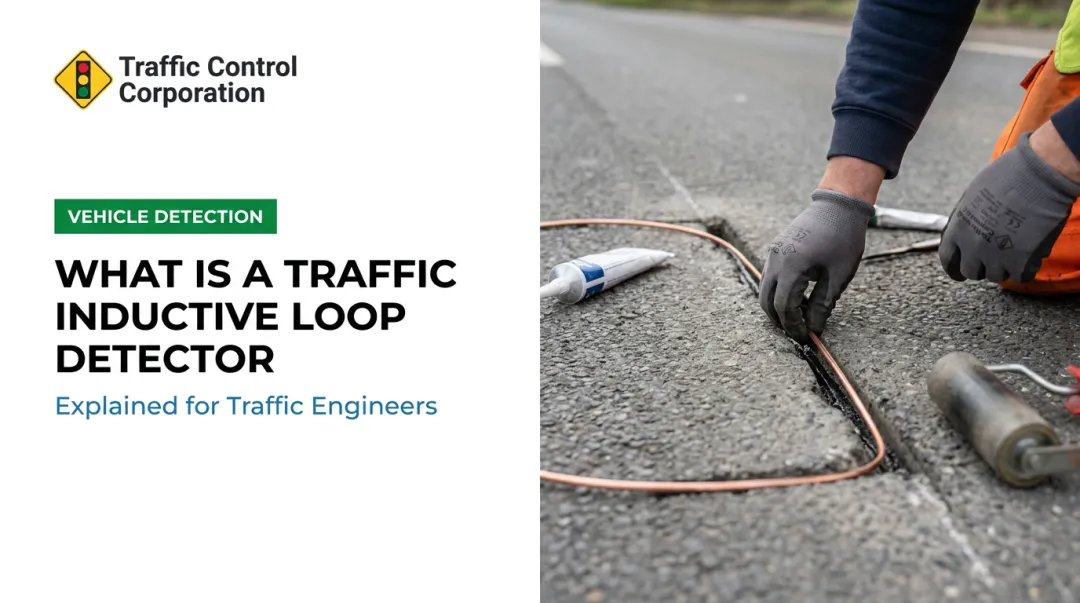
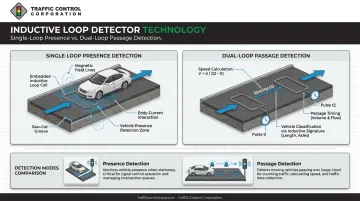
A wire loop gets embedded in the pavement and energized to create a magnetic field. When a vehicle's metal body passes over it, eddy currents form and reduce the loop's inductance. The detector electronics catch that shift and send a call to the controller.
Dual-loop setups add capability. Two loops spaced a known distance apart create a speed trap:
- Speed calculation comes from dividing loop spacing by the time between actuations
- Vehicle classification uses estimated length and inductive signature data from both loops
- Passage timing typically runs 100-150 milliseconds regardless of dwell time
Controllers need two distinct data types to operate correctly. Presence detection keeps a signal active the entire time a vehicle sits at the stop bar, while passage detection (sometimes called pulse detection) fires briefly as a vehicle rolls through an advance loop further back.
Without both signals, an actuated controller cannot distinguish a car waiting patiently from one that already cleared the intersection.
Over-Roadway Detection (Radar, Video, and Beyond)
Radar and microwave sensors detect movement using Doppler shift, flagging any object moving within a defined field. Video detection works differently: software analyzes virtual "zones" drawn over live camera footage and flags a vehicle when it crosses into one.
Installation quality matters more than most agencies realize. NCHRP research, validated across 376 intersections, found inductive loop accuracy (measured by weighted mean absolute percentage error) ranging from 4.0% to 45.5%, while comparable over-roadway radar units ranged from 1.8% to 31.5%.
Neither range reflects a fixed product spec. Site geometry, calibration, and equipment condition drive real-world performance, regardless of which technology you choose.
Types of Traffic Detectors: In-Roadway vs. Over-Roadway
Agencies generally classify detection technology into two buckets based on where the sensor physically sits relative to the road surface. Each comes with distinct tradeoffs.
In-Roadway Detectors
These sensors live inside or on the pavement:
- Inductive loops – the most common intersection detector
- Magnetometers – wireless, less pavement disturbance than a full loop
- Piezoelectric/pressure mats – detect axle weight and count
- Weigh-in-motion sensors – used mainly at weigh stations
| Factor | In-Roadway Detectors |
|---|---|
| Reliability | Decades-proven; unaffected by rain, fog, or darkness |
| Installation | Requires saw cuts and lane closures |
| Vulnerability | Damaged by resurfacing, pavement cracking, and utility work |
| Best fit | Standard signalized intersections with stable pavement |
Over-Roadway (Above-Ground) Detectors
Mounted on poles or mast arms, these sensors avoid touching the road at all:
- Video image processors – reconfigurable zones without pavement work
- Microwave/radar units – reliable across weather conditions
- Bluetooth/Wi-Fi readers – built for corridor travel-time sampling, not stop-bar calls
- LiDAR – 3D detection for complex, multimodal intersections
- Infrared – supplemental presence detection
The advantage is flexibility: no pavement disruption, remote reconfiguration, and continued operation through construction. The tradeoff is that camera-based systems can lose accuracy in fog, glare, or heavy snow, and every above-ground sensor depends on a clear line of sight.
Increasingly, agencies combine both categories rather than picking one. Pairing a radar unit with loop detectors at the same intersection, for instance, balances the loop's proven reliability with radar's flexibility during pavement work or lane reconfiguration. TCC stocks both sides of that pairing, from Sensys Networks loop and magnetometer detectors to radar and video units from Econolite and Applied Information, so agencies can mix technologies without managing separate vendors.
Can Traffic Detectors Control Traffic Lights?
Not directly. Detectors supply calls and data; the signal controller runs the logic that actually changes the light. That distinction trips up a lot of people outside the industry.
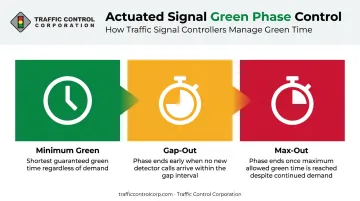
In actuated signal control, three concepts govern how a green phase behaves:
- Minimum green – the shortest time a phase must stay green regardless of demand
- Gap-out – the phase ends early if no new detector calls arrive within a set gap interval
- Max-out – the phase ends once it hits its maximum allowed green time, even with continued demand
Detector calls extend or end a phase based on real-time traffic, but the controller's programmed parameters set the boundaries.
Adaptive signal control takes this further. Detector data from multiple intersections feeds a central or edge system that continuously recalculates timing plans instead of relying on fixed schedules.
A Florida DOT evaluation across eight corridors in cities including Gainesville, DeLand, and Sarasota found an overall 9.36% reduction in travel time after adaptive deployment. Not every corridor improved equally: denser intersections and higher-speed roadways saw smaller gains, a useful reminder that adaptive systems aren't a universal fix.
Latest Technologies in Traffic Detection
Detection technology has moved fast over the past few years, and much of it centers on smarter software layered onto existing hardware.
- AI-enhanced video analytics now distinguish bicycles, pedestrians, and vehicle classes with far fewer false positives from shadows or headlight glare than earlier machine-vision systems produced
- Connected vehicle and cellular/GPS-based detection identifies traffic conditions without any physical roadway infrastructure, making it ideal for rural corridors or temporary work zones
- LiDAR is gaining ground at complex, multimodal intersections where agencies need consistent 3D object detection regardless of weather. TCC's Ouster LiDAR, paired with the BlueCity platform, builds a real-time digital twin that keeps working through rain, snow, and nighttime glare
- Cloud-connected detector networks let agencies monitor detector health remotely and receive automated maintenance alerts, catching failures before they silently degrade signal timing
That last point matters most: a loop or radar unit can fail quietly, still appearing operational while feeding bad data to the controller. Cloud monitoring closes that gap.
Choosing & Maintaining the Right Traffic Detectors for Your Agency
Detector selection comes down to three practical factors, and skipping any one of them tends to cause problems down the road.
Roadway type drives the first decision. A stable urban intersection with predictable traffic suits inductive loops well. A rural highway or temporary work zone often favors radar or video, since there's no pavement to cut and no reason to commit to fixed infrastructure.
Budget is the second constraint, and it's bigger than most people expect. A complete signalized intersection detector system, including engineering and supporting construction, can run into six figures according to WSDOT project guidance.
Costs vary by detector type, number of lanes, cabinet compatibility, and whether pavement cutting is involved.
Regional climate is the third, and it's where Midwest agencies face a specific challenge. Freeze-thaw cycles, pavement shifting, and heavy snow don't blind loops the way fog blinds a camera, but they crack pavement, damage wire insulation, and shorten service life.
Video and radar units generally hold up better in cold climates but still need clear sightlines through snow and glare.
Installation quality and periodic recalibration matter just as much as the initial technology choice:
- Recalibrate after repaving projects
- Reconfirm detection zones after any equipment change
- Inspect loops and radar alignment after extreme weather events
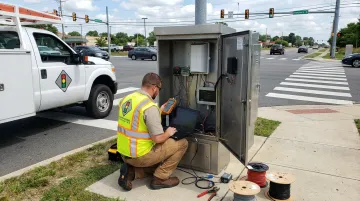
This is where TCC fits into the picture. As the Midwest's regional distributor representing 40+ manufacturers, including EDI loop detectors, Econolite EPIQ radar and Autoscope OptiVu video systems, and Ouster LiDAR, TCC carries a multi-million-dollar inventory out of its Woodridge, Illinois facility.
Factory-trained field technicians:
- Guide product selection based on intersection geometry and cabinet compatibility
- Commission new detection systems before they go live
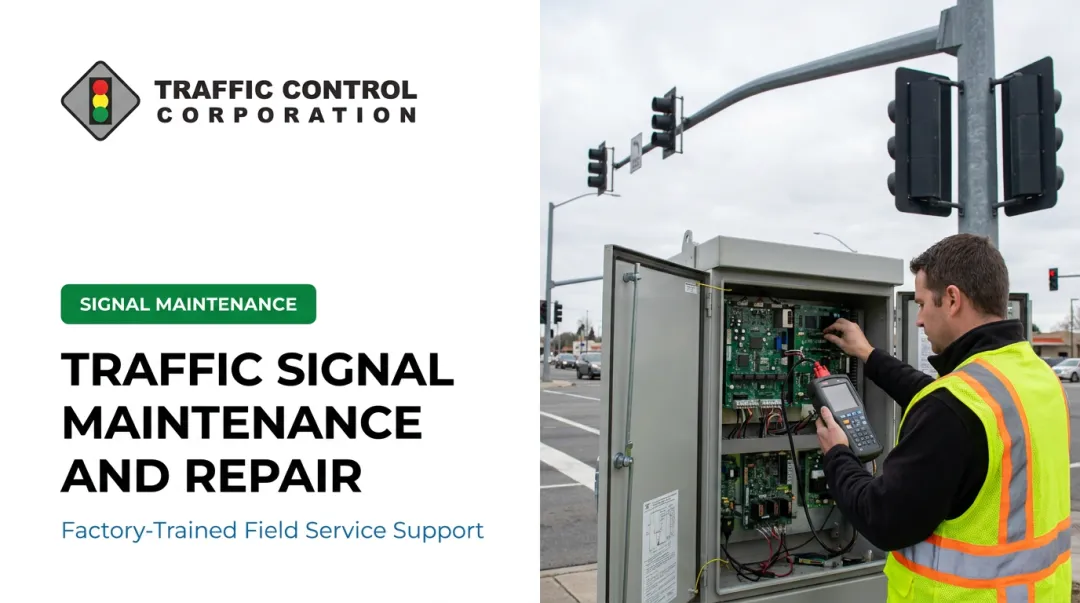
- Troubleshoot malfunctioning loops and radar units onsite
- Train agency staff on detection fundamentals
For agencies across Illinois, Indiana, Iowa, Minnesota, Missouri, and the broader Midwest region, that combination of inventory and field expertise tends to matter more than any single spec sheet.
Frequently Asked Questions
How do traffic signal detectors work?
Detectors sense vehicle, bicycle, or pedestrian presence and passage using methods like inductive loops or radar. That data becomes a call sent to the signal controller, which uses it to inform timing decisions.
Can traffic signal detectors control traffic lights?
No. Detectors supply data and calls, but the signal controller's programmed logic actually determines when lights change. The detector is an input, not the decision-maker.
What are the latest technologies in traffic signal detectors?
AI-enhanced video analytics, connected vehicle and cellular-based detection, and LiDAR lead current innovation. Each improves accuracy or removes the need for physical roadway infrastructure.
What are the different types of traffic signal detectors?
In-roadway detectors include inductive loops and magnetometers, installed directly in the pavement. Over-roadway detectors include radar, video, and Bluetooth/Wi-Fi readers, mounted above the road on poles or mast arms.
How long do inductive loop detectors typically last?
Properly installed loops often last 10-20 years, roughly tracking pavement lifespan. Freeze-thaw damage, poor installation, and repaving cycles can shorten that considerably.
How much does it cost to install a traffic detector system at an intersection?
Costs vary widely by technology and system complexity, with full intersection systems potentially exceeding $100,000. A local distributor like TCC can provide accurate estimates based on your specific roadway and cabinet setup.