Introduction
Most drivers don't think twice about a traffic light. Green means go, red means stop—simple enough. But behind every signalized intersection sits a complex ecosystem of hardware, software, detection systems, and actively managed timing plans that most people never see.
The scale of this infrastructure is significant. A 2019 benchmarking report estimated 327,860 traffic signals operating across the U.S. in 2018—and signalized intersections account for about one-third of all intersection fatalities, according to FHWA. Keeping those intersections safe and efficient requires far more than just functioning lights.
That safety and efficiency gap is where signal operations comes in. The discipline covers active management of the entire intersection infrastructure: timing optimization, equipment maintenance, detection systems, asset tracking, and the connected technology that ties it all together. This guide breaks down each component, from how controllers work to how modern ITS tools are reshaping day-to-day signal management across the Midwest.
Key Takeaways
- Signal operations means actively managing signal infrastructure—not just fixing things when they break
- Every signal system has five core components: controller, signal heads, detection, cabinet, and communications
- Control modes range from simple fixed-cycle timing to real-time adaptive systems
- FHWA recommends retiming signals every three to five years as good engineering practice
- Modern ITS tools—remote monitoring, V2I, and cloud analytics—give agencies real-time visibility into signal network performance
What Is Traffic Signal Operations?
Traffic signal operations is often reduced to maintenance—fix the broken light, replace the burnt-out LED. That framing misses the point entirely.
FHWA describes the programmatic approach as one that:
"strategically links business processes, workforce, systems and technology, and management decisions to objectives consistent with the goals of the organization."
The operative word throughout is active. Signal operations isn't passive upkeep; it's deliberate, ongoing management of infrastructure to maximize safety and minimize delay.
Three Core Pillars
In practice, effective signal operations rests on three interdependent areas:
- Asset management — Knowing what equipment you have, its age and condition, and when replacements are due
- Ongoing maintenance — Scheduled inspections and proactive repairs that prevent failures before they occur
- Signal timing optimization — Continuously calibrating timing plans to match actual traffic demand
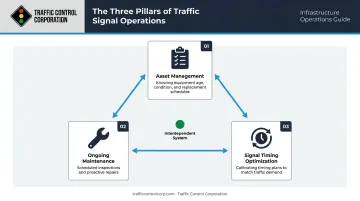
These three areas don't operate in isolation. Weakness in any one area degrades the others. An agency with excellent timing plans but neglected detection equipment will see those plans fail in practice. Well-maintained hardware paired with outdated timing still produces unnecessary delay and driver frustration.
Reactive vs. Proactive Operations
The distinction between reactive and proactive management has real consequences:
- Reactive: Wait for a motorist complaint or a visible failure, then dispatch a crew. In practice, this means days or weeks of degraded performance before anyone acts.
- Proactive: Use scheduled inspections, remote monitoring, and data-driven analysis to catch problems early—often before drivers notice anything is wrong.
Research from PennDOT illustrates the difference: after implementing automated signal performance monitoring, the agency identified lost intersection communications within one day, compared to months under their previous process.
Key Components of a Traffic Signal System
Every signalized intersection shares the same fundamental architecture. These five components work together to manage vehicle and pedestrian movement — and understanding each one clarifies how the broader system behaves.
Signal Controllers
The controller is the brain of the system—the hardware and software unit that executes timing plans and responds to detector inputs. Modern controllers comply with standards such as NEMA TS-2 or ATC (Advanced Transportation Controller) and support communication with traffic management centers.
Traffic Control Corporation (TCC) distributes several controller platforms through its partnership with Econolite, including:
- Cobalt Series: Features a hardened 7-inch touchscreen GUI and Linux-based OS, paired with EOS Traffic Control Software
- 2070LX Series: ATC-compliant platform meeting NEMA TS1 and TS2 Type-1 and Type-2 standards
- ASC/3®: A well-established platform used extensively in controller training programs
With over 10,280 Econolite controllers deployed across multiple regions, Midwest agencies have a proven track record to draw from.
Signal Heads and Displays
Signal heads are the physical displays showing red, yellow, and green indications for vehicles and pedestrians. The shift from incandescent bulbs to LED technology changed how agencies manage maintenance — and reduced operating costs significantly:
- Energy consumption: LEDs use roughly 8–25W versus 67–150W for incandescent bulbs—approximately 10% of the power draw
- Service life: Up to 10 years for LEDs versus roughly 2 years for conventional lamps
- Failure mode: LEDs degrade gradually rather than failing suddenly, giving maintenance crews more warning time
Vehicle and Pedestrian Detection
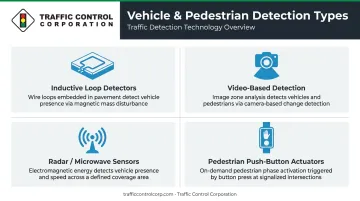
Detection systems tell the controller who is waiting — and accurate detection is what makes actuated and adaptive control modes work. Common detection types include:
- Inductive loop detectors: Wire loops embedded in pavement that detect the inductance change from a vehicle's metal mass
- Video-based detection: Camera systems that detect changes in defined image zones
- Radar/microwave sensors: Emit electromagnetic energy to detect vehicles across a coverage area
- Pedestrian push-button actuators: Enable pedestrian phases on demand
Signal Cabinet and Power Supply
The cabinet houses and protects the controller and associated electronics from weather and physical damage. It also contains the conflict monitor—a critical safety device that prevents a signal from displaying conflicting green indications simultaneously.
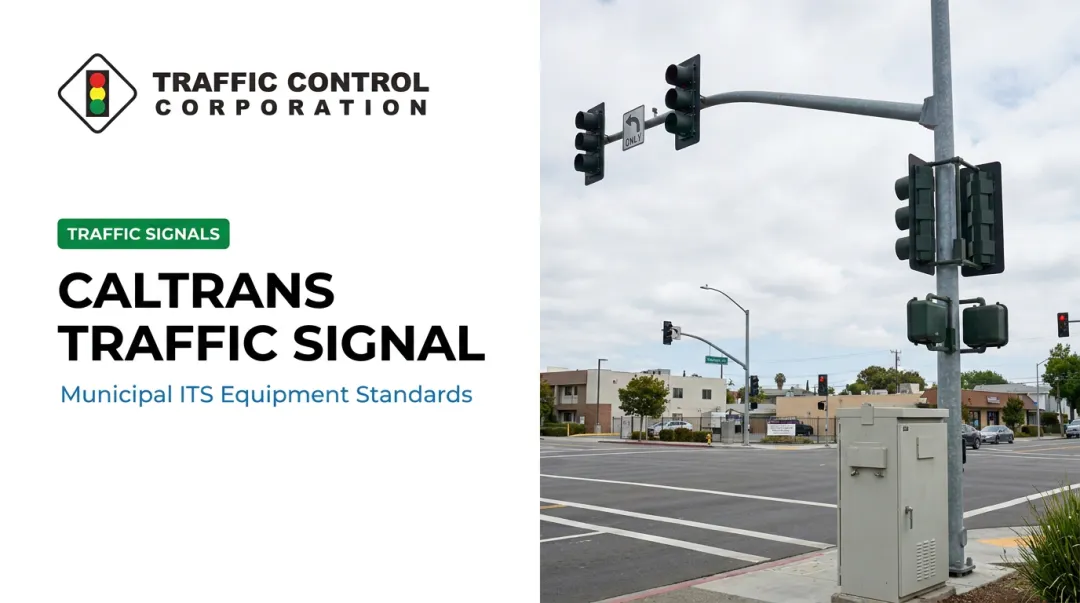
TCC's Econolite cabinet lineup spans NEMA TS1/TS2, ATCC, and Hybrid configurations, with NEMA cabinets constructed from 5052-H32 aluminum for durability in harsh weather. Cabinets also integrate with battery backup systems (BBS) to maintain signal operations during power outages — a practical necessity across a service territory that sees significant Midwest winters.
Communication Infrastructure
Signal systems connect to each other and to traffic management centers through fiber optic cable, wireless networks, or cellular connections. This infrastructure enables:
- Coordinated signal timing along corridors
- Remote monitoring and fault detection
- Real-time configuration changes without a field visit
Modes of Traffic Signal Control
Not every intersection warrants the same control strategy. The right mode depends on traffic volume variability, available detection, and the intersection's role in the broader network.
Pre-Timed Signal Control
Pre-timed signals follow a fixed, repeating cycle regardless of actual traffic volumes. No detection is required. This approach works well at intersections with highly predictable, consistent traffic patterns—but it cannot adapt to unexpected surges or drops in demand. During an incident that reroutes traffic onto a normally quiet side street, a pre-timed signal will keep serving empty lanes.
Semi-Actuated Signal Control
In semi-actuated control, detectors are placed only on the minor (side-street) approaches. The major road holds a continuous green until a side-street vehicle is detected, triggering a phase change. This mode is common at rural highway intersections or major arterials crossing low-volume side streets, where giving the side street a green on every cycle would unnecessarily delay the main flow.
Fully Actuated Signal Control
All approaches have detectors, and the controller dynamically adjusts phase lengths and sequences based on real-time demand across every approach. This is the most common mode in urban and suburban environments. It responds to actual conditions rather than an assumed average, reducing unnecessary delay and accommodating variable demand patterns.
Adaptive Signal Control Technology (ASCT)
Adaptive systems represent the most advanced tier. Rather than optimizing a single intersection, ASCT algorithms continuously adjust timing across a network of intersections in real time, responding to incidents, special events, and shifting demand patterns across entire corridors.
FHWA reports that ASCT improves average performance measures by 10% or more, with gains reaching 50% or more where existing timing is especially outdated. A 2020 USDOT survey found that only 29% of 341 responding arterial agencies had deployed ASCT at all—and 59% of those users had installed it at fewer than 10% of their signals. Cost, procurement complexity, and agency capacity constraints continue to slow wider rollout.
Quick Comparison: Traffic Signal Control Modes
| Mode | Detection Required | Best Suited For |
|---|---|---|
| Pre-Timed | None | Predictable, consistent volumes |
| Semi-Actuated | Minor approaches only | Major arterials with low-volume cross streets |
| Fully Actuated | All approaches | Urban/suburban variable demand |
| ASCT | All approaches + network integration | High-volume corridors, incident-prone routes |
Traffic Signal Timing Optimization
Good hardware running a bad timing plan still produces bad outcomes. Timing optimization is where signal operations meets driver experience directly.
The Core Parameters
Three parameters define a coordinated signal timing plan:
| Parameter | Definition |
|---|---|
| Cycle length | Total time for all phases to complete one full sequence |
| Phase splits | How cycle time is divided among individual movements |
| Offset | The timing relationship between adjacent signals, creating green waves along a corridor |
Getting these right requires analysis of real traffic volume data—collected by time of day, day of week, and season. Multiple time-of-day plans (AM peak, PM peak, overnight) allow a single intersection to serve very different demand patterns throughout the day.
When to Retime
FHWA identifies retiming every three to five years as good engineering practice, with earlier action warranted when demand increases by 5–10%, traffic flow drops 10–15%, land use changes nearby, or crash patterns shift.
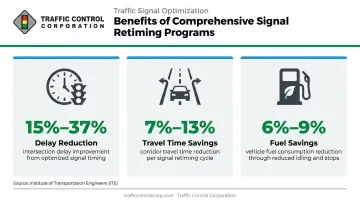
ITE documents that comprehensive signal retiming programs produce:
- 15%–37% reduction in delay
- 7%–13% lower overall travel time
- 6%–9% fuel savings
Skipping retiming produces the opposite: longer queues, excess idling, higher emissions, and drivers running red lights out of frustration. Each of those outcomes carries direct safety and environmental costs that compound over time.
Signal Equipment Inspection and Asset Management
What a Thorough Inspection Covers
A complete traffic signal inspection goes well beyond checking whether the lights turn on. A comprehensive inspection scope includes:
- Signal head alignment and LED/lamp condition
- Controller functionality and programming review
- Detector operation and accuracy
- Cabinet condition, wiring, fans, and filters
- Conflict monitor/MMU function
- Structural elements: mast arms, poles, span wire
- Grounding and power supply
- Physical damage, corrosion, and rodent or insect intrusion
How Often?
No single federal standard mandates a universal inspection interval, but the UConn T2 Center recommends inspections at least once every other year as a minimum. State practice varies: Utah DOT conducts ground-level preventive maintenance annually; Pennsylvania uses 6- or 12-month intervals for specified components; Virginia DOT performs condition inspections every four years.
Asset Management in Practice
Asset management means maintaining an accurate inventory of all equipment, tracking age, condition, and performance, to forecast replacements and budget proactively. When agencies know a cohort of controllers is approaching end-of-life, they can plan replacements systematically rather than scrambling after failures.
TCC's multi-million dollar inventory at its Woodridge, IL facility supports exactly this kind of proactive approach. Agencies can execute scheduled maintenance programs with confidence that replacement components are available without extended lead times:
- Cabinet audits
- Annual MMU conflict monitor certification
- Detection health checks
- Controller end-of-life replacement planning
Proactive vs. Reactive: The Real Comparison
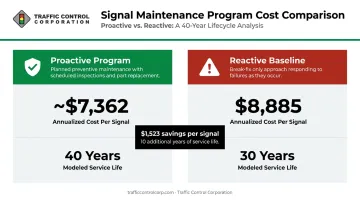
A MnDOT analysis modeled in FHWA's asset management primer found that adding structural inspections every five years produced measurable cost savings and extended service life.
| Metric | Proactive Program | Reactive Baseline |
|---|---|---|
| Annualized cost per signal | ~$7,362 | $8,885 |
| Cost reduction per signal | $1,523 savings | — |
| Modeled service life | 40 years | 30 years |
The data is clear: reactive maintenance doesn't just cost more per incident — it shortens infrastructure life by a decade. For agencies managing hundreds of intersections, that gap compounds into budget pressure that proactive programs are designed to prevent.
Modern ITS Technology in Traffic Signal Operations
Remote Monitoring and Performance Data
Automated Traffic Signal Performance Measures (ATSPM) tools collect high-resolution controller data that transforms how agencies identify and respond to problems. Rather than relying on field visits or motorist complaints, staff can review timing logs, identify malfunctioning detectors, and analyze performance metrics from a central location.
The PennDOT case study mentioned earlier captures this well: communications failures that previously went undetected for months were identified within a day once remote monitoring was in place. Staff also identified stuck pedestrian push buttons—a subtle problem that directly impacts pedestrian safety.
Connected Vehicle and V2I Technology
Signal Phase and Timing (SPaT) broadcasts transmit real-time controller data to approaching connected vehicles and roadside infrastructure. Documented applications include:
- Eco-approach and departure for fuel efficiency (up to 9% fuel savings for diesel trucks in USDOT testing)
- Transit signal priority, with a 12% improvement in bus reliability documented in Utah
- Emergency vehicle preemption and advance warning systems
TCC distributes Applied Information's C-V2X Roadside Units (RSU) and Onboard Units (OBU) for agencies building out V2I infrastructure, with 5G upgrade capability built into current deployments.
Selecting the Right Equipment
Deploying these technologies effectively depends on choosing controllers, cabinets, detection systems, and communications infrastructure that work together and scale as standards evolve. That requires both product depth and on-the-ground familiarity with how equipment performs in the field.
Traffic Control Corporation represents over 40 manufacturers across an eleven-state Midwest territory, giving agencies direct access to:
- Product selection and application guidance for controllers, cabinets, and detection systems
- Technical field support and onsite troubleshooting
- Training programs for signal technicians and agency staff
- Connected vehicle deployment support, including Applied Information C-V2X RSUs and OBUs
Whether an agency is modernizing cabinet infrastructure or evaluating adaptive signal controllers, working with a distributor embedded in the region reduces delays and avoids specification mismatches.
Frequently Asked Questions
What is signal operation?
Traffic signal operation refers to the active management of signal infrastructure at intersections to maximize safety, minimize delay, and improve traffic throughput. It encompasses timing optimization, equipment maintenance, detection systems, and asset management—well beyond simply repairing broken equipment.
What are the main components of a traffic signal system?
Five core components make up a complete traffic signal system:
- Signal controller — the processing "brain" that executes timing plans
- Signal heads and displays — the visible indications drivers and pedestrians respond to
- Vehicle and pedestrian detection systems — sensors that feed real-time demand data to the controller
- Signal cabinet — the roadside enclosure housing the controller and conflict monitor
- Communication infrastructure — the network connecting signals to each other and to traffic management centers
What is the difference between pre-timed and actuated signal control?
Pre-timed signals follow a fixed cycle regardless of traffic conditions. Actuated signals use detector inputs to dynamically adjust phase lengths and sequences based on actual demand—reducing unnecessary delay when traffic volumes vary throughout the day.
What is traffic signal timing optimization?
It's the process of analyzing real traffic volume data to calibrate cycle length, phase splits, and offsets so that signal plans accurately reflect actual demand. Comprehensive retiming programs reduce delay by 15%–37%, lower travel time by 7%–13%, and cut fuel consumption by 6%–9%.
How often should traffic signals be inspected?
The UConn T2 Center recommends a minimum of once every other year for routine inspections, though state practices vary from annual to every four years depending on component type and agency standards.
What does a conflict monitor do?
A conflict monitor (or Malfunction Management Unit) is a safety device inside the signal cabinet that detects hazardous conditions—such as conflicting green displays—and forces the signal to flash mode. Annual MMU testing and certification ensures this safety function remains reliable.