Introduction
Every time a driver safely coasts through a yellow light and clears an intersection before cross-traffic moves, they're benefiting from a principle Garrett Morgan established over a century ago: traffic in all directions must stop before anyone gets to go.
Morgan, a self-taught Black entrepreneur from Cleveland, Ohio, filed for what would become U.S. Patent No. 1,475,024 on February 27, 1922, and received it on November 20, 1923, the first U.S. patent for a three-position traffic signal. His invention wasn't a minor refinement. It solved a problem that was killing Americans at scale.
NHTSA's historical fatality data records 17,870 traffic deaths nationwide in 1923 alone, with a fatality rate of 21.02 per 100 million vehicle-miles. Roads were dangerous, signals were crude, and the gap between Stop and Go was getting people killed.
This article traces how Morgan identified that gap, what his three-position signal actually did, what became of his patent, and why his core idea of managed intersection clearance is still built into every signalized intersection today.
Key Takeaways
- Morgan patented the first U.S. three-position traffic signal on November 20, 1923, after witnessing a collision on Cleveland streets
- His design added an all-directional stop between Stop and Go, giving intersections a clearance interval for the first time
- Morgan sold the patent to General Electric for $40,000 — roughly $753,000 in today's purchasing power
- The FHWA recognizes his work as a foundational contribution to Intelligent Transportation Systems (ITS)
- Beyond traffic signals, his 1914 gas mask patent saved lives in WWI — making him a serial public-safety inventor
Before Morgan: The Dangerous Reality of Early American Roads
No Rules, No Transitions, No Safety
Early 20th-century American intersections were chaotic. Automobiles, horse-drawn carriages, bicycles, and pedestrians competed for the same asphalt with no standardized right-of-way rules. In 1920, the Census Bureau's Mortality Statistics recorded 9,103 automobile-accident deaths in its death-registration area — a rate of 10.4 per 100,000 people. Cleveland specifically recorded 104 deaths that year at a rate of 12.9 per 100,000.
Traffic signals existed, but they had a fundamental design flaw.
The Two-Position Problem
The signal timeline looked like this before Morgan:
- December 1868 — Railway engineer J.P. Knight installed a gas-powered semaphore outside the Houses of Parliament in London. It exploded within two months, injuring the operating officer, and the experiment ended
- August 5, 1914 — James Hoge's red-and-green electric signal was installed at Euclid Avenue and East 105th Street in Cleveland — the first electric traffic signal in the U.S.; a police officer in a nearby booth operated it manually
- Early 1920s — Two-position Stop/Go systems spread across American cities, but all shared the same critical flaw
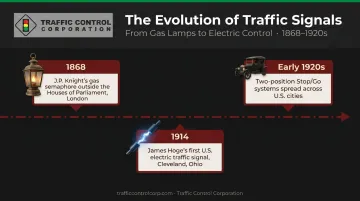
When a signal flipped from Stop to Go, there was no transition interval — vehicles still clearing the intersection from one direction had no protected time before cross-traffic received its Go signal. The FHWA notes that operator fatigue made timing erratic, and at night — when officers left their posts — motorists frequently ignored signals entirely.
Morgan lived and worked in Cleveland during this period. Watching the city's intersections operate without any clearance interval, he set out to solve a problem that traffic engineers of the era had yet to address.
Garrett Morgan: The Man Who Saw a Problem and Built a Solution
From Kentucky to Cleveland
Born March 4, 1877, in Paris, Kentucky, to parents who had been enslaved, Morgan relocated to Cincinnati as a teenager to find work. His formal schooling ended at the elementary level, so he hired a tutor to study English grammar — his first demonstration of the self-directed problem-solving that defined his career.
He moved to Cleveland in 1895 and built a business portfolio that shows exactly what kind of thinker he was:
- 1907 — Opened a sewing machine repair and sales shop
- 1909 — Expanded to a tailoring business with 32 employees
- 1920 — Founded the Cleveland Call newspaper
None of this involved formal engineering training. Morgan developed his mechanical intuition through commerce, not academia.
The Collision That Sparked an Invention
Morgan witnessed a collision between an automobile and a horse-drawn carriage on Cleveland streets. He owned and drove a car himself — uncommon for any American at the time, and particularly rare for a Black man in the early 20th century. He navigated these intersections every day. The problem wasn't abstract to him.
A Black Inventor Navigating Systemic Barriers
Morgan's achievements carried additional weight given the racial climate of the time. His gas mask invention (discussed below) initially earned significant acclaim, but the FHWA and USPTO both document — drawing on research by historian Lisa D. Cook — that some Southern fire departments canceled orders after discovering the inventor was Black. He responded by continuing to invent.
The Gas Mask: Establishing a Pattern
Morgan filed for a breathing device patent in 1912 and received U.S. Patent No. 1,090,936 in March 1914. The recognition followed quickly:
- First-prize gold medal at the International Exposition of Safety and Sanitation (per the Smithsonian)
- Gold medal from the International Association of Fire Chiefs (per the FHWA)
On July 25, 1916, Morgan and his brother used the device during rescue operations after an explosion in a waterworks tunnel beneath Lake Erie — one of the most documented demonstrations of an inventor's own technology saving lives in real time.
The traffic signal came next, applying the same approach: a dangerous public problem, observed firsthand, solved with a mechanical device.
The Three-Position Traffic Signal: Design, Function, and Why It Changed Everything
What the Device Actually Did
Morgan's patented device was a T-shaped pole unit with three distinct operating positions. The mechanical design used a crank, rack-and-pinion mechanism, rotating shaft, and semaphore arms. Internal electric lamps illuminated Stop and Go lettering at night.
The three positions worked in sequence:
- Stop — Horizontal arms halted traffic in one direction
- All-directional stop — Arms raised vertically, halting all approaches simultaneously
- Go — Arms rotated 90 degrees, signaling the cross street to proceed
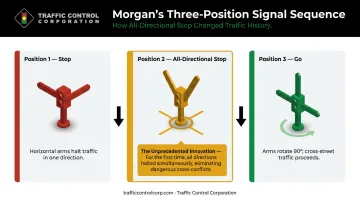
That second position — the all-directional stop — was the invention. No prior U.S.-patented system included it.
Why the Third Position Was the Real Innovation
The collision problem Morgan witnessed wasn't caused by reckless drivers. It was caused by a system that gave two directions of traffic conflicting permissions at the same moment. When a two-position signal flipped from Stop to Go, vehicles already in the intersection had no protected time to clear.
Morgan's all-directional stop solved this by inserting a mandatory clearance interval. Before any direction received Go, every direction stopped simultaneously. Pedestrians could clear. Late-moving vehicles could exit. The patent document itself describes the position as addressing drivers' "over-anxiety" — the reflex to surge forward the instant a signal changed.
The clearance interval is the direct ancestor of today's all-red phase, still standard in modern signal timing.
The Half-Mast Feature
That clearance interval addressed constant-traffic intersections — but Morgan also accounted for conditions where a full stop sequence was unnecessary. During low-traffic periods, such as late nights, the signal could rest at a half-mast position, alerting approaching drivers to proceed with caution rather than triggering the complete three-position cycle. The FHWA describes this as functionally equivalent to today's flashing yellow caution light — a mode that reduces unnecessary stops without reintroducing conflict risk.
Patent Details and Scope
- Filed: February 27, 1922
- Granted: November 20, 1923
- U.S. Patent No.: 1,475,024
- Additional patents: Great Britain and Canada
The FHWA is precise about what this represents: Morgan was the first to apply for and receive a U.S. patent for a three-position traffic signal. Detroit police officer William Potts built a three-color, four-direction signal in 1920 — The Henry Ford museum preserves it — but Morgan's is the foundational patented design in U.S. legal and historical record.
That distinction matters: patent priority established Morgan's design as the legal and technical baseline from which subsequent signal standards developed. The T-shaped form factor contributed to this reach — it faced all approaches at once, rather than requiring separate units per direction, making it practical for real-world intersection deployment.
The Patent Sale, Recognition, and Lasting Legacy
The $40,000 Sale to General Electric
According to the FHWA and Case Western Reserve University's Encyclopedia of Cleveland History, Morgan sold his traffic signal patent rights to General Electric Corporation for $40,000. Using Federal Reserve CPI data, that figure represents approximately $753,000 in 2025 purchasing power — a significant transaction that gave GE the manufacturing infrastructure to deploy the technology at national scale.
GE's acquisition moved Morgan's invention from a Cleveland inventor's workshop to intersections across the country. That distribution chain has a direct continuation: Traffic Control Corporation (TCC), founded in 1946 as an exclusive regional distributor for Automatic Signal Company, later became an exclusive distributor for General Electric's traffic products across the Midwest and today carries that relationship forward through GE Current. The pipeline that delivered GE's traffic signal infrastructure into eleven Midwestern states traces directly back to what Morgan's patent made possible.
Government Recognition and FHWA's Ongoing Tribute
Shortly before his death in 1963, Morgan received a U.S. Government citation for his traffic signal contribution. The institutional commitment that followed has proven durable.
The FHWA's Garrett A. Morgan Technology and Transportation Education Program uses Morgan's legacy to attract K-12 students from underrepresented groups toward transportation-related STEM careers. A FY2024–FY2026 FHWA funding notice offered up to $1.8 million across no more than six awards of up to $300,000 each for qualifying programs — confirming the initiative remains actively funded.
From One Intersection to 330,000 Signals
The FHWA estimates more than 330,000 traffic signals currently operate in the United States. Morgan's conceptual contribution — the managed transition interval — runs through every one of them. His all-directional stop evolved directly into the amber/yellow clearance phase that global signal standards now require.
The FHWA explicitly identifies Morgan's work as a significant contribution to the development of Intelligent Transportation Systems (ITS) — the sensor-based, data-driven network that underpins modern traffic management. Every signal phase standard, every ITS framework, and every clearance interval in use today carries a direct line back to the problem Morgan solved at a Cleveland intersection over a century ago.
From Morgan's T-Shaped Post to Today's Smart Traffic Infrastructure
A Century of Evolution
Morgan's signal required a human operator turning a crank. The evolution since then has been dramatic:
- 1920s — Automatic timers eliminated the need for manual operation
- 1952 — Denver installed one of the earliest demand-actuated computerized signal systems
- 1990s — LED signal technology began replacing incandescent bulbs, with ITE publishing its first interim LED specification in June 1998
- Today — Adaptive signal systems adjust timing in real time based on measured vehicle demand
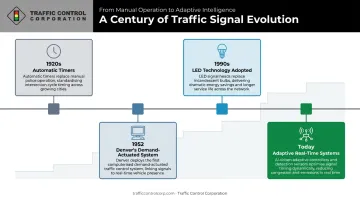
What hasn't changed is the underlying objective Morgan identified: explicitly manage the transition between competing movements at an intersection.
What "Intelligent" Looks Like Now
Modern signal infrastructure extends Morgan's clearance principle across entire corridors and networks:
| Capability | How It Connects to Morgan's Principle |
|---|---|
| Adaptive signal control | Dynamically adjusts timing based on real-time demand — Morgan's clearance interval, now automated |
| Video and radar detection | Identifies vehicles and pedestrians to trigger appropriate phases |
| Corridor coordination | Synchronizes multiple intersections for traffic progression |
| Emergency vehicle preemption | Clears intersections for responders — a direct extension of Morgan's all-stop concept |
| Accessible pedestrian signals | Audible and tactile guidance, protecting the same vulnerable users Morgan's clearance interval served |
TCC's Role in Carrying the Legacy Forward
That evolution doesn't happen without the distributors and engineers who bring these systems into the field. Traffic Control Corporation (TCC), headquartered in Woodridge, Illinois, has served as the Midwest's local expert on traffic control matters since 1946. With over 75 years of experience and representation of more than 40 manufacturers, TCC supplies the signal controllers, detection systems, EVP equipment, pedestrian safety devices, and ATMS platforms that state and local transportation agencies across eleven states depend on daily.
Specific deployments illustrate the direct line from Morgan's concept to current practice. Opticom emergency vehicle preemption — which TCC has distributed since 1999, with deployments such as 17 intersections in Crestwood, Illinois — and Econolite's Centracs ATMS platform are both built around the same core problem Morgan solved in 1923: how do you safely manage competing movements at an intersection? The technology has changed. That problem hasn't.
Frequently Asked Questions
Where was the world's first traffic light?
The world's first traffic light was installed outside the Houses of Parliament in London in December 1868. Designed by railway engineer J.P. Knight, it used semaphore arms and a gas-lit lantern. A gas leak caused an explosion within two months, ending the experiment.
Where was the first traffic light in the USA?
The first electric traffic signal in the U.S. was installed at the corner of Euclid Avenue and East 105th Street in Cleveland, Ohio, on August 5, 1914. It was based on a design by James Hoge and operated manually by a police officer, nearly a decade before Morgan's patent.
Who invented the first traffic light?
Multiple inventors contributed at different stages. J.P. Knight built the first signal in 1868 in London; Lester Wire and James Hoge developed early U.S. electric signals. Garrett Morgan holds the first U.S. patent for a three-position traffic signal (1923), the design most directly ancestral to the modern system.
What did Garrett Morgan sell his traffic signal patent for?
Morgan sold the rights to his traffic signal patent to General Electric Corporation for $40,000 — approximately $753,000 in today's purchasing power. GE's acquisition enabled the technology to be manufactured and deployed at national scale.
How did Morgan's traffic signal differ from earlier signals?
Earlier signals had only two positions — Stop and Go — with no transition interval. Morgan's design added a third "all-directional stop" position that halted traffic from every direction simultaneously before allowing movement to resume, creating a protected clearance interval that dramatically reduced intersection collisions.
What other inventions is Garrett Morgan known for?
Morgan's 1914 Safety Hood and Smoke Protector patent produced an early gas mask that earned a gold medal at the International Exposition of Safety and Sanitation and was later adapted for U.S. soldiers in World War I. A 1916 tunnel rescue in Cleveland demonstrated its real-world effectiveness.