Manual methods can't keep pace with modern planning demands. Agencies need continuous, classified traffic data to justify funding, design pavement, and time signals correctly.
That's where the Automatic Traffic Counter and Classifier (ATCC) comes in. These systems record volume, vehicle classification, and speed around the clock, without a person standing in the roadway. This guide walks through how ATCC technology works, the sensor options available, national classification standards, and how to choose the right setup for your agency.
Key Takeaways
- ATCC systems use inductive loops, pneumatic tubes, or radar to detect, count, and classify vehicles automatically.
- Most U.S. agencies classify vehicles using FHWA's 13-category axle-based scheme for consistent, comparable data.
- This data feeds directly into signal timing, pavement design (ESALs), safety studies, and AADT reporting.
- Sensor choice depends on traffic volume, data collection duration, and access to trained local installation support.
What Is an Automatic Traffic Counter and Classifier (ATCC)?
An ATCC is a sensor-based system that automatically detects vehicles passing a roadway point, then sorts them into categories, such as passenger car, bus, or multi-trailer truck, without a human observer recording anything by hand.
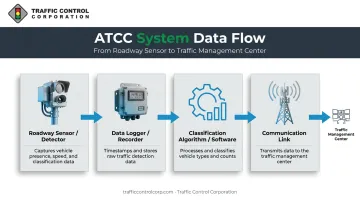
Core components of any ATCC system:
- Roadway sensor or detector – the hardware that physically or remotely detects a vehicle (loop, tube, or radar unit)
- Data logger/recorder – captures the timestamped detection event
- Classification algorithm/software – interprets axle count, spacing, or vehicle length to assign a category
- Communication link – for permanent stations, transmits data back to a traffic management center
Basic Counters vs. True Classifiers
A basic traffic counter only tallies how many vehicles pass. An ATCC goes further: it uses additional data such as axle spacing, axle count, or vehicle length to determine what passed, not just that something passed.
There are two deployment models:
- Portable/temporary ATCC – deployed for days or weeks to support short-duration studies
- Permanent/continuous ATCC – installed for years of uninterrupted trend monitoring
Regardless of deployment model, typical outputs include volume by vehicle class, speed, headway, and gap data. The shift from manual tallying to sensor-driven counting cut labor hours and gave agencies longer-duration, repeatable electronic records that hold up under audit and federal reporting requirements.
How ATCC Systems Detect and Classify Vehicles
Every ATCC technology follows the same basic logic: a sensor identifies vehicle presence or passage, a data logger records the event, and software classifies the vehicle using length, axle count, or axle spacing. Where they differ is in how that detection happens physically.
Inductive Loop-Based ATCC
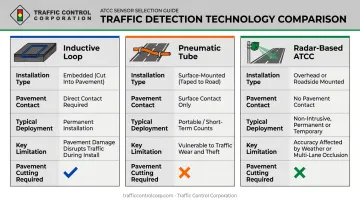
A wire loop embedded in the pavement changes its electromagnetic field when a vehicle's metal mass passes over it. A single loop captures presence and volume. Two loops, spaced a known distance apart, calculate speed by dividing distance by travel time, and support classification through vehicle signature analysis.
Loops are mature, durable, and rank among the most accurate detection methods available. However, FHWA's Traffic Monitoring Guide notes that installation requires cutting into pavement, meaning temporary lane closures and traffic disruption during setup.
Pneumatic Tube ATCC
Paired rubber tubes stretched across the lane compress each time an axle rolls over them. The resulting air pulse tells the recorder both axle count and axle spacing, which the software then uses to classify the vehicle.
Tubes are inexpensive and portable, making them a favorite for short-duration studies. But they degrade fast:
- Rubber tubing cracks and wears with temperature swings
- Air switches become less reliable in extreme heat or cold
- Axle counts grow less accurate in high-volume, high-truck, or slow-moving traffic conditions
Radar and Non-Intrusive ATCC
Radar-based ATCC units mount roadside or overhead and measure vehicle length and speed using reflected microwave energy, with zero pavement contact. That means no cutting, no lane closures, and no installation-related traffic disruption.
State DOTs continue expanding evaluation and deployment of non-intrusive radar sensors as an alternative to loops, particularly on corridors where pavement work is costly or disruptive. Minnesota DOT, for example, has field-tested successive generations of non-intrusive sensors for over a decade as part of its ongoing detection strategy.
Vehicle Classification Standards: The FHWA 13-Category Scheme
Most ATCC systems deployed in the United States classify vehicles according to FHWA's standardized 13-category scheme, based primarily on axle count and vehicle configuration.
| Class | Vehicle Category |
|---|---|
| 1 | Motorcycles |
| 2 | Passenger cars |
| 3 | Other two-axle, four-tire single-unit vehicles |
| 4 | Buses |
| 5 | Two-axle, six-tire single-unit trucks |
| 6 | Three-axle single-unit trucks |
| 7 | Four-or-more-axle single-unit trucks |
| 8 | Four-or-fewer-axle single-trailer trucks |
| 9 | Five-axle single-trailer trucks |
| 10 | Six-or-more-axle single-trailer trucks |
| 11 | Five-or-fewer-axle multi-trailer trucks |
| 12 | Six-axle multi-trailer trucks |
| 13 | Seven-or-more-axle multi-trailer trucks |
This standardization enables direct data comparisons between agencies and underpins national reporting obligations such as the Highway Performance Monitoring System (HPMS).
Many ATCC platforms also support custom, user-defined classification bins, sometimes up to 14 categories. This flexibility lets an agency isolate transit buses, emergency vehicles, or other traffic types that matter for a specific local study.
Key Applications and Data Outputs of ATCC Systems
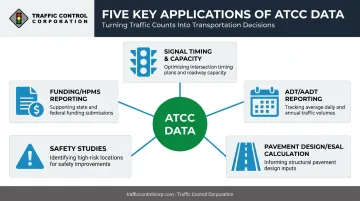
ATCC data isn't collected for its own sake. It drives real decisions across nearly every corner of transportation planning.
Signal timing and capacity analysis. Volume and classification counts feed directly into signal timing plans, helping engineers set phase lengths that reflect actual traffic mix rather than guesswork.
ADT vs. AADT. These terms get confused constantly, so here's the distinction:
- ADT (Average Daily Traffic) – volume averaged over a shorter period, such as a single day, week, or season
- AADT (Annual Average Daily Traffic) – volume averaged across a full calendar year, calculated by applying time-of-day, day-of-week, and month-of-year adjustment factors to shorter counts
AADT is the metric most funding and planning decisions actually rely on.
Pavement design. Truck classification data converts into Equivalent Single Axle Loads (ESALs), the standardized measure of how much pavement damage a given traffic stream will cause over its design life. Without accurate classification, pavement engineers are guessing at structural requirements.
Safety studies. Classification data pinpoints heavy-vehicle corridors, speeding hotspots, and locations that need traffic calming or a signal upgrade before a crash pattern develops.
Funding and federal reporting. Continuous ATCC data supports HPMS submissions and broader transportation planning.
Georgia's DOT, as one example, currently maintains approximately 330 permanent continuous-count stations and 35 permanent weigh-in-motion sites, supplementing them with short-term 48-hour counts at roughly 27,000 sites on a rotating three-year cycle. That scale illustrates just how central ATCC infrastructure has become to statewide reporting.
Choosing and Deploying the Right ATCC System for Your Agency
Selecting an ATCC setup isn't a one-size-fits-all decision. A few factors should drive the choice:
- Expected traffic volume and road classification – a rural two-lane road and an urban arterial have very different sensor needs
- Portable vs. permanent – short-duration studies favor tubes or temporary loops; ongoing trend monitoring favors permanent loops or radar
- Integration requirements – compatibility with existing ITS infrastructure, signal cabinets, and central ATMS software
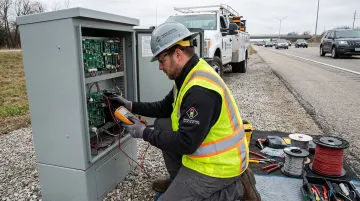
Hardware selection is only half the equation. Long-term data accuracy depends just as much on proper installation, calibration, and ongoing maintenance. A loop that's installed carelessly, or a radar unit mounted at the wrong angle, will quietly produce bad data for years before anyone notices the numbers look off.
This is where a regional distributor with factory-trained field service earns its keep. Traffic Control Corporation, for instance, represents 40+ manufacturers across an 11-state Midwest territory.
Its lineup spans EDI loop detectors and loop sealant for inductive-loop installations, plus radar sensors from Sensys Networks and Econolite that agencies increasingly deploy where cutting pavement isn't practical. That kind of breadth lets an agency compare sensor technologies against a specific corridor's conditions rather than settling for whatever one manufacturer happens to sell.
Beyond product selection, ongoing value comes from:
- Onsite troubleshooting when detection data starts drifting or a sensor stops reporting reliably
- Product and systems training for in-house staff, reducing dependence on outside vendors for routine maintenance
- Detection system audits that catch failed loops, misaligned radar, or dirty optics before they degrade data quality
Agencies that pair the right sensor technology with local, trained support tend to keep their ATCC data reliable for years, not just for the first few months after installation.
Frequently Asked Questions
What is an automatic traffic counter?
It's a sensor-based device that automatically detects and tallies vehicles passing a roadway point. Most modern units pair this with classification software to identify vehicle type as well as count.
What is the difference between AADT and ADT?
ADT reflects traffic volume averaged over a shorter period, like a day or a season. AADT represents the average daily volume across an entire year, adjusted for seasonal variation.
How accurate are automatic traffic counters and classifiers?
Accuracy varies by technology, with loops and radar typically performing best. New York State's DOT requires at least 95% hourly volume accuracy and 90% classification accuracy, though installation quality matters just as much as the sensor.
How long can an ATCC unit collect data before needing maintenance?
Portable units typically run days to weeks depending on the sensor and conditions. Permanent stations operate continuously but need periodic calibration and sensor checks to stay accurate.
What vehicle classification scheme do most ATCC systems in the U.S. use?
Most agencies rely on FHWA's standardized 13-category axle-based scheme, which runs from motorcycles up through seven-or-more-axle multi-trailer trucks, supporting national data consistency.
Can ATCC systems count pedestrians and bicycles too?
Many modern non-intrusive sensors, including radar units with pedestrian and bicycle detection modes, can capture non-motorized traffic alongside vehicles, or be paired with a dedicated counter for that purpose.