Introduction
Outdated signal equipment doesn't just annoy drivers. It costs real money and creates real risk.
The 2025 Urban Mobility Report from the Texas A&M Transportation Institute found that U.S. traffic congestion cost the country $269 billion in 2024, with the average urban commuter losing 63 hours a year to delay.
Intersection control directly affects those numbers. Agencies running legacy or poorly maintained controllers often see more stop-and-go delay, worse coordination, and higher long-term maintenance costs.
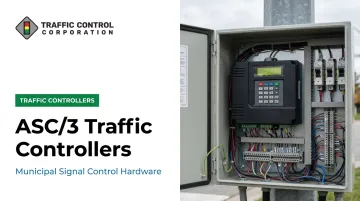
ASC/3 traffic controllers, engineered by Econolite, are among the most widely deployed platforms addressing this problem. They manage real-time signal timing, coordination, and detection at intersections across the country.
This article covers how ASC/3 controllers work, their key features, the benefits they deliver to agencies, common applications, and how to choose the right installation and support partner.
Key Takeaways
- ASC/3 controllers are NEMA TS2-compliant, managing phase timing, coordination, and detection at signalized intersections.
- Built-in diagnostics and rugged hardware reduce field service visits and support long-term reliability.
- The platform integrates with modern ATMS software, detection sensors, and preemption systems.
- Factory-trained installation and service are essential to getting full value from an ASC/3 deployment.
What Is an ASC/3 Traffic Controller?
The ASC/3 is part of Econolite's long-running controller lineage. It followed the earlier ASC/2 series (introduced in 1997) and eventually paved the way for the newer Cobalt platform.
Econolite's own documentation confirms that Cobalt's ASC software package carries forward all ASC/3-LX features and adds new interface functions on top. That continuity makes ASC/3 the foundation the current generation was built on, not a product agencies need to phase out.
Econolite describes the ASC/3 series as NEMA TS2 actuated controllers. Some configurations, like ASC/3-LX software, also run on ATC hardware. These two standards cover different things:
- NEMA TS2 governs the controller assembly's functional, environmental, electrical, and communications requirements, including how it interfaces with cabinet components.
- ATC defines an open-architecture hardware and software platform capable of running multiple ITS applications concurrently.
Because ASC/3 units meet these standards, they slot into the standard traffic control cabinets already deployed at most U.S. intersections. No custom cabinet retrofit required in most cases.
Core Function at the Intersection
The ASC/3 processes detector inputs, executes phase timing plans, and manages coordination logic in real time. This logic runs on dedicated firmware built specifically for intersection management, not a general-purpose operating system trying to do double duty.
The controller also communicates outward. It links to ATMS software, field detection sensors, and communication networks, functioning as one node within a much larger ITS ecosystem. While Cobalt is Econolite's newer platform, ASC/3 remains a proven, widely supported workhorse in agency networks nationwide today.
Key Features and Capabilities of ASC/3 Controllers
ASC/3 controllers pack a lot of functionality into a compact cabinet footprint. Here's what agencies actually use day to day.
Field Updates and Remote Connectivity
Technicians can securely update signal timing plans and coordination parameters directly in the field. That means adjustments to phase splits, offsets, or cycle lengths don't require pulling the controller or waiting for a full reprogramming session back at the shop.
ASC/3 also supports Ethernet-based connectivity, including IPv4/IPv6 configuration, enabling communication with centralized or cloud-native ATMS platforms. This is what allows agencies to monitor and manage intersections remotely instead of dispatching a technician for every routine check.
Built-In Diagnostics
Documentation from Econolite confirms the ASC/3 maintains separate event logs for:
- Detector activity
- Detector failures
- Controller events
- Malfunction management unit (MMU) events
These logs give technicians a head start when isolating a fault, whether it's hardware, wiring, or programming. TCC's own field service process leans on exactly this kind of layered diagnostic approach. Technicians work through the controller, monitor, load switches, detection inputs, and communications to pinpoint the source of an issue before a truck roll turns into a wasted trip.
Advanced Control Logic
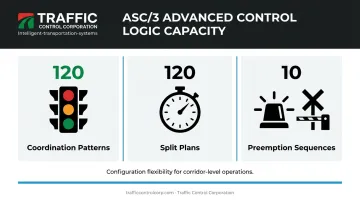
The platform supports coordination patterns, traffic-responsive timing adjustments, and preemption sequences for emergency vehicles and rail crossings. Documented configurations include up to 120 coordination patterns, 120 split plans, and 10 preemption sequences, giving agencies substantial flexibility for corridor-level operations.
Rugged, Field-Ready Design
ASC/3 hardware is built to withstand extreme weather and electrical transients over years of continuous field deployment. That durability matters just as much in a rural county as it does in a downtown corridor.
Mixed-Vendor Flexibility
ASC/3 controllers work across multiple cabinet types and pair with third-party detection systems, from radar to video to inductive loop. This adaptability matters for agencies managing intersections built over different decades with different vendors.
Why ASC/3 Controllers Matter: Benefits for Transportation Agencies
Upgrading signal control technology carries direct consequences for crash rates and long-term operating budgets, making it a priority agencies can't afford to defer.
Safety Gains That Support Vision Zero
FHWA's evaluation of adaptive signal control technology found meaningful safety improvements at some sites. Virginia locations saw a 13.3% reduction in total crashes and a 35.8% reduction in fatal and injury crashes, both statistically significant. Texas sites saw rear-end crashes drop by 44%.
These results weren't universal, though. Florida sites in the same FHWA analysis showed no statistically significant change.
Results depend heavily on site conditions, detection quality, and how the system is configured, not the controller alone. ASC/3's dilemma zone detection and reliable preemption logic give agencies the tools to pursue Vision Zero goals, but implementation quality still matters.
Reduced Congestion and Delay
FHWA's Every Day Counts program states that adaptive signal control technology improves travel time by more than 10% on average, with some outdated corridors seeing improvements as high as 50%. A Florida before-and-after study across eight corridors backed this up with a measured 9.36% travel-time reduction and a 15.57% drop in major-street queues.
One caveat: minor-street queues in that same study increased nearly 17%. Adaptive timing often redistributes delay rather than eliminating it everywhere at once.
Additional Benefits: Lower Costs and Long-Term Scalability
Beyond safety and congestion, ASC/3 controllers deliver measurable operational value across three areas:
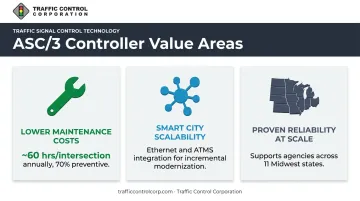
- Lower maintenance costs: FHWA benchmarks estimate roughly 60 maintenance hours per intersection annually, with 70% tied to preventive work. Built-in diagnostics and rugged hardware catch problems before they become costly emergency repairs.
- Smart city scalability: Ethernet connectivity and ATMS integration let agencies modernize incrementally instead of ripping out equipment, creating a bridge toward future connected-vehicle initiatives.
- Proven reliability at scale: TCC supports agencies across an eleven-state Midwest region, where dependable controller hardware between service visits is what makes that scale possible.
Applications and Real-World Use Cases
ASC/3 controllers show up in a wide range of deployment types, not just big-city corridors.
- Coordinated urban and suburban corridors: Synchronized timing plans keep traffic moving in green-wave progression across intersections, the same use case behind MoDOT's acceptance of the ASC/3-2100 for coordinated TS2 operation.
- Emergency and transit preemption: ASC/3's preemption sequences integrate with emergency vehicle and transit priority systems, helping first responders and buses move through intersections faster.
- Adaptive traffic management: In congestion-prone metro areas, ASC/3 supports traffic-responsive timing that adjusts to real-time conditions rather than running a fixed schedule.
- Rural and lower-traffic corridors: Rugged hardware and lower maintenance demands make ASC/3 a practical fit where agencies can't justify frequent site visits.
The common thread: whether it's a six-lane arterial or a two-lane rural crossing, the same core platform scales to fit different traffic volumes and budgets.
Choosing, Installing, and Maintaining Your ASC/3 System
Getting the most out of an ASC/3 deployment starts well before installation day.
What to Evaluate Before You Buy
- Cabinet compatibility — Confirm your existing NEMA TS1, TS2, or ATC cabinet can accommodate the controller without a costly retrofit.
- Budget constraints — Consider whether a full replacement or a targeted repair path makes more financial sense for aging units.
- Network growth plans — Factor in future ATMS integration and detection expansion so the controller you install today doesn't become a bottleneck in five years.
Hardware decisions only tell half the story, though. A controller is only as good as its configuration, and improperly set timing plans or coordination parameters can undercut every benefit the hardware is capable of delivering. That's why proper technician training, at the keystroke level, on real timing and coordination logic, is non-negotiable for long-term reliability.
TCC's Role as a Midwest Distributor
Traffic Control Corporation has distributed traffic signal equipment across the Midwest since 1946. As an authorized Econolite distributor, TCC brings:
- Factory-trained field technicians who service the ASC/3 platform directly
- A multi-million-dollar parts inventory based in Woodridge, Illinois
- Onsite troubleshooting support across an eleven-state service territory
- Basic and Advanced Controller Operation & Programming courses built around ASC/3 and Cobalt platforms
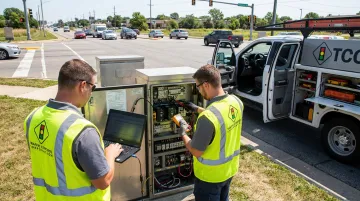
Ongoing maintenance and access to responsive local support are what actually determine controller uptime and lifespan. If you're evaluating an ASC/3 upgrade or need field support, reach out to TCC's team to talk through cabinet compatibility, budget, and network plans specific to your agency.
Frequently Asked Questions
What is the difference between ASC/3 and Cobalt controllers?
Cobalt is Econolite's newer controller platform, built on updated hardware and software. ASC/3 remains a widely deployed, proven legacy platform still actively supported in many agency networks.
Are ASC/3 controllers still supported and available for new installations?
Yes. Manufacturers and authorized distributors continue to support ASC/3 controllers, providing parts, service, and technical support through channels like TCC.
What traffic cabinets are compatible with ASC/3 controllers?
ASC/3 controllers work within standard NEMA TS2 and ATC-compliant traffic control cabinets, the same enclosures most transportation agencies already use.
How do ASC/3 controllers support adaptive or traffic-responsive signal control?
The controller uses real-time detector data to adjust phase timing and coordination based on current traffic conditions, rather than running on a fixed schedule regardless of demand.
How often do ASC/3 controllers require maintenance?
Built-in diagnostics cut down on manual inspections, but agencies should still perform routine field checks and periodic firmware or timing plan updates for optimal performance.
Who can install, configure, and service ASC/3 traffic controllers?
Factory-trained technicians familiar with the controller's configuration requirements should handle installation and service, such as those provided through authorized regional distributors like TCC.