Introduction
Work zones are among the most dangerous environments in transportation. According to FHWA data, contact with construction vehicles, objects, and equipment is the leading cause of highway-construction worker injuries and fatalities — and traffic controllers stand at the front line of that exposure on every shift.
The consequences of a single struck-by incident extend far beyond the individual. Projects stop. Liability investigations begin. Regulatory scrutiny follows. For the controller on the ground, a moment of inattention or a lapse in positioning can mean a permanently disabling or fatal injury.
Traffic control work is high-exposure by design — disciplined behavior is required every time a controller takes position on the roadway. Whether managing a 20-minute utility repair or a multi-week road rehabilitation, the safety requirements don't change.
This guide covers the core protocols, PPE requirements, common mistakes, and environmental hazards every traffic controller needs to understand before stepping onto an active roadway.
Key Takeaways
- Traffic controllers face vehicle strike risk on every assignment — safety depends on consistent positioning, not traffic volume
- MUTCD Section 6C.05 requires ANSI/ISEA 107 Class 2 or Class 3 hi-vis apparel; Class 3 is required for nighttime work
- Work zone setup follows a specific sequence: advance warning first, teardown in reverse
- Opposing controllers must coordinate and confirm before any change in traffic flow direction
- Complacency and fatigue are the dominant behavioral causes of veteran worker incidents in work zones
Safety Guidelines for Traffic Controllers
Traffic controller safety is a layered system, not a single action. Pre-shift planning, correct equipment, proper positioning, situational awareness, and disciplined communication all have to function together. Remove any one layer and the system weakens.
Controllers face three categories of risk on every assignment:
- Operational hazards — vehicle strikes, moving into the path of traffic, insufficient escape clearance
- Environmental hazards — low visibility, sun glare, night work, adverse weather
- Behavioral risks — driver inattention, non-compliance with signage, and the controller's own fatigue or distraction
A well-designed work zone still becomes dangerous when a controller abandons positioning discipline or gets distracted. Zone layout creates the conditions for safety. Staying in position and staying focused is what actually delivers it.
General Safety Precautions
PPE is non-negotiable. The MUTCD Section 6C.05 requires all workers within a highway right-of-way who are exposed to traffic to wear ANSI/ISEA 107 Class 2 or Class 3 apparel. Class 3 is the recommendation for nighttime flagging. The class you wear should be based on your hazard assessment and the road environment — not a generic speed threshold.
Minimum PPE requirements:
- ANSI/ISEA 107 high-visibility vest or garment (Class 2 or 3)
- Hard hat meeting ANSI Z89.1 where impact, falling object, or electrical hazards are present (per 29 CFR 1926.100)
- Safety footwear meeting ASTM F2413 standards where falling objects, rolling hazards, or sole puncture risks exist
No multitasking while directing traffic. No phone use. No side conversations that break sustained attention. No secondary tasks while vehicles are moving through the zone. Controllers managing active traffic have one job.
Body positioning matters as much as PPE. Stand on the shoulder or in a protected lane position — never in the active travel lane. Face oncoming traffic. Know your escape route before you take position, and keep it clear throughout the shift.
Safety During Work Zone Setup
Setup and teardown are the most dangerous phases of any assignment. Not all devices are in place, traffic speeds haven't dropped yet, and the zone isn't fully delineated. Controllers are exposed without the protection the complete setup provides.
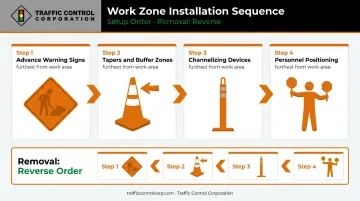
The correct installation sequence:
- Place advance warning signs first — furthest from the work area
- Install tapers and buffer zones
- Place channelizing devices
- Position personnel only after the zone is fully delineated
Removal always runs in reverse order. Personnel clear first, channelizing devices come out next, then the taper, then advance warning signs last.
Stop setup if any of these conditions exist:
- Sight distance is insufficient due to hills, curves, or weather
- Signing equipment is damaged or non-compliant with MUTCD standards
- Traffic volume and speed make safe placement impossible without additional controls like a pilot vehicle or temporary signals
Equipment compliance is a setup issue before it becomes a field issue. Confirming that signs, arrow boards, delineators, and warning beacons meet MUTCD standards before deployment — with support from a knowledgeable supplier — removes a preventable failure point. Traffic Control Corporation supports contractors and agencies across eleven Midwest states with product selection for work zone applications.
Safety While Directing Active Traffic
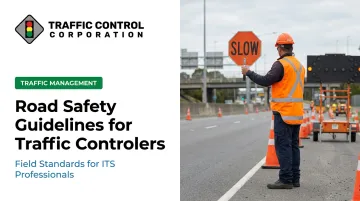
Signaling consistency protects both the controller and the driver. The STOP/SLOW paddle is the primary hand-signaling device under MUTCD Section 6D.02 — it's octagonal, at least 18 inches wide, with 6-inch letters, and must be retroreflectorized for night use. Erratic or ambiguous signals create driver confusion and increase conflict within the zone.
Communication between opposing controllers is a foundational requirement. MUTCD Section 6E.02 states that opposing controllers should be able to coordinate orally, electronically, or through manual signals that cannot be mistaken for traffic-control signals. Two-way radio is the most reliable method for most conditions. The protocol is clear: one controller releases traffic only after receiving confirmation from the opposite end that traffic has cleared. Never assume. Always confirm.
Stop traffic immediately if any of these occur:
- A vehicle ignores signals and enters the zone
- A pedestrian bypasses barriers
- Equipment has shifted out of position
- Communication with the opposing controller fails
Don't attempt to resolve the hazard while traffic is still moving. Stop the flow first, then address the problem.
Fatigue on long shifts is a real operational risk. A 2022 Work Zone Safety Information Clearinghouse study found that construction workers reported fatigue severe enough to raise safety concerns after 10-hour days sustained over 3 to 4 consecutive days.
Slower reaction times and lapses in signaling consistency follow. Supervisors should build rotation schedules into extended assignments — no shift length justifies reduced vigilance.
Environmental and Visibility Hazards
Environmental conditions don't change the fundamental safety requirements — they raise the stakes for every one of them.
Nighttime and Low-Light Conditions
At night, retroreflective PPE and retroreflective signage become the primary safety mechanism. Per MUTCD Section 6F.01, temporary signs must be retroreflective or illuminated. Flagger stations must also be illuminated except in emergencies. Class 3 apparel is the nighttime recommendation.
Before any night shift begins, verify that:
- All high-visibility garments are properly retroreflective and undamaged
- The STOP/SLOW paddle is retroreflectorized
- All devices in the zone meet nighttime visibility requirements
Adverse Weather
Rain, fog, and snow reduce both driver stopping distances and sight lines. When conditions deteriorate, controllers need to assess whether the existing setup still provides adequate advance warning distance.
MUTCD Table 6B-2 provides sight distance benchmarks by posted speed:
| Posted Speed | Minimum Sight Distance |
|---|---|
| 40 mph | 305 feet |
| 50 mph | 425 feet |
| 60 mph | 570 feet |
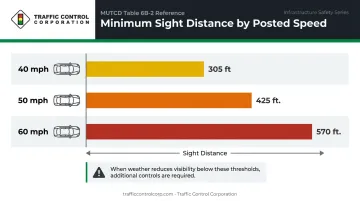
When weather reduces effective sight distance below those thresholds, the appropriate responses include additional advance warning signage, reduced speed limits, or temporary suspension of operations.
Sun Glare and Heat
Sun glare can make a controller effectively invisible to an approaching driver at certain times of day, regardless of what they're wearing. Positioning adjustments and additional signage are the operational response.
Heat presents a distinct but equally serious risk in the same outdoor environment. NIOSH and OSHA both identify outdoor construction workers as a high-risk group for heat illness. Controllers on long summer shifts need access to water, rest rotation, and monitoring, particularly during the acclimatization period in early summer when heat tolerance hasn't fully developed.
Common Safety Mistakes Traffic Controllers Must Avoid
These aren't rookie errors. They show up across experience levels, and they're preventable.
Skipping the Pre-Shift Work Zone Inspection
Assuming yesterday's setup is still correct is a leading precursor to struck-by incidents. Cones shift. Signs get clipped or moved. A barricade that was protecting you at the start of yesterday's shift may no longer be in position. Walk the zone before you take position — every shift.
Treating Slow Traffic as Safe Traffic
A distracted driver moving at 15 mph hitting an unprotected controller is still a life-threatening event. Low vehicle speeds don't reduce the need for proper positioning, PPE, and escape route awareness. Full protocols apply at every traffic volume.
Losing Escape Route Awareness Over Time
Controllers who become comfortable at a familiar site often stop tracking their designated escape path. Complacency, not inexperience, is the dominant factor in veteran worker injuries in work zones. Experienced controllers are at greater risk precisely because they stop expecting conditions to change. Treat every shift as if the situation could change without warning — because it can.
Conclusion
Traffic controller safety depends on three things functioning together: regulatory compliance, proper equipment, and personal discipline. None of the three substitutes for the others. A controller with the right PPE but poor positioning is still at risk. A well-laid-out zone with non-compliant signs offers false protection.
Safety briefings, pre-shift zone inspections, and PPE checks are the foundation of operations, not administrative box-ticking. Agencies and contractors who treat them that way see measurably better safety outcomes.
Traffic Control Corporation has supported Midwest DOTs, municipalities, and contractors for over 75 years. For agencies and crews across Illinois, Indiana, Iowa, Minnesota, Missouri, and surrounding states, TCC offers product selection guidance, technical support, and access to a deep inventory of traffic control equipment built to regulatory standards.
Frequently Asked Questions
What do I need to be a traffic controller?
Complete an accredited traffic control training course covering MUTCD Part 6 procedures and equipment requirements. State-specific licensing requirements apply before performing TCP duties and vary by state and DOT contract.
What makes a good traffic controller?
Sustained situational awareness, consistent and clear signaling, and sound judgment when conditions change. Strong controllers also communicate proactively with the opposing end of the zone and maintain strict positioning and escape route discipline — even on quiet sites where the temptation to relax protocols is highest.
What are the 5 main components of a traffic control zone?
The MUTCD defines four official areas:
- Advance Warning Area — alerts drivers to the upcoming change
- Transition Area — redirects traffic through a taper
- Activity Area — contains the buffer space and work space
- Termination Area — returns traffic to normal flow
Buffer space and work space sit within the Activity Area, not as separate top-level zones.
What are the 5 basic requirements of a traffic control device?
Per MUTCD Section 1D.01, an effective traffic control device should: fulfill a need, command attention, convey a clear and simple message, command respect from road users, and give adequate time for a proper response. These are guidance criteria, not a standalone legal compliance checklist.
What PPE is required for a traffic controller on a roadway?
At minimum, traffic controllers need:
- High-visibility apparel: ANSI/ISEA 107 Class 2 or Class 3 (Class 3 recommended for nighttime)
- Hard hat: ANSI Z89.1 compliant where impact or falling object hazards exist
- Safety footwear: ASTM F2413 compliant where foot hazards are present
The appropriate hi-vis class depends on your hazard assessment and work zone conditions.
What should a traffic controller do if a vehicle enters the work zone without stopping?
Move immediately to your designated escape route and clear the zone. Do not attempt to stop or confront the vehicle. Alert the opposing controller via radio, report the incident to your supervisor, and document what happened before resuming operations.