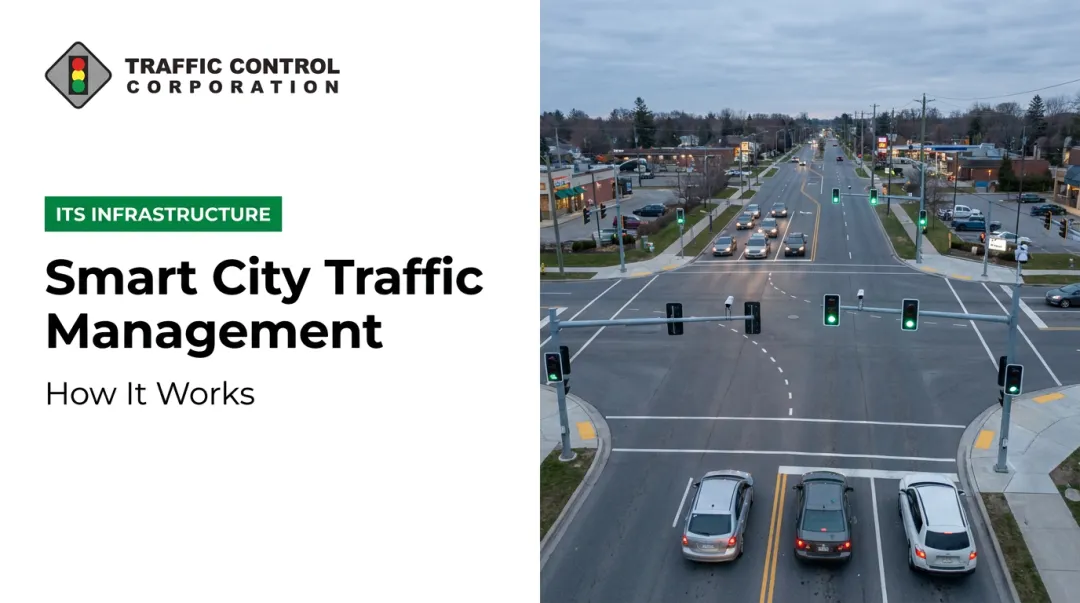
This scenario repeats itself thousands of times a day across every city that still relies on fixed-time signal plans. Traffic engineers have a fix for it: adaptive traffic signal control technology, or ASCT.
ASCT uses real-time sensor data instead of preset schedules to adjust signal timing continuously, responding to actual traffic conditions rather than what a timing plan assumed months or years ago. This article covers how ASCT works, what it delivers in measurable benefits, where it's already proving itself, and how transportation agencies can evaluate and implement the right system for their corridors.
Key Takeaways
- ASCT continuously adjusts signal timing using live traffic data, not fixed schedules
- The FHWA reports 10%+ average travel-time gains, reaching 50% on outdated corridors
- Success requires reliable detection hardware, compatible controllers, and expert local support
- Agencies should weigh corridor type, budget, and vendor expertise before adopting ASCT
What Is Adaptive Traffic Signal Control?
Adaptive traffic signal control dynamically adjusts red, yellow, and green timing based on live traffic conditions rather than a schedule programmed weeks or months in advance. It's the difference between a system that reacts to what's happening right now and one that follows a script written for "typical" traffic patterns.
Fixed-time systems fail the moment conditions deviate from that script. Construction detours, weather events, seasonal shifts, a stadium letting out early — any of these can turn a well-designed timing plan into a source of gridlock. Static plans simply can't account for variability they weren't built to handle.
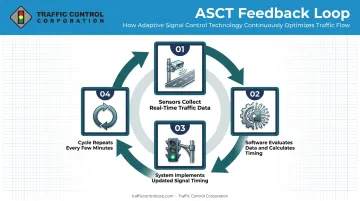
The FHWA describes the ASCT feedback loop in four repeating steps:
- Sensors collect real-time traffic data at the intersection or corridor
- Software evaluates that data and calculates timing improvements
- The system implements updated signal timing
- The cycle repeats every few minutes, continuously refining performance
This capability didn't exist in early signal infrastructure. Traffic control evolved from electromechanical dial controllers to standardized NEMA and ATC platforms, an evolution that gave engineers the computing power and interoperability needed to support adaptive algorithms in the first place.
Types of Traffic Signal Control Systems
Not every intersection needs adaptive control. Three tiers exist, each suited to different conditions:
- Pretimed (fixed-time) control runs on a predetermined cycle with no real-time responsiveness. It suits temporary roadwork zones or grids with highly consistent traffic.
- Actuated control (semi- or fully-actuated) responds to vehicle presence at a single intersection, triggering calls and extensions without optimizing across a corridor.
- Adaptive control operates at the corridor or network level, adjusting cycle length, splits, and offsets in real time. SCATS (Sydney, Australia) and SCOOT (UK) are the most established examples.
How Adaptive Signal Control Systems Work
ASCT functions through five interconnected layers, and weak performance in any one of them limits the entire system's effectiveness.
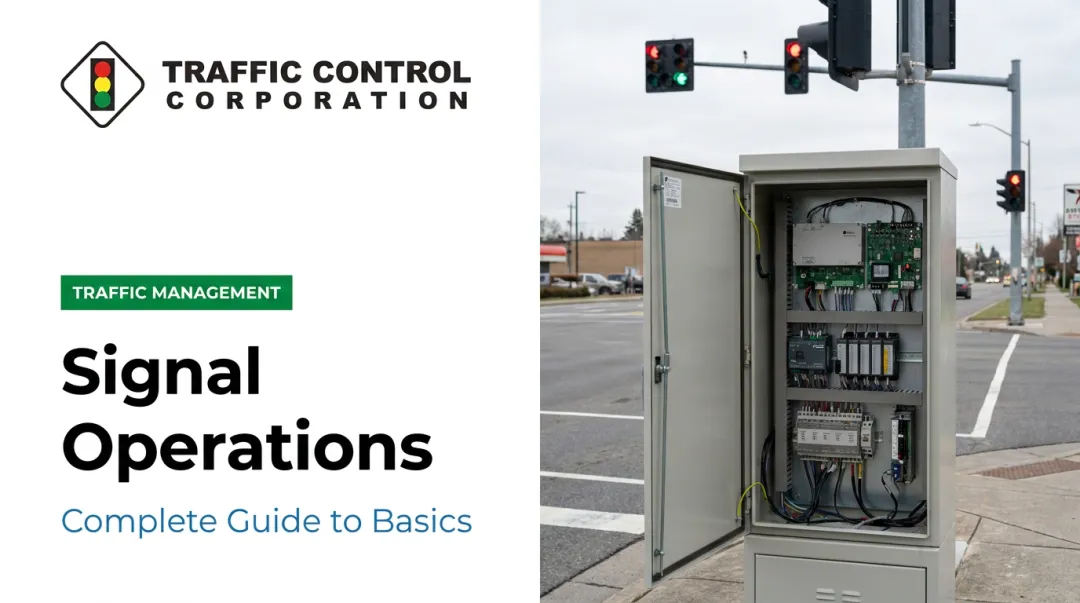
- Detection layer. Inductive loops, video cameras, radar, and multimodal sensors capture vehicle, bicycle, and pedestrian activity continuously. The technology mix matters: some sensors handle presence detection well but struggle with speed data, while others cover wider zones but need clear sightlines.
- Data processing layer. Central or edge software analyzes volume, speed, and occupancy data across an intersection or the full corridor, building a live picture of demand rather than a snapshot.
- Optimization layer. Algorithms recalculate phase splits, cycle lengths, and offsets to reduce delay for whichever movements currently carry the heaviest load. This is where the system adapts.
- Communication and controller layer. Standardized protocols like NTCIP (National Transportation Communications for ITS Protocol) let controllers at multiple intersections coordinate corridor-wide, so a change at one signal accounts for what's happening at the next.
- Performance monitoring. Automated Traffic Signal Performance Measures (ATSPM) convert high-resolution controller data into actionable metrics. This is the feedback mechanism agencies use to confirm timing plans are working, not just running.
Agencies running Econolite's Centracs pair this feedback loop with audits that catch a drifting plan early.
Benefits of Adaptive Traffic Signal Control
The case for ASCT rests on measurable outcomes across mobility, environment, safety, and infrastructure use.
Reduced travel time and delay. As noted above, the FHWA's benchmark shows average improvements exceeding 10%, climbing to 50% or more on corridors where existing timing plans were badly out of date. These are program-level figures, not per-project guarantees, but they establish a strong baseline case for investment.
Lower fuel consumption and emissions. Less idling and stop-and-go driving means less wasted fuel. Transport for NSW reports that SCATS deployments average a 12% reduction in fuel consumption and a 15% reduction in total emissions, alongside measurable drops in CO2 and particulate output.
Improved safety outcomes — though results vary by site. FHWA research found:
- A 13.3% reduction in total crashes and 39.6% reduction in angle crashes at Virginia InSync installations
- A 44% reduction in rear-end crashes in Texas ASC Lite deployments
- No statistically significant safety change at a Florida InSync site
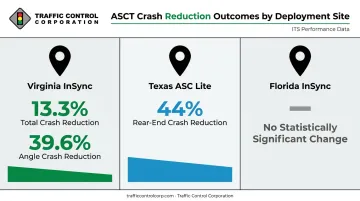
That last point matters. Safety gains aren't automatic. They depend on the corridor, the detection quality, and the timing objectives set during implementation.
Extended infrastructure lifespan. ASCT helps agencies squeeze more capacity from existing roads, often deferring or avoiding expensive widening and reconstruction projects.
Better resilience during disruptions. Construction, special events, and seasonal traffic shifts stop being emergencies. Adaptive systems adjust automatically instead of waiting for an engineer to reprogram a plan.
Real-World Applications and Where ASCT Works Best
ASCT isn't a universal upgrade. It delivers the strongest returns in specific environments:
- Suburban corridors with unpredictable peak periods
- Downtown grids with fluctuating pedestrian activity
- Tourist districts and event venues with irregular traffic spikes
- High-crash arterials where responsive timing can reduce conflict points
Documented outcomes back this up:
- Toronto's SCOOT deployment reduced travel time by 8%, cut delay by 17%, and lowered vehicle stops by 22% in an on-street evaluation
- New York City's Midtown in Motion reported a 10% travel-time improvement in its initial test-bed phase
- NJDOT has designated adaptive corridors closer to home along Routes 130, 168, and 32
Beyond these documented results, ASCT is increasingly bundled into broader Smart City and Connected Vehicle initiatives. V2X integration allows signals to prioritize transit vehicles, coordinate emergency preemption, and eventually communicate directly with connected cars, extending the value of the same detection and controller infrastructure already in place.
Choosing and Implementing the Right Adaptive Signal System
Selecting an adaptive system requires agencies to work through a sequence of technical and operational questions before committing budget.
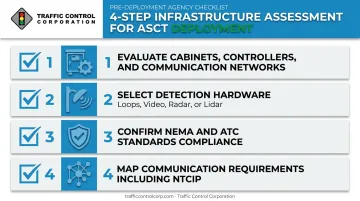
Start with an infrastructure assessment:
- Evaluate existing cabinets, controllers, and communication networks for compatibility
- Select detection hardware suited to the corridor: loops, video, radar, or lidar depending on lane configuration and weather exposure
- Confirm NEMA and ATC standards compliance so new equipment integrates with what's already installed
- Map out communication requirements, including NTCIP compliance across every intersection in the corridor
Vendor experience matters as much as the hardware. This is where a lot of projects stall: agencies pick technology without a clear path to installation support, technician training, or long-term troubleshooting.
TCC has spent over 75 years supporting Midwest transportation agencies with this kind of hands-on guidance. That includes access to 40+ manufacturers such as Econolite, GE Current, and Reno A&E, plus factory-trained technical staff for installation and repair.
Deployment doesn't end at turn-on. Long-term ROI depends on:
- Staff training on new controller interfaces and software
- Onsite support for troubleshooting as conditions change
- Ongoing ATSPM-based performance monitoring to confirm timing plans are still delivering results months and years later
Agencies that skip this last step often see initial gains erode quietly over time, without anyone noticing until complaints start rolling in.
Frequently Asked Questions
What is traffic signal control?
Traffic signal control is the automated management of red, yellow, and green lights to regulate vehicle, pedestrian, and cyclist movement at intersections. It ranges from simple fixed-time plans to fully adaptive, real-time systems.
What are the three types of traffic control devices?
The MUTCD recognizes signs, signals, and pavement markings as the primary traffic control device families, along with other devices used to regulate, warn, or guide traffic. Each serves a distinct role in managing roadway behavior.
How is adaptive signal control different from actuated signal control?
Actuated systems respond only to vehicle presence at a single intersection, extending or calling phases based on local detector input. Adaptive systems continuously analyze data across a corridor and adjust cycle length, splits, and offsets network-wide.
How much does it cost to implement adaptive traffic signal control?
Costs vary widely based on corridor size, detection technology chosen, and whether existing controllers need replacing. A regional distributor like Traffic Control Corporation can provide a needs-based estimate specific to your agency's infrastructure.
Which cities or agencies use adaptive traffic signal control systems?
Sydney's SCATS, Toronto's SCOOT, and New York City's Midtown in Motion are among the most documented deployments. NJDOT has also implemented adaptive corridors along Routes 130, 168, and 32.
Does adaptive signal control help pedestrians and cyclists, not just vehicles?
Yes. Multimodal sensors let ASCT detect pedestrians and bicycles, adjusting crosswalk timing accordingly. This can reduce wait times and improve safety for non-vehicle traffic, not just cars moving through the intersection.