
Introduction
Illinois recorded 303,913 crashes in 2024 — including 1,085 fatal crashes and 63,109 injury crashes — according to IDOT's 2024 Illinois Crash Facts & Statistics. Behind every one of those events sits a standardized form: the SR 1050 Traffic Crash Report.
Most people glance at a crash report to find who was cited — and stop there. The coded fields covering injury severity, contributory causes, road conditions, and traffic control status contain most of the useful information on the page.
Insurance adjusters use those codes to assess liability. Attorneys use them to build or contest claims. Municipal traffic engineers use them to identify high-risk locations and justify infrastructure changes.
This guide explains the SR 1050 structure, decodes the key field categories in plain terms, and traces how crash data flows from individual scenes to statewide safety decisions.
Key Takeaways
- Illinois law requires officers to file an SR 1050 whenever a crash involves injury, death, a towed vehicle, or property damage exceeding $1,500.
- Injury severity follows the KABCO scale: K (fatal), A (incapacitating), B (non-incapacitating), C (possible), O (no injury).
- Unit 1 identifies the vehicle the officer believes caused the crash — not a legal finding of fault.
- Contributory cause codes drive both insurance claims and long-term infrastructure planning decisions.
- Report errors can be challenged through supplemental filing — understanding crash codes helps agencies, engineers, and attorneys respond effectively.
What Is an Illinois Traffic Crash Report?
The Illinois Traffic Crash Report — form SR 1050 — is the standardized document completed by a responding law enforcement officer after any qualifying crash. IDOT's Bureau of Data Collection supplies the form and receives all submitted reports, which feed into the statewide crash database.
Who Must File and When
Under 625 ILCS 5/11-407, an officer-completed report is required when a crash involves:
- Injury or death
- Property damage exceeding $1,500
- Property damage exceeding $500 when an involved vehicle required to carry insurance is uninsured
- Certain school-bus incidents
Officers must forward the completed report to IDOT within 10 days of their investigation.
One notable legislative update: Public Act 102-0560, effective August 20, 2021, repealed the private motorist written-reporting requirement. Drivers no longer submit a separate SR1B form, though the law enforcement obligation under Section 11-408 remains fully intact.
Who Uses the Report
The SR 1050 is referenced across multiple professional disciplines:
- Insurance companies — establishing coverage liability and claim processing
- Attorneys — building or defending personal injury cases
- IDOT data analysts — compiling statewide safety trends
- Municipal traffic engineers — identifying high-crash locations
- Transportation planners — justifying infrastructure investment requests
Each group interprets the same coded fields differently, which is why understanding the report's structure matters.
Key Sections of the Illinois Traffic Crash Report
The SR 1050 is a two-sided form. The front captures structured, coded data; the reverse captures the diagram and narrative.
Page 1 — Crash Identification and Unit Data
The top of Page 1 records the basic facts: crash date, time, location (roadway name, distance from a reference point, municipality, county), investigating agency, and the responding officer's information. Location data carries particular weight — IDOT uses it to map crash cluster sites and identify dangerous corridors.
The unit system is one of the form's most important structural elements. Every vehicle, pedestrian, or bicyclist involved gets assigned a unit number. For each unit, the report captures:
- Driver license details
- Vehicle information (year, make, model, VIN)
- Insurance details and registered owner
Unit 1 is the vehicle the officer identified as the at-fault party. If fault isn't clear, it defaults to the striking vehicle. This is a coding convention, not a legal determination of liability.
The bottom section of Page 1 is where most of the analytical value sits. Coded fields here include:
- Primary and secondary contributory cause codes
- Crash type and manner of collision
- Road surface condition
- Weather and lighting conditions
- Traffic control device present (or absent)
- Citations and arrests issued
Page 2 — Narrative and Diagram
Page 2 is required for Type B crashes. It contains a scaled diagram showing vehicle travel paths, points of impact, skid marks, traffic signal locations, and final resting positions. This visual record is essential for crash reconstruction.
The written narrative captures the officer's observations, witness statements, driver statements, and interpretation of the sequence of events. The narrative reflects the officer's professional opinion. It is not a judicial finding of fault and can be challenged or supplemented.
Illinois Traffic Crash Report Codes Explained
All coded fields on the SR 1050 draw from IDOT's standardized crash coding manual — the 2019 SR 1050 Instruction Manual. Here's what the key categories mean.
Injury Severity Codes
Illinois uses the KABCO scale, a national standard attributed to the National Safety Council and formalized in ANSI D16.1:
| Code | Classification | What It Covers |
|---|---|---|
| K | Fatal | Injury results in death |
| A | Incapacitating | Severe laceration, broken/distorted extremity, crush injury, suspected skull/chest/abdominal injury, significant burn, unconsciousness at scene, or paralysis |
| B | Non-incapacitating | Injury evident at scene but not incapacitating — lumps, abrasions, minor lacerations |
| C | Possible injury | Complaint of pain or limping, but no visible injury evident |
| O | No apparent injury | No injury observed or reported |
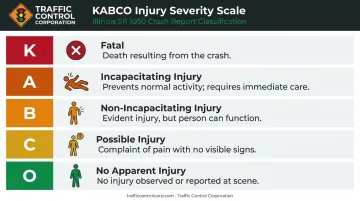
The distinction between A and B matters significantly for how a crash gets counted in statewide safety statistics and severity-weighted analyses. A Code A injury carries far more weight than a Code B when agencies calculate severity indices for site ranking.
Crash Type and Manner of Collision Codes
Crash type tells you the basic severity classification:
- Type A — Property damage only; the vehicle remained drivable
- Type B — Involves death, injury, or a vehicle towed from the scene due to crash damage
This distinction affects insurance processing, legal thresholds, and IDOT severity statistics. A rear-end fender-bender where both cars drive away is Type A. Any crash involving injury or a vehicle that can't be driven is Type B.
Manner of collision codes describe the physical dynamics:
- Front-to-rear (rear-end), angle, front-to-front (head-on)
- Sideswipe same direction, sideswipe opposite direction
- Fixed object, pedestrian, pedalcyclist, overturned, parked motor vehicle
- Animal, train, other non-collision types
These codes help analysts identify location-specific patterns: repeated angle crashes can point to sight distance problems, while a cluster of rear-end crashes often signals a signal timing issue.
Contributory Cause Codes
The primary and secondary contributory cause fields are among the most consequential on the form. They record the officer's assessment of what caused or contributed to the crash. Common codes include:
- Code 2 — Disregarding traffic signals
- Code 3 — Disregarding stop sign
- Code 10 — Failing to reduce speed
- Code 11 — Failing to yield right of way
- Code 15 — Improper lane usage
- Code 23 — Under influence of alcohol/drugs (arrest made)
- Code 25 — Weather
- Code 26 — Exceeding authorized speed limit
- Code 27 — Exceeding safe speed for conditions
- Codes 28–32 — Distracted driving (inside distraction, outside distraction, cell phone, texting, other electronic device)
Speed-involved crashes illustrate how these codes aggregate into planning intelligence: IDOT's 2024 data shows speed was a factor in 31.1% of all crashes, 45.3% of fatal crashes, and 35.2% of injury crashes statewide.
Environmental and Road Condition Codes
These four fields capture conditions at the time of the crash:
| Field | Coded Options |
|---|---|
| Road Surface | Dry, wet, snow, ice, slush, sand/mud/gravel, standing water, other |
| Weather | Clear, cloudy, fog/smoke, rain, sleet/hail, snow, severe crosswinds, freezing rain, blowing snow |
| Lighting | Daylight, dawn, dusk, dark-lighted, dark-unlighted, dark-unknown |
| Traffic Control Device | No control, stop/yield sign, traffic signal, flashing signal, railroad gate, officer, flagger, school crossing guard, pavement marking, warning sign |
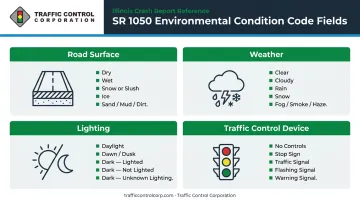
When a crash report codes the traffic control field as "no control" or the device as non-functioning, it creates direct documentation for an infrastructure improvement request.
How Crash Report Codes Inform Traffic Safety Planning
The SR 1050 does more than document a crash. Every coded field feeds into the statewide data systems that drive Illinois infrastructure investment decisions.
From Individual Reports to Network Analysis
IDOT aggregates all coded crash data into its statewide crash records system, which supports GIS crash mapping, trend reports, and the interactive tools published through IDOT's crash data portal. Municipal and county transportation agencies pull this data to conduct spot studies at specific intersections, corridor analyses along road segments, and network screenings across entire jurisdictions.
When a particular location shows repeated crashes with the same contributory cause code — say, multiple "disregarding traffic signals" events at one intersection — that pattern triggers an engineering review. The review examines signal timing, signal visibility, or equipment condition.
How Severity Codes Drive Prioritization
Not all crashes count equally in safety planning. FHWA's Equivalent Property Damage Only (EPDO) methodology weights crashes by societal cost, so a single fatal crash (Code K) outweighs dozens of property-damage-only events. Illinois agencies use this approach (alongside safety performance functions, excess expected crash frequency, and benefit-cost analysis) to rank locations for intervention funding.
The IDOT Highway Safety Improvement Program (HSIP) translates this analysis into funded projects. In FY2025, Illinois awarded HSIP funds to projects including:
- Intersection reconstruction in Elk Grove Village ($1,853,184)
- Intersection improvements with a median island in Aurora ($676,060)
- Systemic pedestrian signals and retroreflective backplates in Moline ($515,308)
The Traffic Control Device Field as a Direct Case for Investment
When crash reports at a location consistently show "no traffic control" or a non-functioning device in the TRFD field, that coding builds a documented case for infrastructure change. The link between crash data and equipment response is direct — federal data quantifies the impact:
- Retroreflective signal backplates reduce total crashes by 15% at urban signalized intersections
- Converting a stop-controlled intersection to a roundabout reduces fatal and injury crashes by 82%
How TCC Helps Build Safer Illinois Roads
When crash report codes point to signal-related contributory causes — disregarded signals, missing traffic control, failed detection — the next step is addressing the equipment gap. That's where Traffic Control Corporation (TCC) comes in.
Founded in 1946 and headquartered in Woodridge, Illinois, TCC has spent over 75 years supporting state and local agencies, DOTs, and municipalities across 11 Midwest states. As a distributor representing more than 40 manufacturers, TCC supplies the specific equipment categories that crash data analysis most commonly flags:
- Traffic signal controllers and cabinets: NEMA, 2070 Series, and ATC controllers from Econolite
- Detection systems: Video (Econolite Autoscope® OptiVu), radar, lidar, and inductive loop for intersections with missed-detection issues
- Pedestrian safety systems: APS units, RRFBs, HAWK signals, and in-roadway crosswalk lighting for pedestrian-involved crash locations
- Emergency vehicle preemption: Opticom EVP systems, for which TCC is the authorized Illinois dealer
- Backup power systems: Alpha Technologies UPS units to keep signals operational during outages
- Traffic calming devices: Radar speed signs, dynamic message signs, and school zone beacons for speed-related corridors
TCC's factory-trained technical staff provides product selection assistance, onsite troubleshooting, signal turn-on service, conflict monitor certification, and annual MMU testing. That depth of support keeps Illinois intersections running reliably after an upgrade is installed.
Transportation agencies, municipalities, and contractors in Illinois and across the Midwest can reach TCC's Illinois regional office at 630-543-1300 or through trafficcontrolcorp.com to discuss traffic control solutions that address root causes identified in crash data analysis.
Frequently Asked Questions
How do you read an Illinois traffic crash report?
The SR 1050 has two sides. The front (Page 1) contains coded fields for crash identification, unit data, contributory causes, and road and environmental conditions. The reverse (Page 2) contains the officer's diagram and written narrative. Reading it accurately requires familiarity with IDOT's standardized code definitions from the 2019 SR 1050 Instruction Manual.
What is a Code 4 injury on an Illinois crash report?
Illinois does not use a "Code 4" designation. The state uses a letter-based KABCO scale: K (fatal), A (incapacitating), B (non-incapacitating), C (possible injury), and O (no injury). "Code 4" is terminology used in other states or emergency dispatch systems and doesn't appear on Illinois SR 1050 forms.
What is a Type B crash in Illinois?
A Type B crash involves a death, a personal injury, or a vehicle towed from the scene due to crash damage — it affects insurance processing, legal proceedings, and IDOT severity statistics. Type A, by contrast, covers property damage only, with the vehicle remaining drivable.
What do contributory cause codes mean on an Illinois crash report?
Contributory cause codes identify the primary and secondary factors the officer attributed to the crash, such as speeding, failure to yield, distracted driving, or disregarding a traffic control device. Agencies aggregate these codes across locations to identify systemic problems and target safety countermeasures.
How do I get a copy of my Illinois traffic crash report?
Reports can be requested through the Illinois State Police online portal at isp.illinois.gov/CrashReports, by visiting the investigating agency in person, or by mailing a request to ISP Patrol Records in Springfield. ISP notes that online requests may take 10 or more business days to process.
What does Unit 1 mean on an Illinois crash report?
Unit 1 is the vehicle the responding officer identified as the at-fault party — or, when fault isn't clear, the striking vehicle. This is the officer's initial assessment based on field observations, not a final legal determination of fault. Unit 2 is typically the other involved party.