
Introduction
Four-way emergency flashers are on virtually every vehicle on U.S. roads — and most drivers have used them at some point. You see them on disabled cars pulled to the shoulder, delivery trucks double-parked outside a restaurant, and slow-moving construction equipment on steep highway grades.
That familiarity can be deceiving. Despite being standard equipment for decades, four-way flashers are routinely misused in ways that create confusion rather than prevent it. Common examples include:
- Activating hazards during heavy rain while traveling at highway speed
- Flipping them on while hunting for a parking spot in a lot
- Turning them on briefly before a highway exit as a courtesy signal
All three are common. All three are potentially dangerous.
This guide covers what four-way flashers are, how they work, when to use them, when to avoid them, and what U.S. law actually says about their use.
Key Takeaways
- Four-way flashers activate all four turn signal lights simultaneously to signal a hazard or disabled vehicle
- They operate on battery power alone, with no engine required
- Correct use: breakdowns, roadside stops, tire changes, slow-moving vehicles on grades
- Incorrect use: illegal parking, heavy traffic, highway exits, routine rain driving
- State laws vary significantly, with no single national rule governing in-motion use
What Are Four-Way Emergency Flashers?
Four-way emergency flashers are a vehicle safety system that causes all four turn signal indicators — two front, two rear — to flash simultaneously. The name comes from that simple fact: all four directional lights activate at once, rather than the single-side activation used for a normal turn signal.
You'll hear them called several things: hazard lights, emergency flashers, four-ways, or just flashers. They all refer to the same system.
What They Are Not
Four-way flashers are distinct from several other systems drivers often confuse them with:
- Turn signals activate on one side only; flashers activate all four corners simultaneously
- Parking lights hold a steady glow; flashers cycle on and off
- Emergency vehicle lights (police, fire, EMS) use separate strobing systems carrying specific legal meanings under traffic law
A Brief History
FMVSS No. 108, the federal standard governing vehicle lighting, was published February 3, 1967. It took effect January 1, 1968, for larger vehicles and January 1, 1969, for passenger cars under 80 inches wide. Before federal requirements, four-way flasher kits were sold as aftermarket accessories — restoration vendors still list reproduction assemblies for 1964–1966 model vehicles, evidence that drivers were demanding this safety feature well before it became mandatory.
Modern vehicles increasingly use LED-based signal lamps, which consume less power and respond faster than incandescent bulbs. Still, some vehicles use incandescent indicators, and FMVSS 108 sets performance requirements regardless of bulb type — so faster response is a common LED advantage, not a universal one.
How Do Four-Way Flashers Work?
The system runs on a dedicated electrical circuit that operates independently of the ignition. This is intentional: the most critical moment to activate hazard lights is often right after the engine has failed.
Activation: The Hazard Switch
The hazard switch is typically a large button on the dashboard or steering column, marked with a red or black triangle-within-a-triangle symbol. Its placement is intentional so it's easy to locate and press quickly in an emergency.
Pressing the button completes the circuit and activates all four lights simultaneously. Press it again and the circuit opens, deactivating them. Because the system bypasses the ignition, it works with the car fully off.
The Flasher Relay
A component called the flasher relay (or turn signal module) controls the rhythmic blinking by interrupting and restoring current at a regular interval, roughly once per second. This same relay handles both turn signals and hazard lights.
That shared circuit creates an important limitation: activating four-way flashers makes it impossible to use turn signals simultaneously. All four lights will flash regardless of what the turn signal stalk is doing. For other drivers, a vehicle with hazards on gives no directional information — a genuine problem in moving traffic.
Battery Dependency
Hazard lights draw continuous power from the vehicle battery. Ford's owner manual content explicitly notes that running flashers with the engine off will drain the battery and may leave insufficient power to restart.
LED systems draw less power than incandescent bulbs, but runtime varies by vehicle. Key factors include:
- Battery size and current charge level
- Bulb type (LED vs. incandescent)
- Other active electrical loads (interior lights, radio)
Activate flashers when needed, but don't wait long to get help — most standard batteries won't sustain hazard lights beyond 1–2 hours without the engine running.
When Should You Use Four-Way Emergency Flashers?
Four-way flashers serve one purpose: telling other drivers your vehicle is an unexpected hazard. That's a narrower definition than most people apply in practice.
Appropriate Use Cases
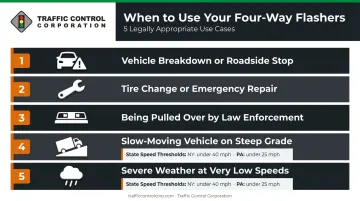
Flashers are appropriate in these situations:
- Vehicle breakdown or roadside stop: Activate immediately upon pulling over for any mechanical failure, flat tire, or overheating. Keep them on until the vehicle safely re-enters traffic or help arrives.
- Tire changes and emergency roadside repairs: Active flashers prompt approaching drivers to give wider clearance, reducing risk to anyone working outside the vehicle.
- Being pulled over by law enforcement: Activating hazards when an officer signals you demonstrates compliance and helps surrounding drivers identify the slowing or stopped vehicle ahead.
- Slow-moving vehicles on steep grades: Commercial trucks traveling well below posted speed limits on steep grades should activate flashers to warn faster-moving traffic.
- Severe weather at very low speeds: Some states permit in-motion hazard use during extreme visibility conditions. Rules vary by state — see the laws section below.
State thresholds for slow-moving vehicles differ. New York requires flasher use for certain vehicles traveling under 40 mph; Pennsylvania requires them when a vehicle can't maintain at least 25 mph. The CDL manual from FMCSA advises slow commercial drivers to use flashers on grades "if legal," acknowledging that state rules vary.
When Should You NOT Use Four-Way Emergency Flashers?
Flashers cause problems in several situations — not just prevent them. Here's where drivers commonly go wrong:
- Double or illegal parking: Hazard lights don't make illegal parking legal. You can still receive a citation while double-parked with flashers running.
- Stop-and-go or construction zone traffic: Congested conditions aren't an emergency. Activating flashers blocks your ability to signal lane changes, leaving surrounding drivers unable to anticipate your movements.
- Highway exits and routine turns: Other drivers can't tell whether a flashing vehicle is pulling over or simply taking an exit. Use your turn signal — that's what it's there for.
- Rain or fog at normal speeds: Most states either prohibit in-motion hazard use or set specific speed thresholds. At highway speeds, flashers confuse other drivers and eliminate your ability to signal.
Four-Way Flasher Laws: What U.S. Drivers Need to Know
There is no single federal rule governing when drivers may use four-way flashers while moving. FMVSS 108 covers vehicle manufacturing standards — it requires the equipment to exist and function, not when drivers must or may use it. Each state sets its own rules, and the variation is substantial.
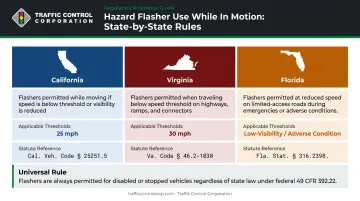
How Three States Handle It
| State | In-Motion Rule | Authority |
|---|---|---|
| California | Permitted when weather or traffic limits speed to 25 mph or less, and when approaching certain hazards | Cal. Vehicle Code § 25251 |
| Virginia | Permitted when stopped at a traffic hazard or traveling 30 mph or less; use above 30 mph is restricted | Va. Code § 46.2-1040 |
| Florida | Generally prohibited while moving, but permitted during extremely low visibility on roads posted at 55 mph or higher (rule took effect July 1, 2021) | Fla. Stat. § 316.2397 |
The One Consistent Rule
Across all states, four-way flashers are always permitted — and often required — when a vehicle is disabled and stopped on a roadway or shoulder. For commercial motor vehicles, 49 CFR 392.22 makes this mandatory: a stopped commercial vehicle must activate flashers immediately, before placing warning triangles or flares.
Using flashers improperly — while speeding, parking illegally, or in situations your state prohibits — does not provide legal protection. It can itself constitute a traffic violation.
Vehicle hazard signals don't operate in isolation. They interact with the fixed infrastructure that transportation agencies manage every day: signals, detection systems, beacons, and dynamic message signs. Traffic Control Corporation (TCC) has worked with state DOTs and local agencies across the Midwest for over 75 years, supplying and supporting the roadway systems that form this broader safety network.
Conclusion
Four-way emergency flashers are a focused communication tool with one job: telling surrounding drivers that your vehicle is an unexpected hazard. Used correctly — for genuine breakdowns, roadside stops, or slow-moving vehicles on grades — they reduce risk. Used incorrectly — for parking convenience, highway exits, or routine rain driving — they create confusion and remove your ability to signal.
The distinction matters because misuse doesn't just inconvenience other drivers — it actively degrades the signal's meaning. Check your state's specific rules, and reserve the flashers for situations where a genuine hazard exists.
Frequently Asked Questions
Are flashers and hazard lights the same thing?
Yes. "Flashers," "hazard lights," "emergency flashers," and "four-way flashers" all refer to the same system — the simultaneous activation of all four turn signal lights to signal a vehicle hazard. The terminology varies by region, but the function is identical.
Is it illegal to drive with 4-way flashers on?
It depends on your state. California and Virginia permit in-motion use below certain speed thresholds (25 mph and 30 mph respectively), while Florida restricts use to specific low-visibility conditions. Some states limit use to stopped or disabled vehicles only. Check your state's motor vehicle code for the specific rule.
How long can four-way flashers run before draining the battery?
Runtime depends on battery capacity and whether the vehicle uses LED or incandescent signal lamps — LED systems draw less power and extend runtime considerably. Ford's documentation confirms that engine-off flasher use will drain the battery and may prevent restarting, so seek assistance promptly rather than leaving them on indefinitely.
Can you use your turn signal while four-way flashers are active?
No. Hazard lights and turn signals share the same relay and lighting circuit, so activating four-way flashers overrides turn signal function entirely. All four lights will flash regardless of turn signal input, making directional signaling impossible while hazards are on.
When were four-way flashers made mandatory on U.S. vehicles?
Federal Standard No. 108 was published February 3, 1967, but took effect January 1, 1968, for larger vehicles and January 1, 1969, for smaller passenger vehicles under 80 inches wide. Before the mandate, four-way flasher kits were available as aftermarket accessories.
Should trucks use four-way flashers on steep grades?
Yes, in most cases. Many states require or advise commercial vehicles to activate four-way flashers when traveling significantly below the posted speed limit on steep grades. New York requires it for certain vehicles under 40 mph; Pennsylvania requires it when a vehicle can't maintain 25 mph. The FMCSA CDL manual advises use "if legal," meaning state rules govern the specific threshold.