This article covers how traffic lights work mechanically and legally, what each signal color and variant means, the genuine safety trade-offs of signalization, and how the technology is changing. Whether you're a daily commuter or a transportation professional evaluating intersection controls, understanding these fundamentals matters.
Key Takeaways
- A traffic signal is a full system: controller, sensors, signal heads, and pedestrian equipment working together
- Red, yellow, and green have precise legal meanings under the MUTCD; arrow and flashing variants modify those rules for specific movements
- Signals reduce severe angle crashes but increase rear-end collisions and vehicle emissions at stop points
- Adaptive signal systems improve average travel times by more than 10%, per FHWA data
- The MUTCD defines nine warrants that engineers must evaluate before installing a signal — satisfying them is necessary but not sufficient on its own
A Brief History of Traffic Lights
The first traffic signal appeared in London in December 1868, outside the Houses of Parliament. It used gas-lit red and green semaphore arms operated by a police officer — and famously exploded within weeks. Still, it proved a core idea: vehicle movement could be managed through a structured signaling system.
Key milestones after that:
- 1912 — The first electric traffic light was installed in Salt Lake City
- 1920 — William Potts introduced the four-way, three-color signal in Detroit, adding the amber caution phase to the existing red/green sequence
- 1950s onward — Traffic management shifted gradually toward computerized control systems, enabling coordination across multiple intersections
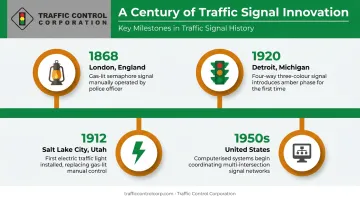
From a hand-operated gas lamp to networked adaptive systems, the technology has evolved considerably in just over 150 years — and the pace of change has accelerated sharply in the last two decades.
How Traffic Lights Work: The System Behind the Signal
The Controller: The Brain at the Cabinet
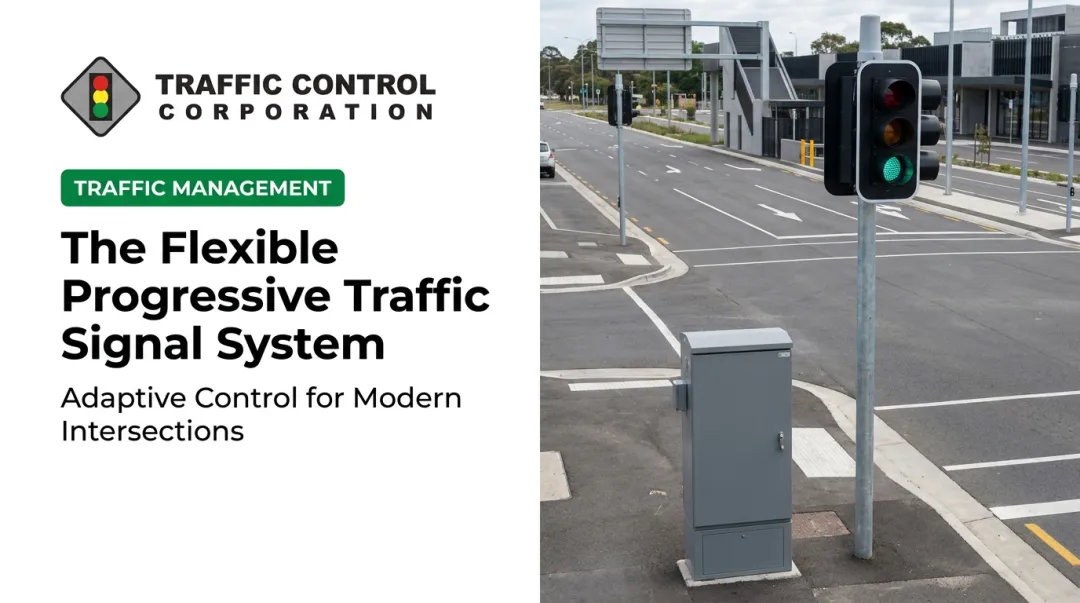
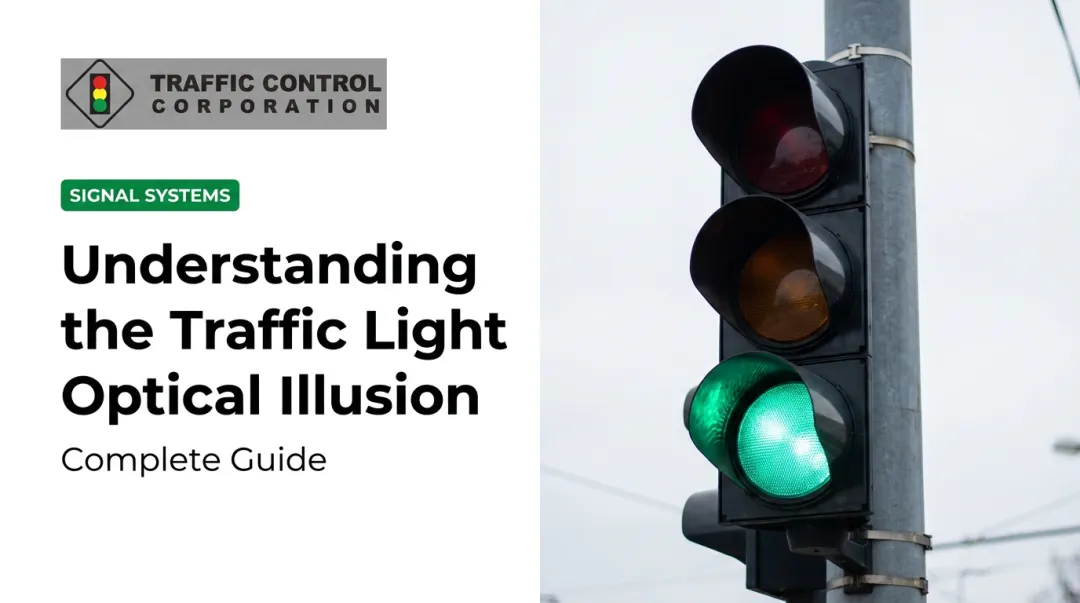
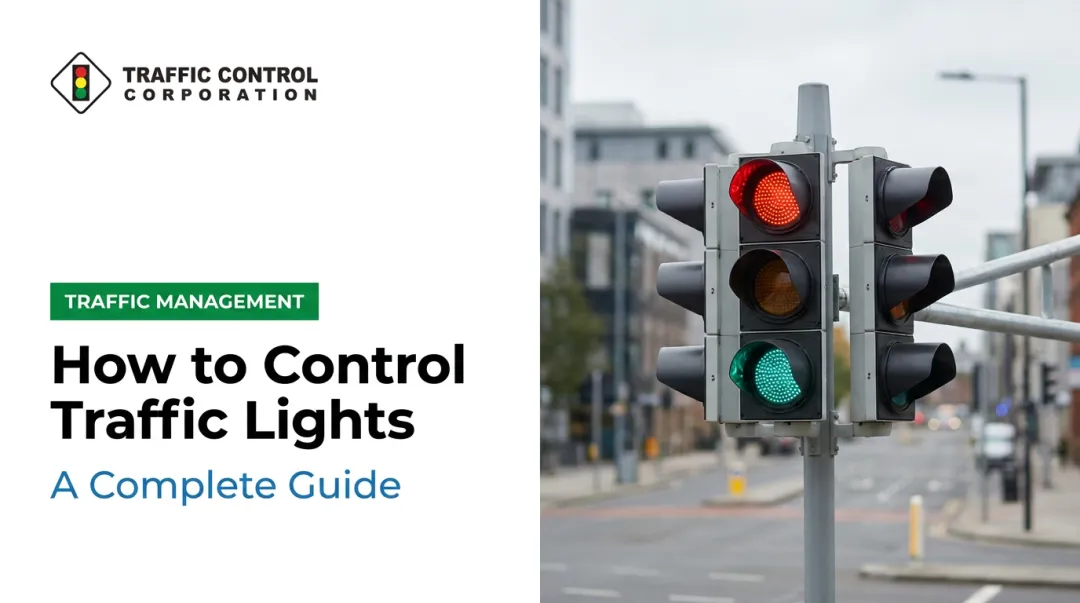
The term "traffic light" typically refers to the signal head — the red/yellow/green lens assembly mounted on a pole or mast arm. The broader "traffic signal" encompasses the entire system: controller, cabinet, detection equipment, poles, pedestrian signals, and communication infrastructure.
The signal controller, housed in a roadside cabinet, determines when each phase activates and how long it stays active. Controllers operate in three modes:
- Pre-timed: Fixed intervals run in a predetermined sequence regardless of actual traffic
- Actuated: Detectors on approach lanes send calls to the controller, which adjusts timing based on observed demand
- Adaptive: Real-time data from across the network continuously reshapes timing, covered in more detail below
Vehicle Detection Methods
Most modern signals rely on some form of detection to allocate green time efficiently:
| Detection Type | How It Works | Known Limitation |
|---|---|---|
| Inductive loop | Wire embedded in pavement detects metal from passing vehicles via inductance changes | Small motorcycles and bicycles can be missed if sensitivity is low or loop geometry is poor |
| Video processor | Camera analyzes image regions for vehicle presence, volume, and speed | Weather, shadows, and glare can degrade accuracy |
| Microwave radar | Transmits electromagnetic energy and evaluates return signals | Continuous-wave Doppler units can't detect stopped vehicles |
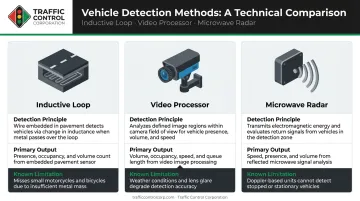
When a vehicle is detected, the controller receives a call to trigger or extend the green phase for that approach. Those calls feed directly into how engineers program timing — which is where coordination across an entire corridor comes into play.
Signal Timing and Coordination
Engineers program signals to maximize throughput on their specific corridor. Arterial roads carrying higher volumes receive more green time. Adjacent intersections are often synchronized using coordinated offsets to create green waves — progression bands that let vehicles travel a corridor at a consistent speed with minimal stops.
Pedestrian signals — WALK/DON'T WALK indicators, countdown timers, and audible signals for visually impaired pedestrians — are integrated into the same coordinated timing plan, not added as afterthoughts.
Each of these system layers requires compatible, properly specified equipment. Traffic Control Corporation (TCC) has supplied Midwest transportation agencies with traffic signal products for over 75 years — stocking Econolite controllers and cabinets, detection sensors, and pedestrian signal equipment. Their factory-trained staff can assist with product selection, installation, and upgrades.
What Do Traffic Light Colors and Signals Mean?
The MUTCD 11th Edition (December 2023) defines the legal meaning of every signal indication in the United States. Here's a practical summary:
Standard Three-Color Indications
- Red — Stop completely before the stop line; remain stopped until the signal changes (turns permitted after stopping where allowed by law)
- Yellow — The green phase is ending; prepare to stop. Yellow is a warning, not an invitation to speed up
- Green — Proceed straight or turn unless prohibited, while yielding to pedestrians and traffic already in the intersection
Arrow Signals
- Green arrow — Protected movement; conflicting traffic is stopped. Proceed cautiously, yielding to pedestrians
- Yellow arrow — The protected movement is ending
- Red arrow — The indicated turn is not permitted
Flashing Signals
- Flashing red — Treat as a stop sign: come to a complete stop, then proceed when clear
- Flashing yellow — Proceed with caution after yielding to pedestrians and conflicting traffic
Flashing Yellow Arrow (FYA)
Now standard at many left-turn lanes, the Flashing Yellow Arrow indicates a permissive movement — drivers may turn but must yield to oncoming traffic and pedestrians. Unlike a protected green arrow, opposing traffic is not stopped.
Signal Malfunction
When all signal heads are dark, the MUTCD does not establish a universal federal rule requiring four-way stop behavior — but most state vehicle codes do. Engineers and technicians should reference the applicable state statutes when drafting malfunction response protocols or signal maintenance procedures.
The Pros of Traffic Lights
Reduced Angle Collisions at High-Conflict Intersections
Signals are most effective where two arterial roads cross at high volumes. Research from the FHWA CMF Clearinghouse found that signal installation at high-speed intersections reduced broadside crashes — with estimated reductions below 64% depending on the specific model and crash category. Angle crashes are typically more severe than rear-end crashes, so this trade-off matters.
Orderly Movement for All Road Users
At busy urban intersections, informal yielding breaks down fast. Signals give pedestrians, cyclists, and drivers structured, predictable crossing opportunities — especially important where volume and complexity would otherwise create dangerous, unpredictable gaps in movement.
Efficient Throughput on High-Volume Corridors
Properly timed and coordinated signal networks move large volumes of vehicles more predictably than stop signs or yield controls. Green wave progression — where signals are timed so drivers hit consecutive greens at a set speed — reduces cumulative corridor delay measurably during peak periods.
Emergency Vehicle Preemption
Modern signal systems support preemption technology that detects approaching emergency vehicles and clears their path — switching all conflicting approaches to red. FHWA's 2024 EVP brief notes that a cited installation achieved a 70% decrease in crashes involving emergency vehicles, though that figure reflects a single installation, not a universal baseline.
These advantages are most pronounced at high-volume, high-conflict locations — which is precisely why signal placement decisions carry real safety and operational weight. The cons, however, deserve equal scrutiny.
The Cons of Traffic Lights
Increased Rear-End Crashes
Signals reduce severe angle collisions but create stop-and-go patterns that generate different crash types. An FHWA CMF Clearinghouse study found a crash modification factor of 1.35 for severe rear-end crashes after signal installation at previously unsignalized Utah intersections — a 35% increase. This is a single-state study with a one-star quality rating, so it should be interpreted as directional, not universal.
Air Quality and Fuel Efficiency Impacts
Repeated deceleration, idling, and acceleration at signals creates localized pollution hotspots. Research cited by the World Economic Forum found peak particle-number concentration at traffic signals up to 29 times that at free-flow locations. That's a peak measurement, not an average. Still, it's a clear signal (no pun intended) that poorly timed signals don't just frustrate drivers — they degrade local air quality in measurable ways.
Installation Costs and Warrant Requirements
Beyond environmental concerns, the financial case for signal installation requires careful justification. Traffic signals aren't cheap: WSDOT reports approximately $250,000 for a basic signal installation and roughly $8,000 per year in maintenance. Costs vary significantly by site conditions, equipment, and civil work requirements — treat these as directional benchmarks, not national averages.
More critically, the MUTCD defines nine warrants that must be evaluated before a signal is installed:
- Eight-Hour Vehicular Volume
- Four-Hour Vehicular Volume
- Peak Hour
- Pedestrian Volume
- School Crossing
- Coordinated Signal System
- Crash Experience
- Roadway Network
- Intersection Near a Grade Crossing
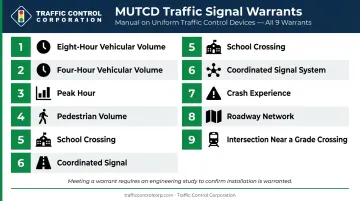
Meeting a warrant doesn't automatically require installation. An engineering study must confirm the signal will improve overall safety or operations at that specific location. Signals installed without sufficient warrant can introduce delay and rear-end crash risk without delivering meaningful safety benefit.
How Traffic Signal Technology Is Evolving
Adaptive Signal Systems
Traditional actuated signals respond to local detector calls but follow fixed timing plans. Adaptive Signal Control Technology (ASCT) continuously adjusts phase timing across a network based on real-time traffic volumes, going beyond what fixed timing plans can achieve.
FHWA reports average travel-time improvements above 10% from ASCT deployment, with improvements as high as 50% where existing timing is significantly outdated. A USDOT case study across eight Florida corridors measured a 9.36% travel-time reduction after ASCT implementation — a more grounded number for planning purposes.
Benefits can include fewer stops, lower delay, reduced fuel consumption, and lower emissions. Actual results vary based on baseline conditions and detector quality.
Connected and Intelligent Transportation Integration
ASCT's real-time optimization is one piece of a broader shift — newer signal systems now communicate well beyond the intersection itself. Signal Phase and Timing (SPaT) data can be broadcast to connected vehicles, enabling proactive speed adjustments before a driver even sees the light. Infrastructure can also support transit signal priority, emergency preemption, and real-time corridor-level optimization from a traffic management center.
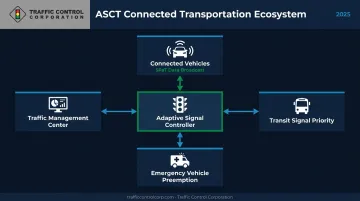
TCC distributes and deploys Econolite's Centracs® ATMS platform across its 11-state Midwest territory, a system that supports real-time monitoring, adaptive timing, and connected vehicle integration. In DuPage County, Illinois, TCC supported an expansion of Centracs from 72 signals to approximately 200, with 60 cameras deployed for remote real-time traffic observation.
That kind of regional deployment depth is where a distributor with factory-trained field service staff makes a practical difference for agencies managing complex infrastructure upgrades.
Frequently Asked Questions
What do the traffic light colors mean?
Red means stop completely before the stop line. Yellow means the green phase is ending — prepare to stop, not speed up. Green means proceed while yielding to pedestrians and vehicles already in the intersection.
How do traffic lights know when to change?
Most modern signals use vehicle detectors — inductive loops, video cameras, or radar sensors — to identify waiting vehicles and send calls to the controller, which adjusts timing accordingly. Some lower-volume intersections still run on fixed pre-timed cycles with no detection at all.
What are the main pros and cons of traffic lights?
Pros include reduced angle collisions at high-conflict intersections, structured crossing opportunities for all road users, and support for emergency vehicle preemption. Cons include increased rear-end crashes, localized air pollution from vehicle idling, and significant installation and maintenance costs. Signals perform best when placed at intersections that meet established MUTCD warrants.
When were traffic lights invented?
The first traffic signal was installed in London in 1868, followed by the first electric signal in Salt Lake City in 1912. The modern three-color, four-way design emerged in Detroit in 1920 with the introduction of the amber phase.
What should you do when a traffic light is not working?
When a signal is completely dark, treat it as a four-way stop — come to a complete stop, yield to any vehicles already stopped at the intersection, and proceed only when it's safe. Confirm your state's specific law, as requirements vary by jurisdiction.
Are roundabouts better than traffic lights?
FHWA reports a 78% reduction in fatal and injury crashes when a signalized intersection converts to a roundabout, and IIHS findings align closely. That said, roundabouts aren't appropriate at every location — geometry, capacity, pedestrian volume, and life-cycle cost all factor into the decision. Engineers typically use the MUTCD warrant system and NCHRP's Intersection Control Evaluation framework to determine the right fit for a given site.