Introduction
Traffic control systems manage the safe movement of millions of vehicles and pedestrians every day across the United States. When these systems fail — whether due to equipment malfunctions, design gaps, or compliance oversights — the consequences are direct: crashes, congestion, and preventable fatalities. The U.S. currently operates more than 330,000 traffic signals, each representing a node in a vast public infrastructure network that requires careful design, procurement, and maintenance.
This guide covers the full spectrum of traffic control systems — from physical roadside devices to signal hardware, software platforms, and modern ITS technology. It's written for traffic engineers, local agency staff, DOT personnel, and transportation contractors who need a practical reference for system types, components, regulatory standards, and procurement considerations.
Whether you're sourcing new signal equipment, evaluating detection technology, or meeting MUTCD compliance requirements, this handbook gives you the specific technical context to specify correctly, procure confidently, and maintain effectively.
Key Takeaways
- Traffic control systems include both static devices (signs, markings) and active, software-driven systems for real-time flow management
- The MUTCD 11th Edition (effective January 2024) is the governing federal standard for all traffic control devices on U.S. public roads
- A functioning signal system depends on the quality and compatibility of every component — controllers, detection, communications, and signal heads
- ITS technologies — adaptive signal control, video detection, and V2I communications — are deployed and operational today
- Partnering with a knowledgeable regional distributor during procurement reduces specification errors and long-term system failures
What Is a Traffic Control System?
A traffic control system is the coordinated use of devices, signals, signs, markings, and technology to regulate, warn, and guide road users safely and efficiently. The MUTCD defines a traffic control device as any device using visual, audible, or tactile information to communicate regulatory, warning, or guidance messages to road users.
For engineers and agency staff, the core distinction is between two control modes:
- Static control — Regulatory signs, warning signs, pavement markings, stop bars, and crosswalk markings. These communicate fixed rules and don't respond to changing conditions.
- Active control — Traffic signals, variable message signs, adaptive controllers, and ITS platforms. FHWA defines Active Traffic Management as dynamically managing congestion using prevailing and predicted traffic conditions.
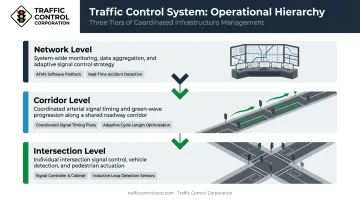
System Hierarchy: Intersection to Network
Traffic control systems operate at multiple scales simultaneously:
- Intersection level — Individual signal heads, controllers, detection sensors managing a single crossing
- Corridor level — Coordinated signals along an arterial, timed to create green waves and reduce stops
- Network level — Traffic Management Centers (TMCs) using central software to monitor and adjust signals across an entire city or region in real time
The primary goals at every scale are the same: reduce conflict points between road users, minimize delay, maximize throughput, and protect vulnerable users — particularly pedestrians and cyclists. The sections that follow break down each component category, from signal controllers and detection technology to pedestrian systems and ITS platforms.
Types of Traffic Control Devices and Systems
The MUTCD organizes traffic control devices into three fundamental categories, each with specific design, placement, and maintenance requirements:
| Category | Examples | Control Type |
|---|---|---|
| Signs | Stop signs, speed limit signs, warning signs | Static |
| Signals | Traffic signal heads, pedestrian signals, beacons | Active |
| Pavement Markings | Stop lines, crosswalk markings, lane lines | Static |
Permanent Traffic Signals and Intersection Control
Traffic signals are the most dynamic form of intersection control, cycling through phases to assign right-of-way to competing movements. Applications range from simple two-phase signals at low-volume intersections to complex multi-phase, multi-ring timing plans at high-volume urban corridors.
The operational difference between isolated and coordinated signal operation matters significantly for network performance. An isolated signal responds only to local detector inputs. A coordinated system synchronizes multiple intersections so traffic can progress along an arterial with fewer stops.
FHWA's analysis of a 2.8-mile corridor in the Denver region found that preset signal coordination reduced aggregate travel time by 671 vehicle-hours per day and fuel consumption by 406 gallons per day compared to the project baseline — a corridor-specific result that illustrates the kind of efficiency gains coordination can deliver.
Temporary Traffic Control (Work Zones)
Temporary traffic control (TTC) is a distinct, MUTCD-governed category required for all construction and maintenance work zones. Key TTC elements include:
- Advance warning signs — Alert drivers to the work zone ahead
- Tapers — Channelize traffic away from the activity area using cones, drums, or tubular markers
- Channelizing devices — Cones, drums, barricades defining the work space boundary
- Flagger control — Human traffic control at active work locations
Work zone safety is a serious, ongoing concern. FHWA reports 850 people died in U.S. work zone crashes in 2024, with speed a factor in 34% of fatal crashes and large trucks involved in 31%.
A proper TTC zone layout consists of four sequential areas:
- Advance warning area — Prepares drivers for the changed conditions ahead
- Transition area — Moves traffic out of its normal path via tapers
- Activity area — Contains the work space and any buffer zones
- Termination area — Returns traffic to normal lanes
Skipping or compressing any area increases risk.
Pedestrian and Bicycle Traffic Control
Pedestrian safety is a growing priority for agencies nationwide. NHTSA reports 7,080 pedestrian fatalities in 2024 — a 3.9% decline from 2023, but still an unacceptably high figure that underscores why pedestrian-specific treatments matter.
Key pedestrian signal equipment types:
- Pedestrian signal heads — Standard walk/don't walk indications at signalized crossings
- Accessible Pedestrian Signals (APS) — Audible and vibrotactile devices serving pedestrians with visual disabilities, with technical specifications now included in the MUTCD 11th Edition
- Pedestrian Hybrid Beacons (PHBs/HAWK signals) — FHWA documents a 55% reduction in pedestrian crashes at uncontrolled crossings where PHBs have been installed
- Rectangular Rapid Flash Beacons (RRFBs) — Associated with up to a 47% reduction in pedestrian crashes and motorist yielding rates up to 98% at uncontrolled crossings
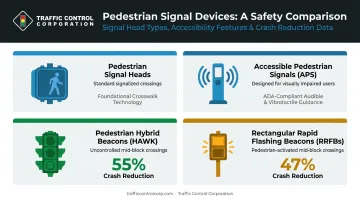
PHBs and RRFBs serve different applications: PHBs suit mid-block locations where a full signal isn't warranted; RRFBs fit lower-volume crossings requiring enhanced conspicuity.
Key Components of a Traffic Signal System
A functioning traffic signal system is an integrated assembly of multiple components. The reliability of the whole depends on the quality and compatibility of each part. The major subsystems are:
- Signal controllers and cabinets
- Vehicle and pedestrian detection
- Signal heads and mounting hardware
- Communications and central management
Signal Controllers and Cabinets
The traffic signal controller is the "brain" of the intersection: it processes detector inputs, executes signal timing plans, and communicates with adjacent signals or a central management system.
Modern installations use either NEMA-standard controllers or the Advanced Transportation Controller (ATC) platform. ITE's current ATC standard is ATC 5201 v06B — an open-architecture platform capable of hosting multiple traffic management and ITS applications.
The ATC 5202 Model 2070 standard has been rescinded by ITE and should not be specified for new procurements, though the 2070 hardware platform itself remains widely installed in the field.
Traffic Control Corporation (TCC) distributes Econolite's full controller lineup, including:
- Cobalt Series — Next-generation NEMA controller with a hardened 7-inch touchscreen GUI and Linux-based OS, with 10,280+ units deployed nationally
- 2070LX+ — ATC-compliant controller meeting Caltrans TEES 2020, suitable for agencies requiring 2070-style cabinet environments
- EOS Traffic Control Software — Companion ATMS software now past 10,000 field installations
The signal cabinet houses and protects the controller, conflict monitor, load switches, and communications equipment. NEMA-standard cabinets dominate in TCC's Midwest markets; Econolite's NEMA line covers form factors from G36 through R77, all built from 5052-H32 aluminum and UL Listed. Cabinet standard preference varies by state DOT, so confirming local agency specifications before procurement is essential.
Vehicle and Pedestrian Detection
Detection is what transforms a fixed-time signal into an actuated or adaptive system. The main technologies in use:
| Technology | Installation | Best For | Trade-off |
|---|---|---|---|
| Inductive loops | In-pavement | Reliable vehicle presence at stop bar | Requires pavement cuts; maintenance-intensive |
| Video detection | Above-ground camera | Multi-modal detection, analytics | Requires calibration; affected by extreme conditions |
| Radar/microwave | Above-ground sensor | Wide-area coverage, multi-approach | Requires proper mounting and field of view |
| Lidar | Above-ground | 3D object detection | Higher cost; newer technology |
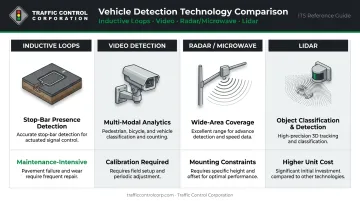
TCC distributes EDI inductive loop detectors for hardwired applications, along with Econolite's radar detection platforms — including the EVO RADAR (110-degree field of view, 900-foot range) and EPIQ RADAR (combined FMCW radar and 1080p camera with Power Line Communications).
For video-based detection, the Econolite Autoscope OptiVu delivers AI-powered classification of vehicles, bicycles, and pedestrians. ISS (Image Sensing Systems), also distributed by TCC, specializes in radar-sensor combinations for ITS detection applications.
Signal Heads, Mast Arms, and Mounting Hardware
Signal head selection affects both safety and maintenance costs. Key considerations:
- LED vs. incandescent — LED signal lamps consume roughly 8–25 watts versus 67–150 watts for incandescent, representing approximately 90% energy savings based on DOE case study data. LED is now the standard for new installations. GE Current, a TCC manufacturer partner, supplies LED signal heads and advanced lighting solutions for transportation applications
- Ball vs. arrow indications — Application-specific; arrows required for protected turn movements
- Pedestrian signal faces — Required at each marked signal-controlled crosswalk under the MUTCD 11th Edition
Mounting configuration choices — mast arm, span wire, or pole-mounted — affect signal visibility, wind load design requirements, and maintenance access. Mast arm installations generally provide better visibility and reduced swing, but require structural engineering appropriate to local wind load zones.
Communications and Central Management
Signal systems communicate through several infrastructure types:
- Hardwired interconnect — Traditional copper twisted pair for closely spaced intersections
- Fiber optic — High-bandwidth, low-latency connectivity preferred for real-time data exchange between intersections and TMCs
- Wireless radio — Intuicom wireless signal interconnect radios (distributed by TCC) replace or supplement hardwired interconnect in locations where trenching is cost-prohibitive
- Cellular — Used for remote locations; adequate for many monitoring functions
These communication links feed into central management platforms. Econolite's Centracs ATMS (available through TCC) provides real-time monitoring, remote timing adjustments, system-wide performance data, and cloud-based signal performance measures. DuPage County, Illinois, for example, uses Centracs to manage approximately 200 signals with 60 remotely accessible cameras. Ruggedcom ruggedized networking hardware, also represented by TCC, provides the hardened Ethernet switching infrastructure needed to keep cabinet communications reliable in harsh outdoor environments.
Traffic Control Standards and Regulatory Framework
The MUTCD: Federal Baseline
The Manual on Uniform Traffic Control Devices (MUTCD) is the federal standard governing the design, placement, and operation of all traffic control devices on public roads in the U.S. FHWA adopted the 11th Edition by final rule on December 19, 2023, effective January 18, 2024; Revision 1, consisting of technical corrections, became effective March 5, 2026.
Under 23 CFR 655.603, the MUTCD is the national standard for traffic control devices on all streets, highways, and bicycle trails open to public travel. State manuals or supplements must be in substantial conformance. Compliance is required as a condition of federal-aid funding.
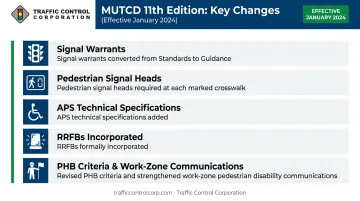
Significant changes in the 11th Edition include:
- Converting signal warrants from Standards to Guidance
- Requiring pedestrian signal heads at each marked signal-controlled crosswalk
- Adding APS technical specifications
- Formally incorporating RRFBs
- Revising PHB criteria and strengthening work-zone communication for pedestrians with disabilities
Supporting Standards
The MUTCD establishes the baseline, but agencies must comply with several interconnected standards that govern equipment interoperability, communications, and state-level requirements:
- NEMA TS 2-2021 — Governs interoperable signal-controller assemblies, including controller units, malfunction management, detector interfaces, cabinets, and environmental requirements
- ATC 5201 v06B — The current ITE open-architecture controller platform standard
- NTCIP 1202 v03A — The communications/interface standard for actuated signal controller data objects
- State DOT supplements — Ohio, Illinois, Wisconsin, and other states maintain their own MUTCD supplements and approved products lists that local agencies must follow
Compliance and Liability
FHWA explicitly states that MUTCD noncompliance can jeopardize federal-aid funding and create tort exposure. Agencies that fail to follow MUTCD requirements risk legal liability in the event of a crash at a noncompliant location.
Proper documentation is a core element of agency risk management. Records to maintain include:
- Signal timing records
- Maintenance logs
- Device condition assessments
Intelligent Transportation Systems (ITS) and Modern Traffic Technology
ITS integrates advanced sensing, communications, computing, and control into traffic infrastructure to improve safety, mobility, and efficiency. Deployment is expanding across all technology categories. The USDOT's 2023 ITS Deployment Tracking Survey found that among arterial agencies, adaptive signal control deployment rose from 8% in 2020 to 10% in 2023, ATSPM use rose from 17% to 24%, and connected-vehicle deployment increased from 8% to 11%. The four subsections below cover the core technology categories driving that growth.
Adaptive Signal Control Technology (ASCT)
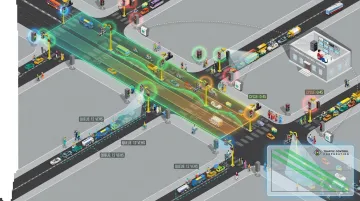
Traditional actuated signals use detection to extend or skip phases based on vehicle presence, but still follow pre-programmed timing plans. Adaptive signal control goes further, continuously recalculating cycle lengths, phase splits, and offsets based on real-time traffic demand across the corridor.
A FHWA before/after evaluation on U.S. 24 in Woodland Park, Colorado found that deployed adaptive control reduced weekend travel time by 19% and stopped delay by 54%. Results vary by corridor and deployment context, but the core benefit — matching timing to actual demand rather than pre-set plans — holds consistently across documented evaluations.
Connected and Automated Vehicle (CAV) Integration
Signal systems are evolving to communicate directly with connected vehicles through Signal Phase and Timing (SPaT) broadcasts using SAE J2735 messages. SPaT data tells equipped vehicles what signal indications are active and when phases will change, enabling safety applications like red light violation warnings and intersection approach speed advisories.
The FCC has transitioned 5.9 GHz ITS operations from DSRC to C-V2X, with 5.895–5.925 GHz designated for C-V2X communications. New roadside unit procurements should verify interoperability across C-V2X, NTCIP, SPaT, and MAP standards. Applied Information, a TCC manufacturer partner, provides connected intersection technology enabling V2I safety applications for local agencies.
Video Analytics and Smart Detection
Modern video detection goes well beyond simple vehicle presence detection. Current systems like Econolite's Autoscope OptiVu and EPIQ RADAR provide:
- Queue length measurement
- Turning movement counts
- Wrong-way vehicle detection
- Pedestrian and cyclist detection
- Road user classification
These data streams feed directly into signal timing optimization and network performance reporting — all from a single camera or sensor unit, without additional field hardware.
Fiber Optic and Wireless Communications Infrastructure
ITS performance depends directly on communications infrastructure. Fiber optic networks deliver high-bandwidth, low-latency connectivity between intersections and TMCs. Wireless technologies serve different roles:
- C-V2X (5.9 GHz) — Direct, low-latency roadside-to-vehicle communication for safety messages
- Wireless broadband radios (Intuicom EB-X series, distributed by TCC) — Replace hardwired signal interconnect at locations where trenching is impractical
- Cellular — Wide-area IP backhaul for remote monitoring and management
Agencies should specify communications based on application requirements — latency, coverage, security, and interoperability — rather than treating fiber, wireless, and cellular as interchangeable. Ruggedcom networking hardware, available through TCC, keeps cabinet communications reliable in harsh outdoor environments where standard commercial equipment fails.
Selecting Traffic Control Equipment for Your Agency
Key Procurement Evaluation Criteria
When procuring traffic signal equipment, agencies should evaluate:
- Conforms to MUTCD, NEMA TS 2, ATC 5201, and applicable state DOT specifications
- Integrates with existing controllers, detection systems, and communications infrastructure
- Backed by factory-trained technicians available locally for installation, troubleshooting, and certification
- Evaluated on total cost of ownership — installation, maintenance, spare parts, and useful life — not just purchase price. FHWA's asset management guidance explicitly recommends lifecycle planning over lowest-bid purchasing
A regional distributor who understands local agency specifications can prevent costly specification errors before they become procurement problems.
Working with a Regional Distributor
The procurement process typically begins with agencies developing technical specifications that reference MUTCD, NEMA, and state DOT standards. Drawing on an experienced distributor's application knowledge during the specification phase — not just after the bid is awarded — improves spec quality and reduces compatibility issues downstream.
Traffic Control Corporation (TCC) has operated as a regional traffic signal distributor since 1946, representing more than 40 manufacturers across 11 Midwest states. Regional offices in Indiana, Missouri, Minnesota, and Iowa support project delivery throughout that territory.
TCC's specification-phase support includes:
- Product selection and application assistance
- State DOT specification guidance
- Systems training for agency and contractor staff
- Factory-trained onsite technical support
Regional Inventory and Emergency Response
For agencies facing emergency signal failures or urgent project timelines, local inventory and field service response capability matter as much as product selection. TCC maintains a multi-million dollar inventory at its Woodridge facility and deploys a team of factory-certified technicians for emergency onsite cabinet troubleshooting, controller repair, conflict monitor certification, and detection system service.
That distinction — between a regional distributor with substantial local stock and field staff versus a national drop-ship supplier with no local presence — becomes most apparent when a signal system goes down at 2 a.m. and an agency needs both parts and a technician, not a tracking number.
Frequently Asked Questions
What is the difference between a traffic control device and a traffic control system?
A traffic control device is an individual component — a sign, signal head, or pavement marking. A traffic control system refers to the integrated combination of devices, controllers, detection, and communications that collectively manage traffic flow at one or more locations.
What is the MUTCD and who is required to follow it?
The MUTCD is a federal standard issued by FHWA establishing uniform requirements for all traffic control devices on public roads. All state and local transportation agencies must comply as a condition of federal-aid funding, and any state supplements must be in substantial conformance with the federal standard.
What is the difference between fixed-time, actuated, and adaptive signal control?
Fixed-time signals run pre-programmed timing plans regardless of real-time demand. Actuated signals go a step further, using detection to extend or skip phases based on vehicle presence. Adaptive systems take this furthest — continuously recalculating timing in real time to match live conditions across the entire corridor.
What are the main hardware components of a traffic signal system?
The core components are: signal heads (ball and arrow indications), traffic signal controller and cabinet, vehicle and pedestrian detection equipment, mast arms or poles, and communications hardware connecting the intersection to a network or central management system.
How do ITS technologies improve traffic control performance?
ITS technologies — including adaptive signal control, video detection, V2I communications, and real-time monitoring software — allow agencies to actively respond to changing conditions rather than relying on static timing plans. The result is reduced delays, improved safety, and performance data that directly informs long-term planning decisions.
How do local agencies procure traffic signal equipment in compliance with standards?
Agencies typically develop technical specifications referencing MUTCD, NEMA, and state DOT standards, then solicit bids or use cooperative purchasing agreements. Engaging a qualified distributor or technical consultant during the specification phase helps confirm compliance, equipment compatibility, and a smoother procurement process.